
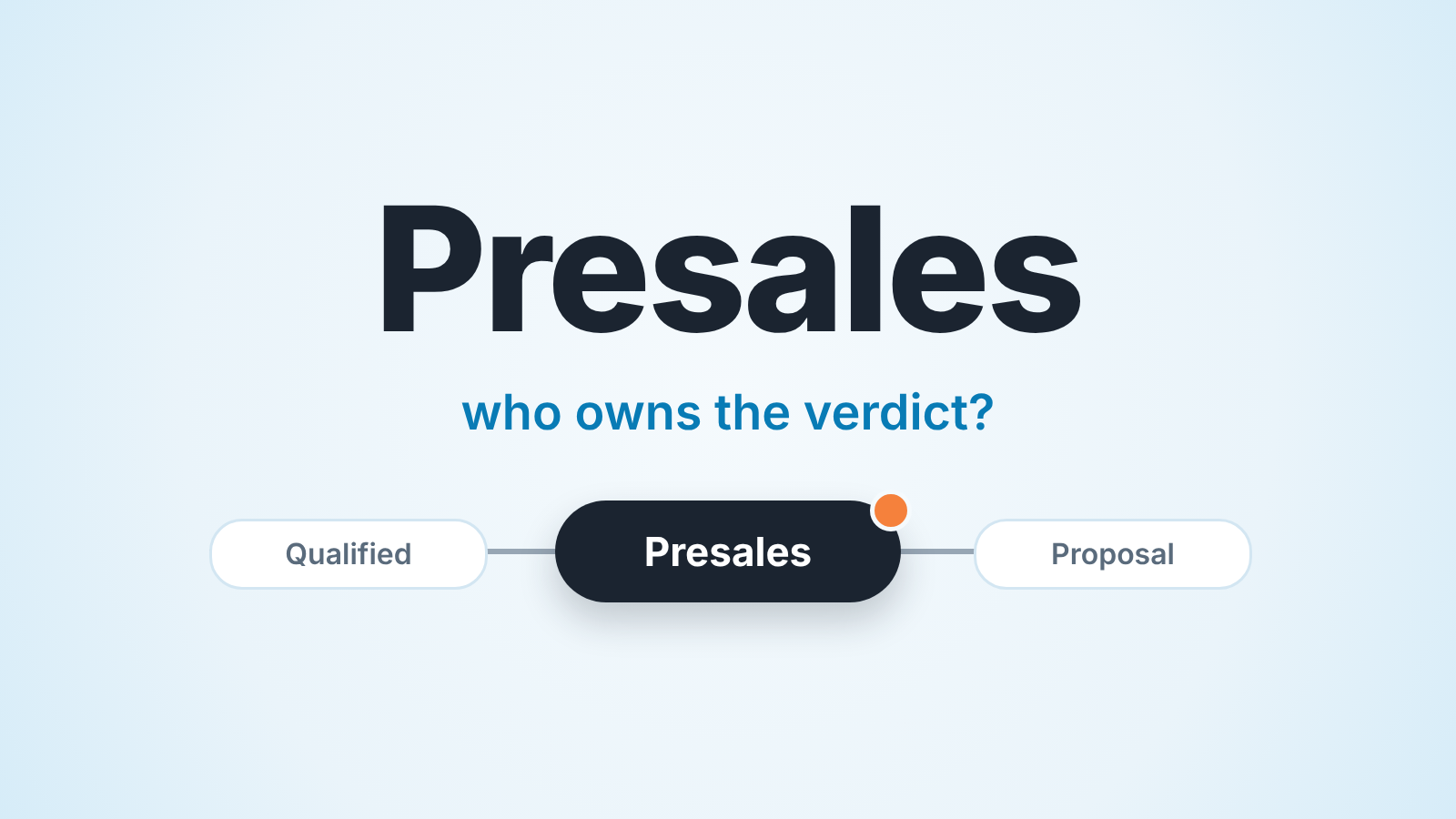
Presales is the work a seller does before a customer commits: understanding the need, running the demo, testing whether the product fits and scoping the offer. In a small B2B team presales is a stage of the deal, and the useful question for a sales manager is who owns the deal during it, what has to be true to leave it, and where the CRM shows that. A presale, which sells tickets or a product before release, is a different thing.
What is presales, from the deal record’s side
Salesforce calls presales all the activities and support before a sale closes; presales.rocks, getting a B2B buyer from interested to ready to sign. Both are accurate, and neither gets to the deal record. In a team of five to fifteen people there is rarely a presales department. There is a rep who found the opportunity, a founder or an engineer who gets pulled in for teh technical part, and a deal sitting in a stage called “Demo” while the two of them each assume the other is driving.
So we define presales by what the CRM can see: the stretch between a qualified opportunity and a priced offer the buyer can say yes to. Everything below follows from that.
Presales vs sales: where one ends and the other starts
Sales owns the buyer and the deal from first contact to close; presales is the segment inside it where the technical question gets answered. The question changes from “do they have a problem we solve” to “does our product actually do it in their environment”. The rep still owns the deal. The person doing presales owns the answer.
Why does the distinction matter? Because when the two roles blur, the rep stops following up (“the engineer has it”) and the engineer stops reporting (“I’ll tell the rep when I’m done”). Nobody lied. The deal has simply left everybody’s list, and we have seen deals go quiet for a month this way without anyone noticing.
In larger companies presales is a job title (solutions engineer, presales consultant); the career side is not our topic. When a small team should pull its technical person in at all is covered in when to call a sales engineer in.
What actually happens in presales
Take a deal for a mid-market logistics company evaluating a routing tool. Discovery found the problem: dispatchers re-plan routes by hand every morning. Presales is everything that has to happen before anyone can price a solution to that.
It starts with a second, more technical discovery call. Then a demo built around the buyer’s own scenario, with the product tour left out. Sometimes a proof of concept follows, meaning a short, time-boxed test on the buyer’s own data: here, they load their depot list and see whether the routes make sense. In parallel the rep needs an estimate from whoever will deliver: how many integrations, how many weeks, what the buyer has to supply. And plenty of B2B deals bring a questionnaire from the buyer’s side, a security review or a formal RFP, where every answer needs an owner and a date (whether to answer at all is its own decision).
Each of these produces a verdict: the demo landed or it did not, the trial proved fit or it exposed a gap, the estimate came back inside budget or not. Presales ends when the verdict exists, whatever the date of the demo. A stage with that exit condition moves, and a stage without one becomes a place where deals wait.
Who does this work depends on the title, and sales engineer vs solutions engineer explains where the two roles divide. Presales itself sits on the sales side of the line, and business development vs sales shows where those two jobs split in a small company.
Who owns the deal while it is in presales
During presales the rep (account executive) stays the deal owner; the presales owner, often an engineer, owns the verdict. The founder who joined the call does not take the deal over, and neither does a “shared” owner, because the owner field is what most CRM pipeline reports, forecasts by rep and activity reminders are built on. Hand the deal to the engineer for three weeks and the forecast by rep is wrong in both directions.
So the deal owner stays put, and presales gets its own field. Call it Presales owner: a user field, or a person field if your CRM does not allow two user fields on a deal. It names who is responsible for producing the verdict. The two can be the same person, on a team of six they often are. The point is that the deal record says so.
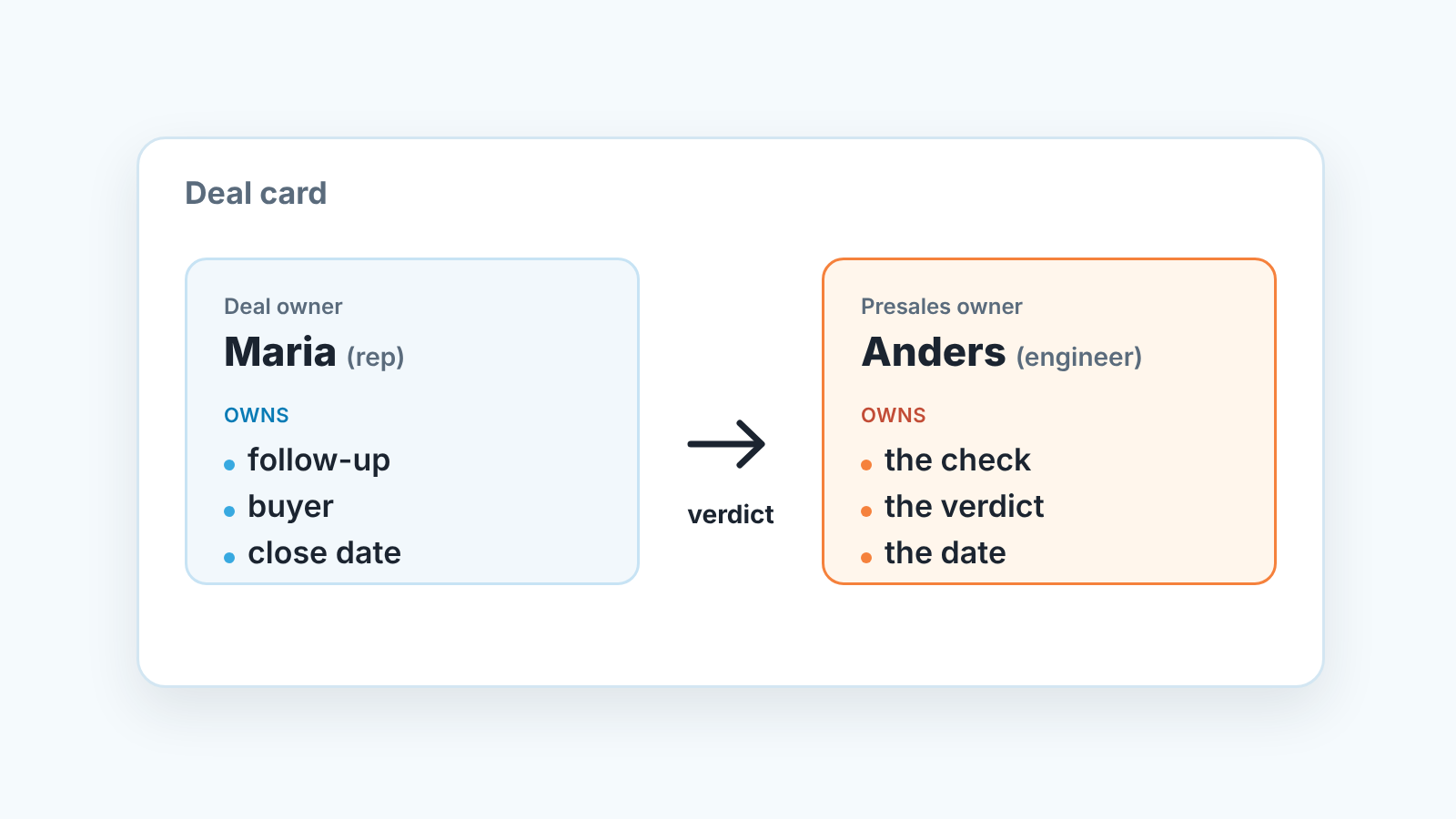
Say the split out loud at the planning meeting: the deal owner owns the buyer, the next step and the close date; the presales owner owns the check and the verdict. If a buyer email arrives asking “any news on the trial?”, it goes to the deal owner, who asks the presales owner.
The stage in the CRM: entry condition, exit condition, five fields
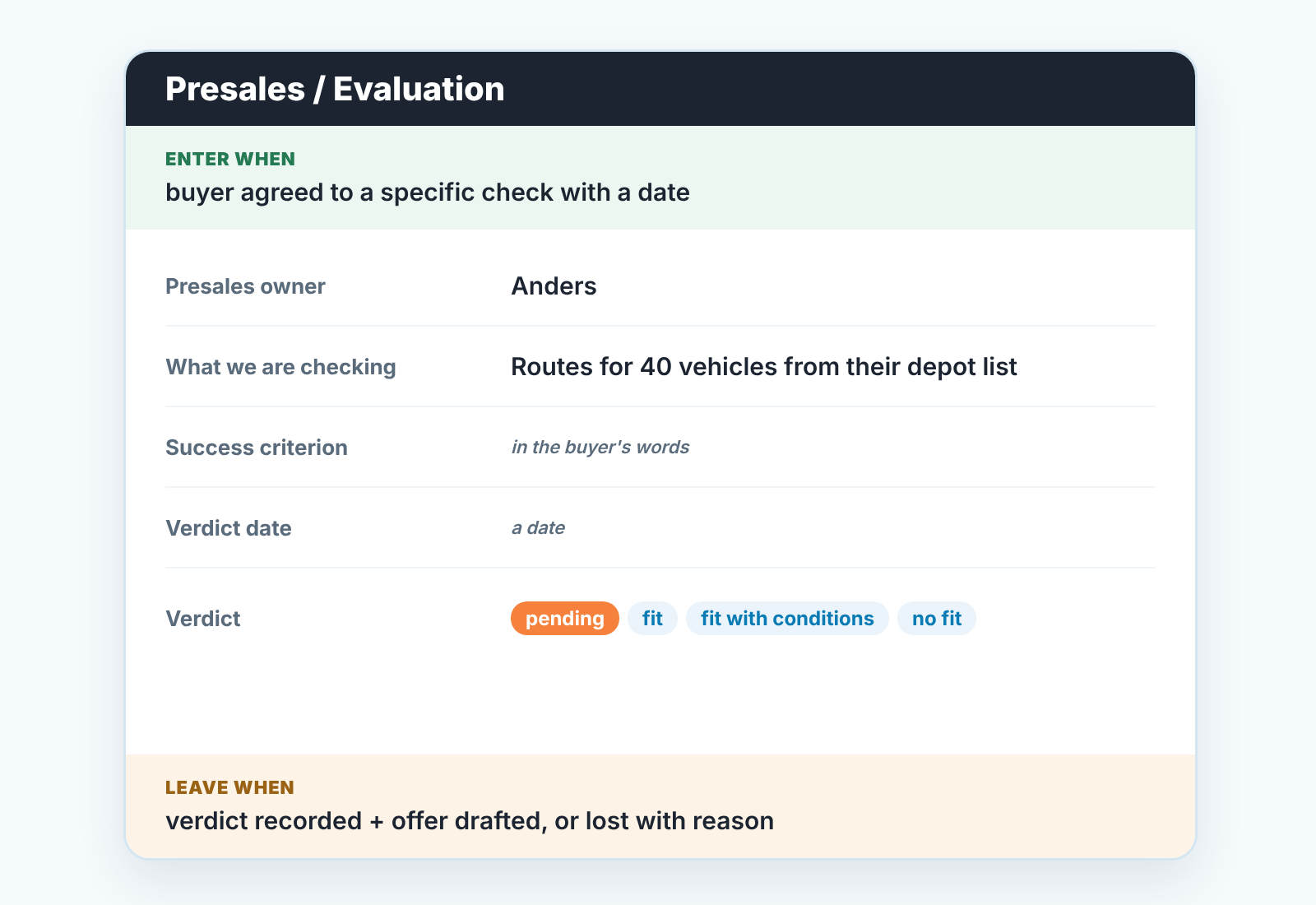
Presales (or Evaluation) is the stage a deal enters when the buyer agrees to a specific check with a date, and leaves when a verdict is recorded. Name it Presales (Evaluation) and avoid Demo, because a demo is an event and a stage named after an event has no exit: the demo happened, the deal still sits there. Reworking the whole pipeline is a bigger job (sales process steps and CRM stages); here we only need this one stage to behave.
Entry condition: the buyer has agreed to a specific check with a date. “They want a demo” is not entry. “Demo of the dispatcher workflow with their ops lead on Thursday” is.
Exit condition: a verdict is recorded and either a priced offer is being drafted or the deal is lost with a reason. A deal that reaches Proposal with the verdict empty goes back.
The five fields are all custom deal fields, whatever Pipedrive, HubSpot, Salesforce or Zoho CRM call them:
- Presales owner: a user or person field. Who produces the verdict.
- What we are checking: one line of text, as specific as “Routes for 40 vehicles from their depot list”. A label like “technical evaluation” is too vague.
- Success criterion, in the buyer’s words. What they said will make them say yes. If you cannot fill this in, you are not ready to enter the stage.
- Verdict date, when the buyer will have an answer or when you commit to giving one.
- Verdict: single select with fit, fit with conditions, no fit and pending. “Pending” is the default and the one the report hunts for.
Five fields is already more than some teams will fill. If you have to cut, keep Verdict date and Verdict. Those two make the stage visible from the outside, and they are what the fields on the quote will need next (quote template and deal fields).
One report for the manager: deals in presales older than N days
A manager does not need a presales dashboard. One filtered list, opened on Monday, is enough: deals in the Presales (Evaluation) stage whose verdict is still pending and whose verdict date is in the past, plus deals that entered the stage more than N days ago regardless of the date. The first half catches promises that slipped. The second half catches deals were nobody set a date at all.
For N, look at last year’s won deals and take the longest normal evaluation in this stage (not the six-month pilot), rounded up. No history yet? Start with a number of days that covers a demo and a short trial for your product, and correct it once a few deals have gone through the stage. In SalesBond, Deal Health runs Progression rules with thresholds you can configure, so the limit is checked on every deal without a saved filter.
Then the part people skip. Ask the deal owner three questions per deal, even when the engineer did the work: what was the check, what did the buyer say will make them decide, and when is the verdict. If any answer is “I’d have to ask” the field is empty, and the deal is waiting in a stage it has not really entered.
Handing the deal back: to the rep, and later to delivery
The verdict is the handoff. When the presales owner records “fit” or “fit with conditions”, the rep moves the deal to Proposal the same day and starts pricing. “Fit with conditions” means the conditions go into the quote, in writing, because what was said on the trial call is otherwise gone by the time the contract is drafted. “No fit” means a lost reason, and an honest one; a deal lost at presales for a product gap is useful data for the roadmap and useless if it is logged as “price”.
The same verdict then travels to delivery, because whoever ran the proof of concept knows what was promised and tested, and that should not live only in their head. The five fields above, filled in, are the handoff note; the rest of the path is in quote-to-cash for a small sales team, and the minimum a deal should carry is in B2B sales deal records.
Where SalesBond fits: Deal Health and the free CRM audit
We build SalesBond, a sales management layer on top of the CRM a team already uses; we started with Pipedrive. Deal Health is the part that checks every deal in the connected CRM against more than 20 rules in categories such as Activity, Progression, Data, Forecast and Ownership, and gives each deal a score from 0 to 100 with the specific violations listed. A presales deal with no next activity, or stuck in the stage too long, shows up with the reason and a recommended action. Frequent owner changes are a rule too, one more reason for a separate Presales owner field.
One limit worth stating plainly: Deal Health scores the deal and leaves the engineer out of it. A stuck presales stage is a progression problem on a deal record. It does not judge the demo or replace a presales tool. It tells the the manager which deals to ask about on Monday: the report above, running on its own. How the rules and the score work is in Deal Health: finding at-risk deals.
How many of your deals are waiting in evaluation right now? The free CRM audit shows that. SalesBond looks at the last 30 days of your connected CRM and sends a large PDF report, including the pipeline bottleneck and deal health; seven days later a second PDF shows what changed. Check your CRM with SalesBond. Pipedrive, HubSpot, Salesforce and Zoho CRM are among the 15 CRMs it works with.
FAQ
What is the purpose of presales? To get to a verdict on fit before anyone prices the deal, so the quote is for something the buyer has already seen work.
Presales vs sales: what is the difference? Sales owns the buyer and the deal from first contact to close. Presales is the segment inside that deal where the technical question is answered, usually by a different person, and it ends when the verdict is recorded.
What are presales skills? The ones the tasks above demand: asking the buyer what they will actually test, building a demo around that scenario rather than the product tour, and writing a verdict a rep can price from. Career guides cover the rest; this article is for the manager.
Presales, pre-sales or presale: is it the same thing? Presales, pre-sales and pre sales are spellings of the same B2B term: the work before a deal is won. A presale is different: selling tickets or a product before it is released.
Start with one deal this week: add the Verdict date and Verdict fields, fill them in for whatever is sitting in your demo stage, and see which dates are already in the past. If you’d rather have that check run on its own, sign up for SalesBond.