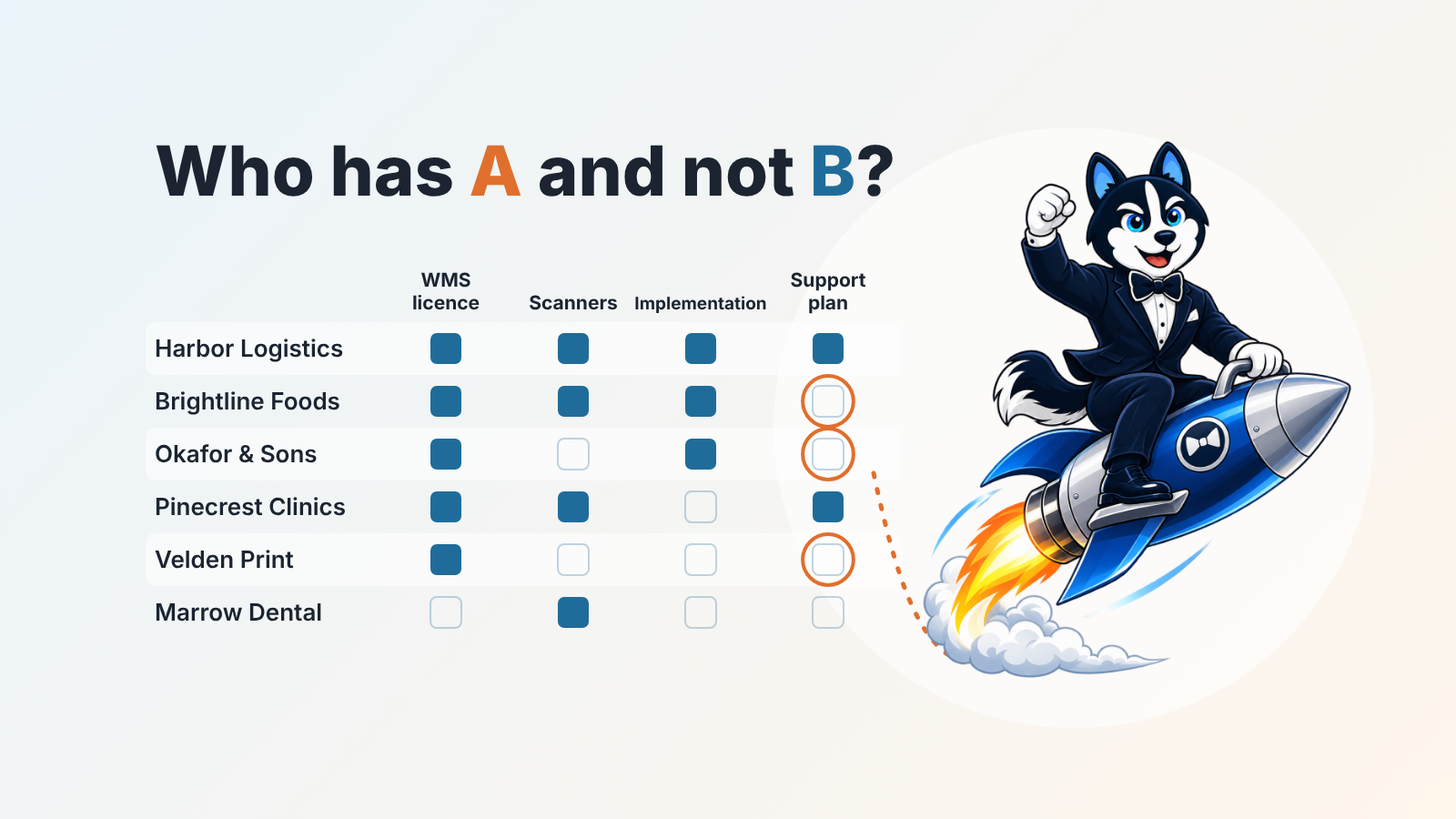
Cross-selling is offering an existing customer an additional product or service that complements what they already bought from you. In B2B the candidates are already in your CRM: every customer who has product A and has never bought product B, ranked by how recently they bought and how much they spend. The right moment is usually when their next order is due anyway.
In a B2B team of three to fifteen people, the work is choosing which strategy fits which account and pulling the candidate list out of closed deals, so nobody has to rely on a rep’s memory.
What is cross-selling, and what it isn’t
Salesforce puts it as “a sales strategy where a seller offers complementary products or services to existing customers” (Salesforce: What is cross-selling?). The two words doing the work are existing and complementary. The buyer already trusts you with one purchase, and the second thing you offer makes the first one work better, last longer or cover more of their business.
What it isn’t is upselling, although most guides bundle the two. Upselling sells more of the same thing, or a bigger version of it; cross-selling sells a different thing that sits next to it. If you want the bookkeeping side of that split, we wrote it up for a Pipedrive team in upsell vs cross-sell: how to track expansion. Upselling as its own topic gets a separate article.
One spelling note, because people search both ways: “cross selling” and “cross-selling” mean the same thing. We hyphenate in running text and don’t correct anyone who doesn’t.
Cross-selling examples in B2B
The examples below are illustrations. We made the company names up. The patterns are typical for teams that sell to other businesses.
A warehouse software vendor sells a WMS licence to a regional distributor. Six weeks in, the distributor is still scanning with phones. The vendor offers its barcode scanner kit, pre-configured for the software. Software plus the hardware it needs to run is about as classic as a B2B cross-sell gets.
An equipment supplier sells a packaging line. The customer’s maintenance team is two people. The supplier offers an annual service plan with a response-time commitment. The plan covers breakdowns that a two-person team cannot handle alone.
A building-materials distributor supplies insulation to a contractor every month. The contractor also buys vapour barrier and fixings, from someone else. The distributor adds a second line to the standing order. Nothing new was invented; the the customer’s next order simply got longer.
A marketing agency runs paid search for a software company. The client mentions that nobody owns their LinkedIn page. The agency proposes a three-month social retainer, triggered by something the client said in a review call.
A SaaS company sells a project-management tool to the engineering department of a manufacturer. The procurement team asks for read-only access to track supplier deadlines. The vendor sells a second set of seats under a separate contract, with onboarding for procurement. Procurement pays from its own budget, so this is a new sale inside an account the vendor already has.
Banking and insurance are the examples most definition articles use. We left them out on purpose: the source we would have cited was not open for us to check, and this article is about teams that sell to businesses, where the deal record lives in a CRM rather than a core banking system.
Each cross-sell came from something visible: a missing piece of hardware, a thin maintenance team, an order that was shorter than the customer’s real need. In a CRM those signals are data, and that is where the method below starts.
Six cross-selling strategies, and when each one fits
Lists of “eight proven cross-selling strategies” tend to be written for online carts. These six hold up in B2B, each with the condition that makes it the right choice.
Sell the piece that makes the first purchase work
The customer bought A, and B makes A work better: scanners for the WMS, a second sensor type for the monitoring platform. This fits when the product line was designed to be used together and the customer bought only part of it. Check the purchase history for the gap before you pitch.
Add the service their own team can’t cover
Implementation, training, a support plan, an annual inspection. It fits when the customer bought a product that needs expertise to run and their team is small. The signal is usually a support ticket or a slow rollout.
Bundle at the first purchase, not after it
Two or three items sold as a package, at one price. Bundles work for new customers at first purchase and for small repeat orders where separate quoting costs more than the margin. They backfire when the customer has already bought one item of the bundle at list price, and thier first question will be why the bundle is cheaper than what they paid.
Go to another department of the same customer
The engineering team uses you; procurement, operations or a second site does not yet. This works when your champion is willing to introduce you and the second department has its own budget. Record it as a new deal on the same organization, with the new contact, or it will look like an upsell to the first team.
Put one more line on the reorder
The customer orders the same thing every month. Next time, the quote includes one more line they have been buying elsewhere. It suits distributors and consumables, and it is the cheapest strategy on the list, because the conversation is already happening.
Raise it at renewal, once the renewal is signed
The contract is coming up, and the renewal call is the natural moment to add a module, a service tier or seats for another team. Anything with an annual term qualifies. It also carries the biggest risk: a renewal call that turns into a pitch can cost you the renewal. Lead with the renewal, close it, then raise the add-on.
Three situations rule all of these out, whatever the data says: the customer has an overdue invoice, there is an open complaint or escalation, or the first purchase is still being implemented and isn’t working yet. Cross selling into a customer who is unhappy with purchase number one turns the complaint into a reason to leave, so get the first purchase working before you offer a second.
Who to offer what: find candidates from purchase history
Here is the part that depends on your data rather than on anyone’s advice. The input is closed won deals that carry products: deals with product line items in Pipedrive, HubSpot or Salesforce, or at minimum a “Product” field on the deal in any CRM. If your deals carry only an amount and a title, start by adding the product field; the method does not work on titles like “Harbor Logistics, Q3”. Our note on line items and deal amounts in HubSpot shows how the two relate and why the amount alone tells you nothing about what was bought.
Three steps, all of them a CRM export and a spreadsheet. No model, no scoring.
Step one is the customer × product table. Export won deals for the last 24 months with organization, product, close date and amount. Pivot it: one row per organization, one column per product, a mark in the cell if that customer has ever bought that product. Add two more columns, date of the most recent purchase and total revenue over the period. Sales teams call this grid a whitespace analysis: the empty cells are the white space. For a few hundred customers and a handful of products it is a short job.
Step two is finding the pairs. For each pair of products, look at the customers who bought A. Of those, who has never bought B? That is the raw candidate list for the cross-sell “B to A-buyers”. To keep the list honest only count pairs where B has actually been bought by other A-buyers: if nobody who owns the WMS has ever bought the support plan, that is a product question. The pairs where A-buyers do buy B, and some of them haven’t yet, are your map.
Step three is the ranking. Sort each candidate list by most recent purchase first, then by total revenue. A customer who bought three months ago and spends the most goes to the top. A customer whose last purchase was 20 months ago sits at the bottom, and probably belongs in a different conversation, about whether they are still a customer at all.
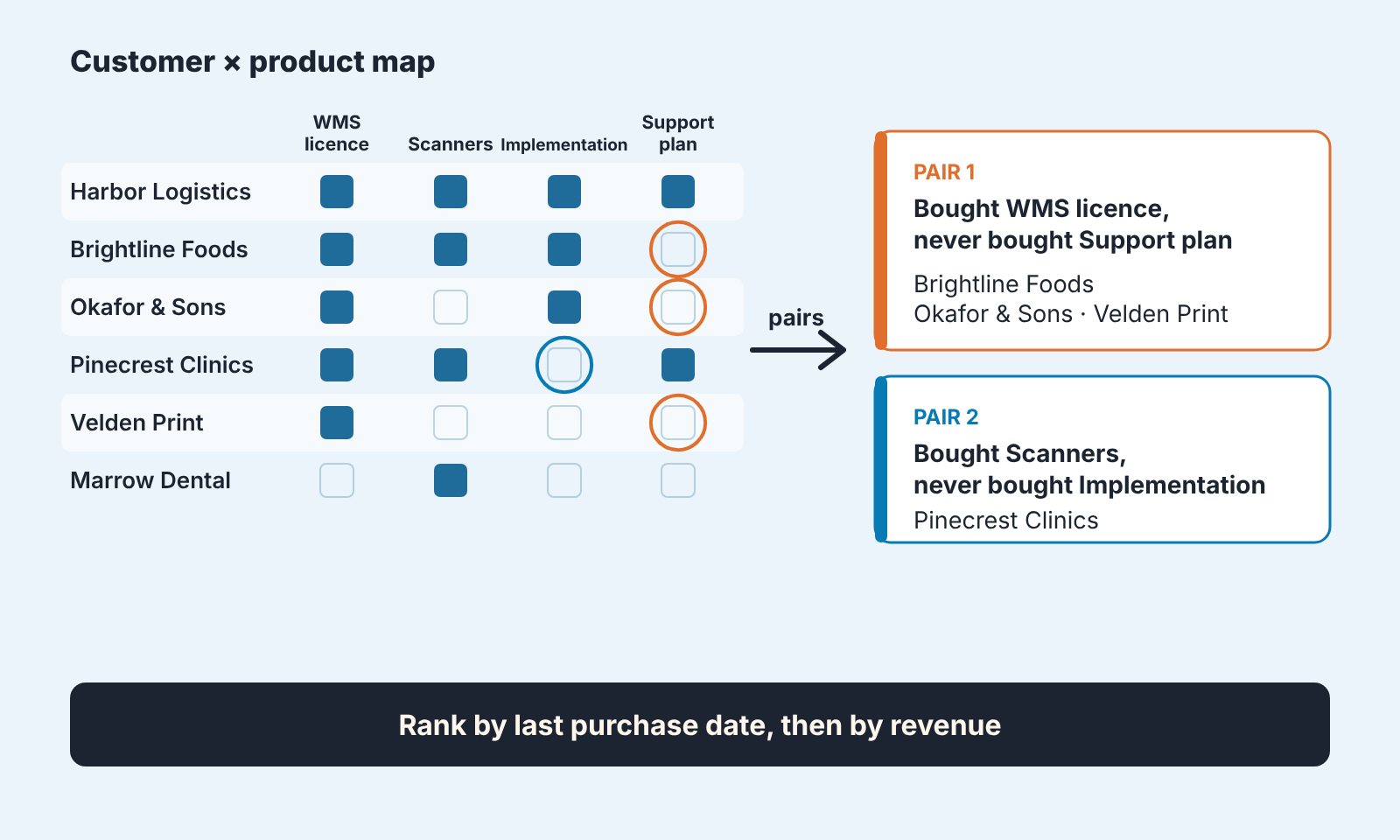
What the result looks like, on invented data for the warehouse software vendor from the examples:
| Customer | WMS licence | Scanners | Implementation | Support plan | Last purchase | Revenue, 24 mo | Candidate for |
|---|---|---|---|---|---|---|---|
| Harbor Logistics | yes | yes | yes | yes | 2026-09 | 48,000 | nothing yet |
| Brightline Foods | yes | yes | yes | no | 2026-10 | 31,500 | Support plan |
| Okafor & Sons | yes | no | yes | no | 2026-08 | 22,000 | Scanners, Support plan |
| Pinecrest Clinics | yes | yes | no | yes | 2026-10 | 19,800 | Implementation |
| Velden Print | yes | no | no | no | 2026-03 | 9,400 | Scanners first, then the rest |
| Marrow Dental | no | yes | no | no | 2025-11 | 2,100 | check if still a customer |
Hypothetical figures, in your base currency. How would you read it? Brightline Foods is the first call: recent, large, one obvious gap. Okafor & Sons has two gaps, and the scanners come before the support plan because the plan covers the hardware. Velden Print bought a licence eight months ago and nothing since, which makes timing the first question for that account.
Two of our guides go deeper on the customer side of the CRM: B2B customer segmentation in HubSpot for the segmentation step, and RFM analysis for a B2B sales team for scoring recency against each customer’s own buying cycle.
When to offer it: timing from the buying cycle
The table tells you what to offer. It does not tell you when. For a customer who buys repeatedly, the answer comes from their own rhythm: a distributor who orders every 30 days should hear about the second line when the next order is being quoted. A software customer on an annual term should hear about the support plan when the renewal is in sight.
So the next column to add is the buying cycle, the typical interval between a customer’s purchases. With two or more won deals you can compute it in the same spreadsheet; with one purchase you cannot, and the customer is simply new. The cross-sell call goes into the window just before the next expected purchase, when the customer is already thinking about ordering.
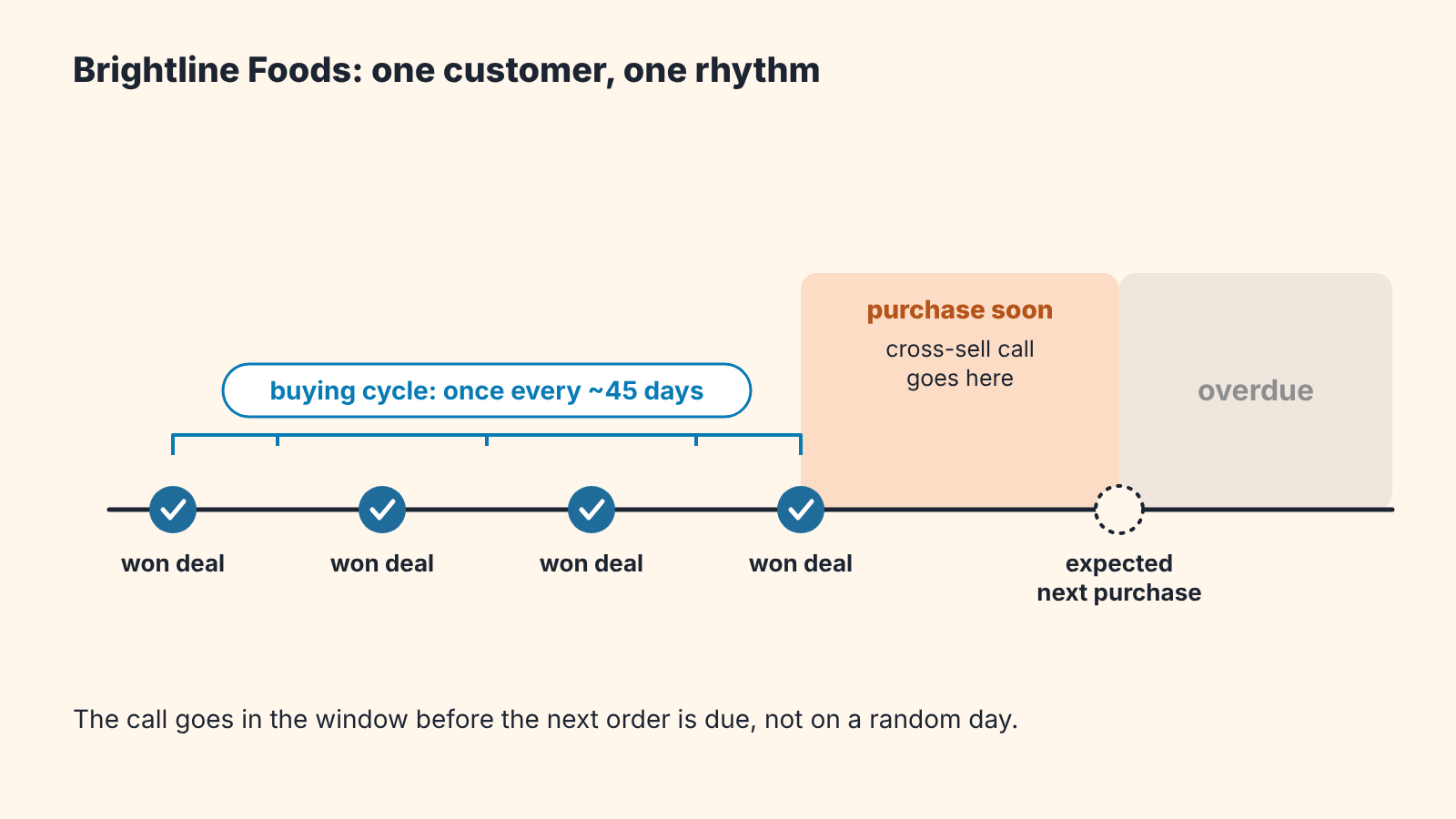
Our own product computes this column, so a short disclosure. We build SalesBond, a sales management layer on top of the CRM a team already uses. Its Repeat Sales section takes every customer with at least two won deals and computes their buying cycle as the median interval between purchases. Each of those customers gets a status from that cycle: on track, overdue, leaving, or in work when an overdue customer already has an open deal and recent contact. A customer with one purchase shows as new, and one with no determinable cycle as undefined. On top of the statuses sits the flag that matters for cross-selling, purchase soon: the customer is on track and their expected next purchase is close. Those customers show up in Sales GPS as customer cards, one per customer, and “Contact” creates a task in the CRM.
What Repeat Sales does not do is tell you which product to offer; that stays in your customer × product table. There is no score and no prediction model either. The statuses come from fixed rules on the interval between purchases. And if your customers buy once and never come back, the section will show mostly new customers and undefined cycles, which is a true picture but not much use for this method.
If you would rather do the timing by hand, our guide to account management by customer status turns the same statuses into a weekly routine, and loyal customers: the second and third order explains why the second order is the one to worry about.
Record the cross-sell so you can count it
One rule, and it is the one teams skip: a cross-sell is a new deal on the customer’s organization, never an edit to the original won deal. Add a field on the deal, call it “Deal type” or “Expansion type”, with values like new, renewal, upsell, cross-sell. Fill it when the deal is created.
The reason is simple. If the scanner order gets added to the WMS deal that closed in April, your April revenue changes, your win rate for scanners does not exist, and nobody can answer “how many customers bought a second product this year”. Three deals on one organization answer all of that.
The field setup is in upsell vs cross-sell in Pipedrive and the one-deal-per-order discipline is in repeat orders: a new deal per order. The same structure works in HubSpot, Salesforce and Zoho CRM with their own custom field screens, as long as every team uses the same field name.
What to measure
Three numbers are enough for a small team, and all of them come out of the deals you just started recording properly.
Share of customers with two or more products. Count organizations with at least one won deal, then count those whose won deals cover two or more distinct products, and divide. We think this is the clearest sign of whether cross-selling is happening at all. Track it quarterly; its a slow number, and that’s fine.
Cross-sell revenue. Sum of won deals where the type field says cross-sell, for the period. Show it next to new-customer revenue and renewal revenue so the team can see the mix. If cross-sell revenue is zero and your customer × product table has forty candidates, that is a management conversation.
Revenue per account. Total won revenue divided by the number of active customers; cross-selling should push it up over time, and owners tend to look at it before anything else. How to compute it from the CRM without double counting is in ARPU for a B2B sales owner. While you are there, decide on a floor: a cross-sell of 300 to a 48,000 account is real work for very little, and our note on minimum deal size for a small team explains where to draw that line.
Want a second opinion on your repeat customers before you build any of this? SalesBond’s free CRM audit looks at the last 30 days of a connected CRM and sends a PDF report with a repeat-customers section in it. Seven days later a second PDF shows what changed. It is a quick way to see whether your purchase history is clean enough for the method.
Where cross-selling goes wrong
Pitching from the catalogue instead of from the gap. A rep who offers every customer the newest product is advertising it, while the table already says which product is missing for which customer.
Cross-selling into a complaint. A customer with an open escalation gets the fix first and the offer later, if at all.
Counting the cross-sell inside the original deal. Revenue looks fine, nobody can measure the programme, and in a year someone asks whether cross-selling works and there is no answer.
Treating the second department as the same buyer. The champion in engineering will not sign for procurement. New contact, new deal, often a new sales cycle; the stages of a B2B sales process apply again from discovery, even inside an existing account.
Discounting the add-on by reflex. The customer did not ask. A complementary product is worth full price precisely because it makes the first purchase work, and a discount tells the customer it was optional.
Waiting for the perfect data. Teams postpone the method because half of last year’s deals have no product field. Start with teh half that does and fix the field going forward. The table fills in over a few quarters, and the candidates in the clean half are real today.
FAQ
What is another word for cross-selling?
Complementary selling, add-on selling, or in account-management language, account expansion. Suggestive selling is the retail term for the same move at the till. None of them is a distinct technique; they all describe offering a second product to an existing buyer.
What is cross selling in retail?
In retail it is the “would you like fries with that” moment: a second item offered at the point of sale or next to the cart. The B2B version is slower and relies on the purchase history rather than the shelf, which is why this article is about CRM data rather than product placement.
What is an example of cross-selling in B2B?
A software vendor sells a warehouse management licence, then offers the barcode scanners and the implementation service the customer needs to actually use it. The same pattern works for equipment plus a service plan, or a distributor adding a second product line to a monthly standing order.
What does cross-selling mean in simple terms?
Selling an existing customer something different that goes with what they already bought. In B2B you find who to offer it to by looking at who has product A and has never bought product B.