

Employee retention strategies are the measures a company takes to keep the people it has and to lower voluntary turnover. In a sales team of five to fifteen people the measures that keep sales staff are a clear target the rep agreed to, weekly feedback built on CRM evidence, a commission plan the rep can recalculate on a napkin and get the same number as finance, and a role that grows. This guide ranks them for an owner with no HR department, starting with what costs nothing, and shows how a departure starts to show in the CRM weeks before the resignation letter.
What employee retention strategies are
For a sales team, employee retention strategies are the decisions about targets, pay, feedback and growth that keep your productive sellers in their seats long enough for the hiring and ramp-up cost to pay back. Ramp-up here means the months a new rep needs before they carry a full quota.
HR sites answer the same question with long lists. AIHR’s version has fifteen items and runs from hiring and onboarding through flexible work, development and career pathing, mentoring, wellbeing, fair compensation, performance management, recognition, leadership and stay interviews (AIHR: 15 employee retention strategies). Built In’s list also has fifteen and covers similar ground (Built In: employee retention strategies). Every item on those lists is reasonable. All of them assume a company with an HR team to run them.
Sales changes the problem. The rep’s income floats with the plan, so every change to targets or commission is a change to their salary. The rep also carries relationships with customers, and those relationships walk out the door with them in a way an accountant’s ledger never does. And the job grades itself every month on the pipeline board, in front of everyone, so a rep who is slipping knows it before you say a word.
Engagement is the daily state that produces retention; we wrote about it separately in employee engagement for a small business owner with a sales team. This article covers the decisions that keep people from handing in notice.
Why sellers leave a team of eight
Take a rep we will call Dan. He is a composite of several sellers we have watched leave small teams, and every detail below happened to at least one of them. Dan was second on the board for two years. He left in March for a company with a lower base. The exit conversation produced “a better opportunity”. What had actually happened: the commission plan was changed in January without a worked example, his two largest accounts were moved to a new hire “to balance the book”, and his manager had cancelled most of their recent one-on-ones. Each of those things was survivable on its own. Together they told Dan that next year would be worse than this one, and he stopped waiting to find out.
We do not have a sourced survey to put numbers on the reasons, so we will stick to what we see in small teams. The plan moved, or the payout cannot be verified. The manager shows up when numbers are red and nowhere else. Lead or territory distribution feels like favoritism, usually because the rule was never written down. There is no visible next role after “senior rep”. The pipeline is too thin to hit plan, and the rep is tired of explaining that every Monday.
One reason is specific to sales. A strong seller hears from recruiters all the time, and when the call comes on a bad week the base pay on offer only has to be close.
In our experience the resignation is the last step of a process that runs for weeks, often a couple of months. That process leaves marks in your CRM long before the letter.
10 employee retention strategies, ranked by cost
The HR lists above are flat, and an owner reading them cannot tell what to do on Monday. We rank the measures by what they cost and what they change in a sales team. The first six cost management time and nothing else. Money starts at step seven. Paying more to a rep whose manager skips the one-on-ones buys you a few months, and the step-two problem is still there when the raise wears off.
- Agree a quarterly target with each rep and write it in the CRM where both of you see it. It costs nothing, and the target stops being something done to them. Start now.
- Hold a weekly one-on-one built on CRM evidence, and never cancel it. The cost is manager time; what the rep gets is a manager who turns up on good weeks too.
- A commission statement the rep can check against their own won deals. Finance spends an hour on it, and pay becomes verifiable. Do it this month.
- Write down the rule for distributing leads and accounts. Free, and fairness becomes something a rep can check.
- Give every new hire a 30-60-90 onboarding plan, starting with the next hire, so new reps reach plan before they lose heart.
- Run a stay interview twice a year with every rep. A stay interview is a short conversation with someone you want to keep about what would make them stay and what might make them go. An hour per rep each time, and you hear the reasons while they can still be fixed.
- Within six months, offer a growth step: a segment, a product line, a mentoring role. Small cost. There is now a next role in this company.
- Review the commission structure at the next plan review, so effort and reward line up again.
- Check base pay against the market once a year. A recruiter’s offer gets harder to accept.
- Benefits and flexible work. They matter, and they work best once the first nine are in place.
This is our ranking from running and advising small teams. No study sits behind the order, and your team may move an item up or down a place or two. The one order we have never seen work is the reverse, where an owner starts at benefits because they are easier to buy than a manager’s habits are to change.
Pay and commission people trust
A rep should be able to take the won deals in the CRM, apply the plan, and land on the same number finance pays out. When that holds, pay rarely comes up when someone leaves. When it fails, even a generous plan turns into a reason to go, because every statement is a small argument the rep cannot win.
Four habits get a small team there. First, the statement shows its work: each won deal with its won date and amount, the rate applied, any accelerator reached (an accelerator is a higher rate that kicks in once the rep passes quota), any adjustment with a one-line reason, and the date the money lands. Second the money lands on the day you said. Reps read a late payout as news about the company’s health, whatever the real cause. Third, the plan changes only at a quarter boundary, is announced at least a month ahead, and comes with a worked example using last quarter’s real deals so every rep can see what they would have earned under the new rule. Fourth, there is no cap. A cap tells your best seller that the company would like them to stop in November, and they will take that advice, in your pipeline or someone else’s.
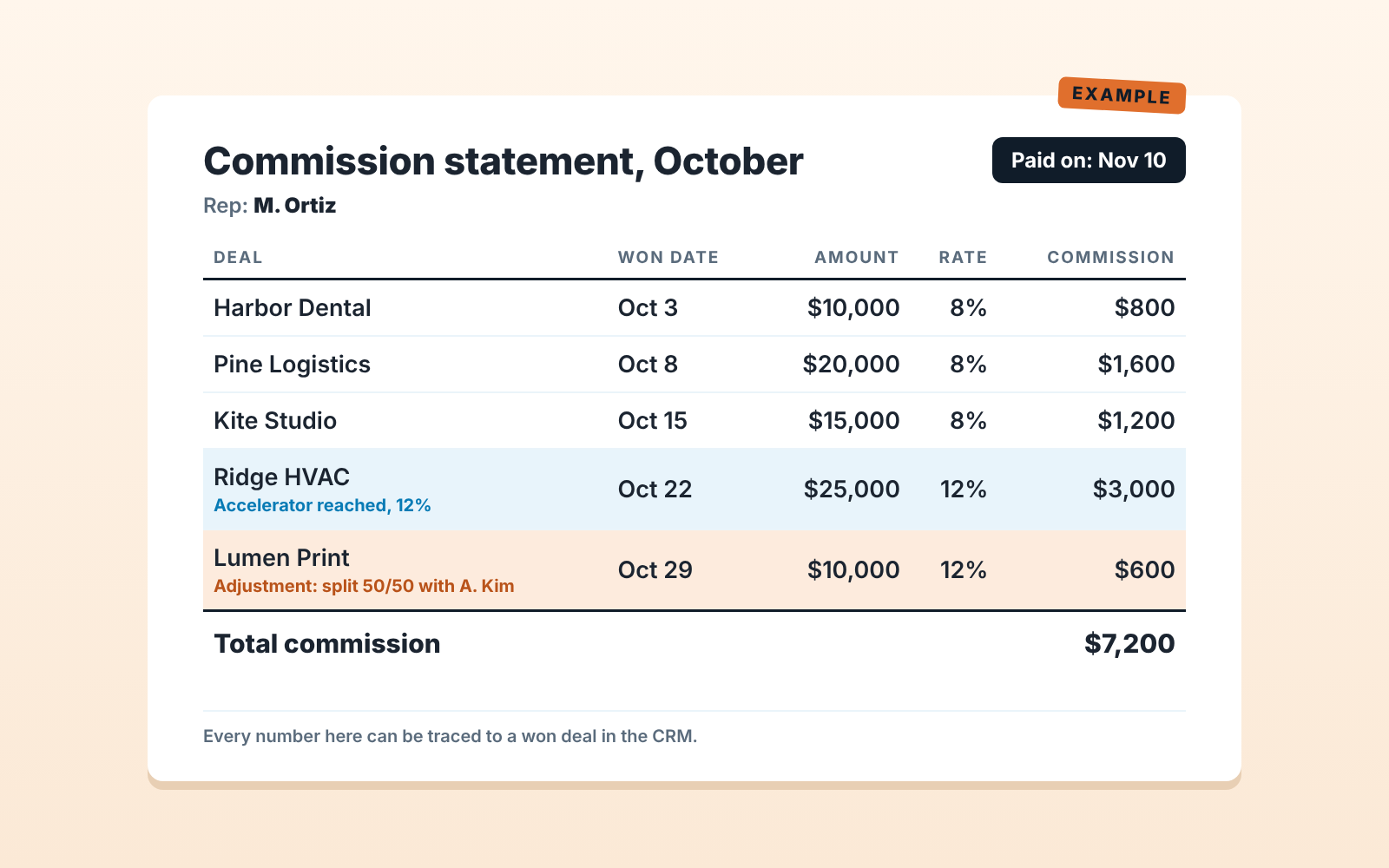
Which structure to choose and when accelerators are worth it are separate decisions, covered in sales commission structures for a small team and how to build a sales incentive plan for a small team. For retention, a plain flat rate that pays on time and can be checked keeps more people than a clever tiered plan nobody can reproduce.
Feedback, growth and the manager relationship
Each one-on-one Dan’s manager cancelled was reasonable on the day. Put together, they said Dan’s week was the least important thing on the calendar, and no amount of “great job” in the team channel undoes that.
The weekly one-on-one is the cheapest retention measure there is, and it works when it has evidence in it. Open the rep’s pipeline together. Look at the deals with no next activity, the close dates that moved, the deal that has sat in one stage for three weeks. Ask what is blocking each one and what the rep needs from you. Thirty minutes, same slot every week. If something forces you to move it, move it to another day that week. We wrote the mechanics up in giving reps feedback from CRM evidence.
Growth is the part owners find hardest, because a company with eight sellers has one manager seat and it is taken. So grow the role and leave the title alone. Give the rep who closes mid-market deals the whole mid-market segment and the authority to shape how it is worked. Let the rep who is good with new hires own onboarding, with a plan like the one in the 30-60-90 onboarding plan for sales reps. Hand the new product line to one person. Each of these gives the rep an answer when a recruiter asks “and where is that going?”
Then ask them directly in the stay interview, and keep performance out of the room. Three questions are enough. What would make you stay here another two years? What has come close to making you look elsewhere? What do you want to be doing in this company that you are not doing now? Write the answers down and act on at least one of them within a month, where the rep can see it. A stay interview that produces nothing is worse than none, because now the rep knows you asked and did nothing.
Signs a rep is about to resign
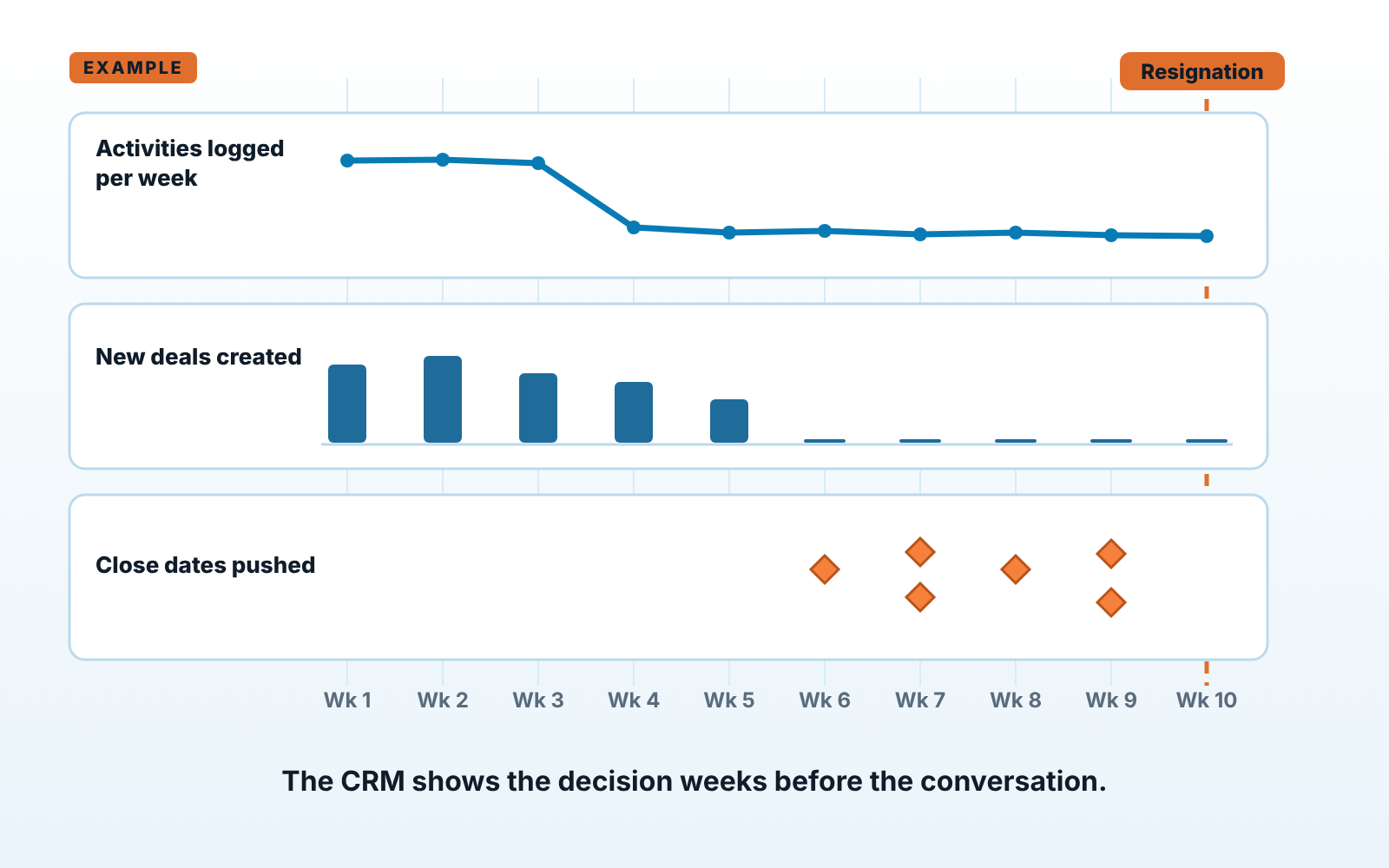
A rep who has decided to leave changes how they work weeks before they tell you, and most of that change goes through the CRM.
Watch for activity that drops while the pipeline looks the same. The deal list is unchanged, but calls and meetings logged per week fall noticeably and stay down. Watch new deal creation slide toward zero: a rep who plans to leave has no reason to open a deal they will not be paid for. Watch close dates on “this month” deals move into next quarter, and notes that shrink from three lines to three words. Watch the opposite on the big deals, where a rep suddenly pushes two large opportunities to close before quarter end and asks finance when commission on them pays out. And watch for the rep who asks for a copy of their commission history “for their records”.
In behavior the signals are quieter. The camera stays off. The rep who used to argue about the plan stops arguing. They are first to leave the Friday call and have no questions in the Monday one. We covered the slow version of this in quiet quitting in a sales rep; the pre-resignation version looks the same and moves faster.
Any one signal is noise. A rep on vacation logs nothing, and a rep closing a huge deal opens no new ones. Our rule of thumb is that two signals holding for three weeks call for a conversation this week, with an open question: “Your activity has dropped since mid-September and I want to understand what changed.” Most of the time you will hear a fixable reason. Sometimes you will hear the real one, and you still have time to act.
Spotting the pattern by hand means opening each rep’s activity report weekly, which is exactly the task that gets dropped in a busy month. SalesBond’s free CRM audit does the first pass for you. It reads the last 30 days of your connected CRM and sends a PDF report that includes a managers section, deal health and the pipeline bottleneck, and seven days later a second PDF with what changed, so one rep’s slide is easy to see next to the rest of the team. Check your CRM with SalesBond if you want that picture without building the filters yourself.
If the rep does leave, their open deals need an owner within a day, and the handover has its own rules. They are in turnover in a sales team and what to do with open deals when a rep leaves.
A 90-day employee retention plan for an owner with no HR department
Ninety days is enough for most of the free strategies on the list and a first decision about money. The plan assumes five to fifteen sellers, one manager or none, and no budget approved yet .
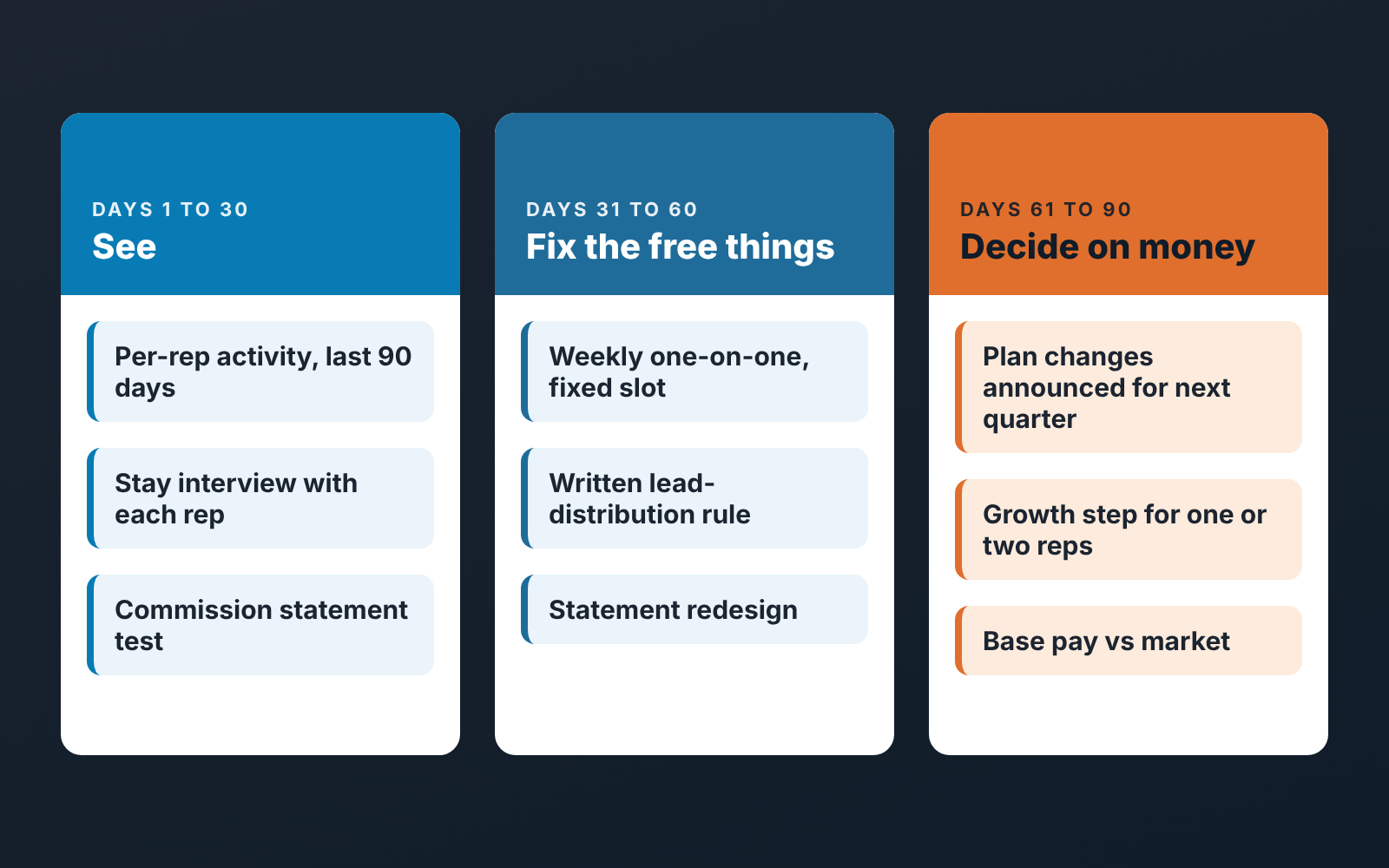
Spend the first thirty days looking. Pull activity and new-deal counts per rep for the last ninety days and look for the the drop patterns above. Run a stay interview with every rep, including the ones you are sure about. Hand one rep their last commission statement and ask them to reproduce it from the CRM; if they cannot, you have found your step three. Write down the rule you actually use for distributing leads and accounts, and notice if you can’t.
Days thirty-one to sixty are for the free fixes. Put the weekly one-on-one in the calendar as a fixed slot and treat it like a customer meeting. Publish the distribution rule, even if it is imperfect, and tell the team it can be challenged in the Monday meeting. Redesign the commission statement so it shows its work. Agree next quarter’s targets with each rep in a conversation, and record the agreed number in the CRM.
The last thirty days are for money, decided with what you learned in the first sixty. If the plan needs to change, announce it now for next quarter with the worked example. Pick one or two reps for a growth step and tell them what it is. Check base pay against what recruiters are offering in your market. Then look at the ranked list again and decide whether a raise is really the next problem, or whether the one-on-ones are still slipping.
Mistakes we keep seeing
The counteroffer at resignation. By the time the letter is on the table the rep has rehearsed leaving for weeks, and money you find that afternoon tells everyone else that resigning is how you get a raise. Spend the same money three months earlier on a market check of base pay, before the recruiter calls.
Contests as a retention tool. A contest moves effort for a month and tells the people who lost that they are behind. It has it’s place, and we wrote the rules in sales contests for a small team on CRM data.
Copying the HR list. Fifteen initiatives in an eight-person team means fifteen things done badly. Pick the next step on the list and finish it.
Changing commission mid-quarter. Even a change that raises payouts teaches the team that the plan is something that happens to them, if it lands mid-quarter without a worked example.
Treating the top rep as untouchable. The seller who brings in the biggest share of revenue needs the same one-on-one and the same stay interview as everyone else, and most of all needs to hear what thier next role is. Their book of customers is also the most portable one in the building.
Waiting for the exit interview. It gives you a polite version of what a stay interview would have told you while there was still time.
FAQ
What is the most effective employee retention strategy for a small sales team?
A weekly one-on-one that is never cancelled, built on the rep’s own pipeline. It costs nothing, it is the measure most often skipped, and in our experience its absence comes up more than anything else when sellers explain why they left.
How do I keep sales reps without raising pay?
Make pay verifiable before you make it bigger. A commission statement the rep can reproduce from their won deals, paid on the promised day, with changes announced at least a month ahead, at a quarter boundary, removes most pay complaints that have nothing to do with the amount. Then agree next quarter’s target with each rep in a conversation, and give the strong ones a segment or a product line to own.
How early can I see that a rep is thinking of leaving?
Often weeks before they tell you, and the CRM shows it first. Logged activity drops while the deal list stays the same, new deals stop being created, and close dates move to next quarter. When two of those signals hold for three weeks, ask.
If you want the CRM side of this plan done for you, sign up for SalesBond and start with the free audit of the last 30 days.