
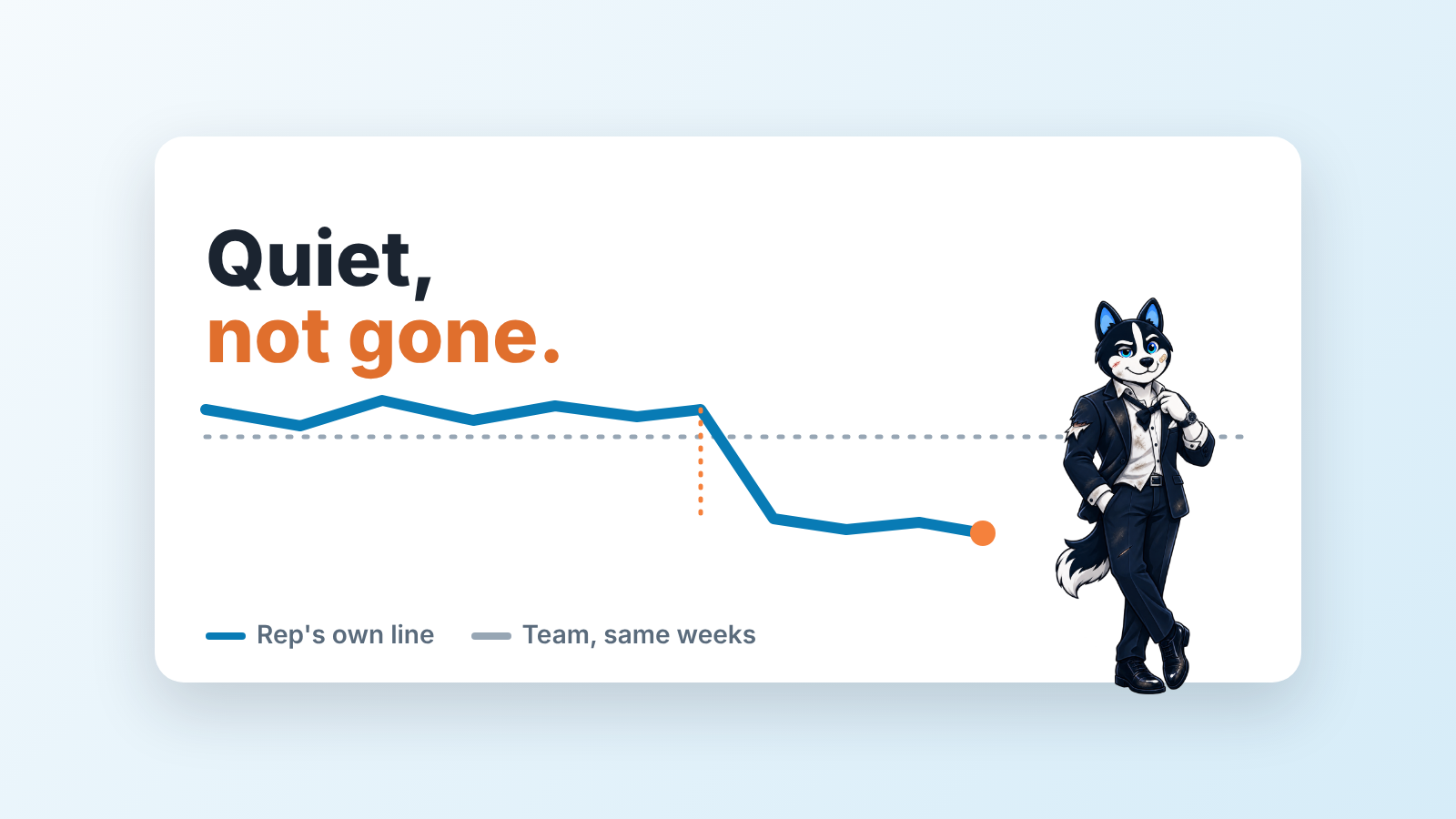
Quiet quitting is when an employee does exactly what the job description says and stops giving anything beyond it. In a sales rep it shows up as a slow slide in activity: fewer calls and meetings, fewer new deals, CRM updates that arrive late or not at all, while the formal minimum still gets done. Before you call it quiet quitting, compare the rep with their own previous weeks and with the rest of the team for the same weeks. Only then have the conversation.
That order matters, because the CRM shows you a change in behavior. It does not show you the reason. A rep whose logged calls fell by a third may be disengaged, or may have inherited a territory of dead accounts, or may have stopped logging calls because the activity form got three new required fields. The data looks the same in all three cases. This article is about telling them apart without turning into the manager who watches the activity feed all day.
Quiet quitting meaning, in plain terms
Quiet quitting means doing the job as written and nothing more, without resigning. The person shows up, closes the tasks that are tracked, and goes home. The discretionary part of the job, the part nobody wrote down, is what disappears.
The term took off on social media in 2022, and that September Gallup put numbers on the idea that millions of people are “not going above and beyond at work” (Gallup, “Is Quiet Quitting Real?”, September 2022). In the second quarter of 2022, 32% of U.S. employees were engaged and 18% were actively disengaged. The ratio of the two, 1.8 to 1, was the lowest in almost a decade. The people in between, who do the minimum and are psychologically detached from the job, are the ones Gallup calls quiet quitters: “at least 50% of the U.S. workforce”.
Two things in that definition are easy to miss. First, quiet quitting is a change in behavior. Someone who always did the minimum is not quiet quitting; they are doing their job as they understood it. The signal is a drop from the person’s own previous level. Second, in sales the discretionary part is unusually large. The tracked part of a rep’s job might be “log your activities and update the stage”. The untracked part is calling the account that went silent, asking for the referral, pushing for the next meeting instead of accepting “I’ll get back to you”. A rep can tick every tracked box and still have a pipeline that is quietly dying.
Why it matters in sales
A disengaged accountant produces the same ledger a month later. A disengaged rep produces a pipeline that looks fine for six to eight weeks and then empties out, because today’s calls are next quarter’s deals. By the time the number is missed, the behavior behind it is two months old.
The forecast suffers too. A rep who has stopped pushing deals forward rarely closes them lost either: a lost deal needs a reason, a note, maybe a conversation with you. Leaving it open is free. So the pipeline keeps its value on paper while the real probability drains out of it.
Six signs you can actually see in the CRM
Most lists of quiet quitting signs are HR lists: less enthusiasm in meetings, camera off, no volunteering. Real, but not measurable, and arguing about them in a 1:1 goes nowhere. The CRM gives you a smaller set of signs that are at least countable. Salesfolks, the one sales-specific piece we found on the topic, names the same cluster from the practitioner side: missed daily activity metrics, “inconsistent CRM updates or ghost pipelines” (Salesfolks).
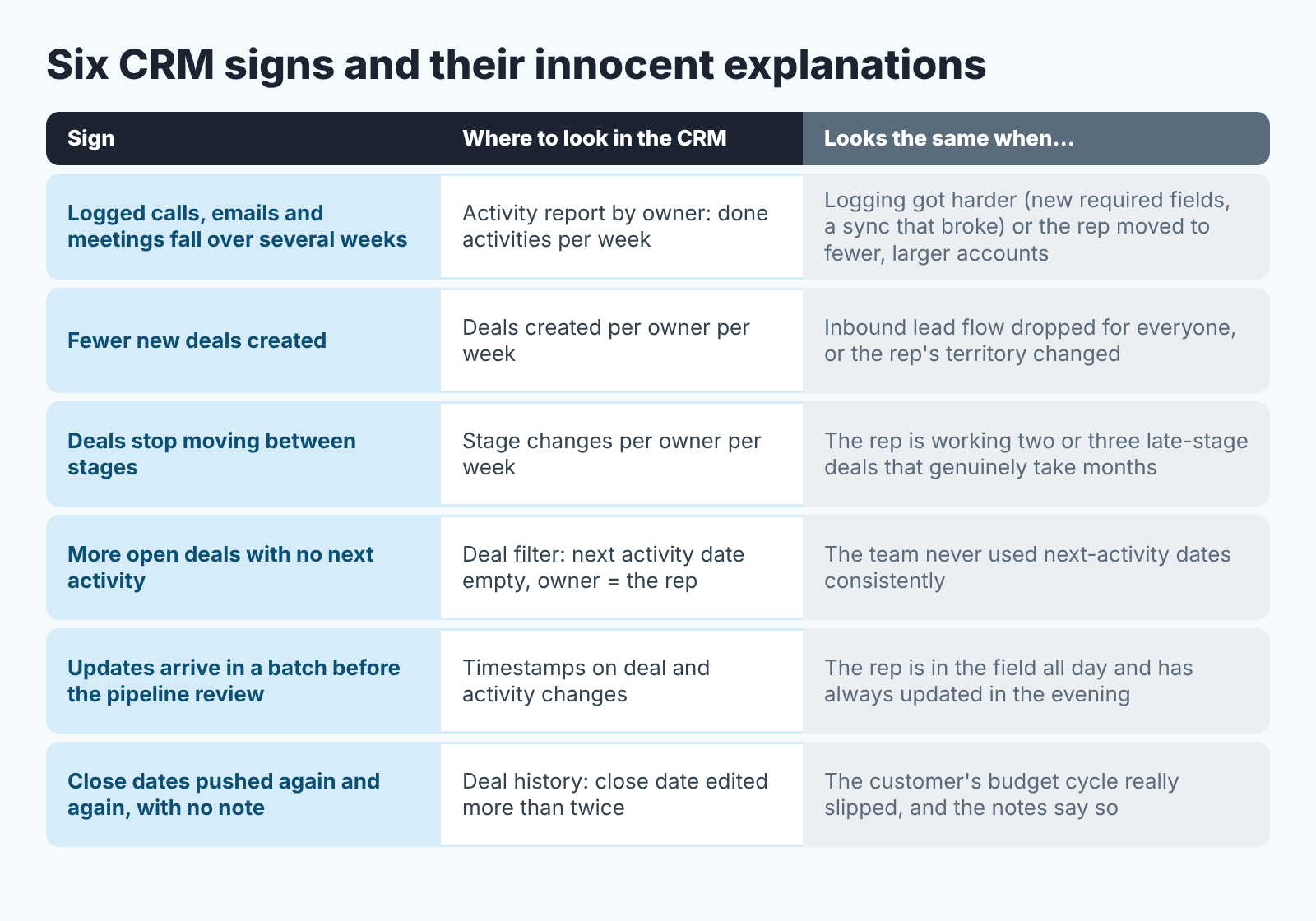
Here they are in plain words, each with the innocent explanation you have to rule out before it means anything:
- Logged calls, emails and meetings fall and stay down for several weeks in a row. Check first whether logging got harder, or whether the rep moved to fewer, larger accounts.
- Fewer new deals get created. If inbound leads dropped for the whole team, this tells you nothing about the rep.
- Deals stop moving between stages. Two or three late-stage deals that really do take months look exactly like this.
- More open deals have no next activity scheduled. Meaningless if your team never used next-activity dates in the first place.
- Updates land in one batch the night before the pipeline review, which is fine for a field rep who has always worked that way.
- Close dates keep getting pushed with no note. A budget cycle that slipped leaves notes; a rep who stopped caring usually doesn’t.
Any CRM with an activity report by owner and a deal filter on next activity date will give you all six, under its own names. If your team’s activity data is thin or unreliable, start with which activity metrics a small team can actually keep before trying to read anything into it.
One sign is missing on purpose: time spent in the CRM, keystrokes, “last seen online”. Some tools offer them, and they tell you nothing about selling. A great rep can live in thier inbox and on the phone and touch the CRM for twenty minutes a day. We’ll come back to where that kind of monitoring stops being management.
Compare the rep to their own baseline, not to a norm
The mistake in most “signs of quiet quitting” advice is the implied norm: a rep should make X calls a day, and fewer means trouble. In a real team the top performer might log, say, twelve calls a day and the second-best four, because one sells to small accounts and the other to three enterprise buyers. A norm catches the second rep every single month and misses the first one when she drops from twelve to seven.
So the comparison that works is the rep against themselves. Take the last 8 to 12 weeks of the rep’s own activity, before you noticed anything, and write down the weekly figures for five things: calls and emails logged, meetings held, new deals created, stage changes, and how fast they respond to an inbound lead or a task. That is the baseline, a description of what normal looked like for this person. If you already keep a weekly scorecard, you have most of it; our scorecard article for Pipedrive shows the columns.
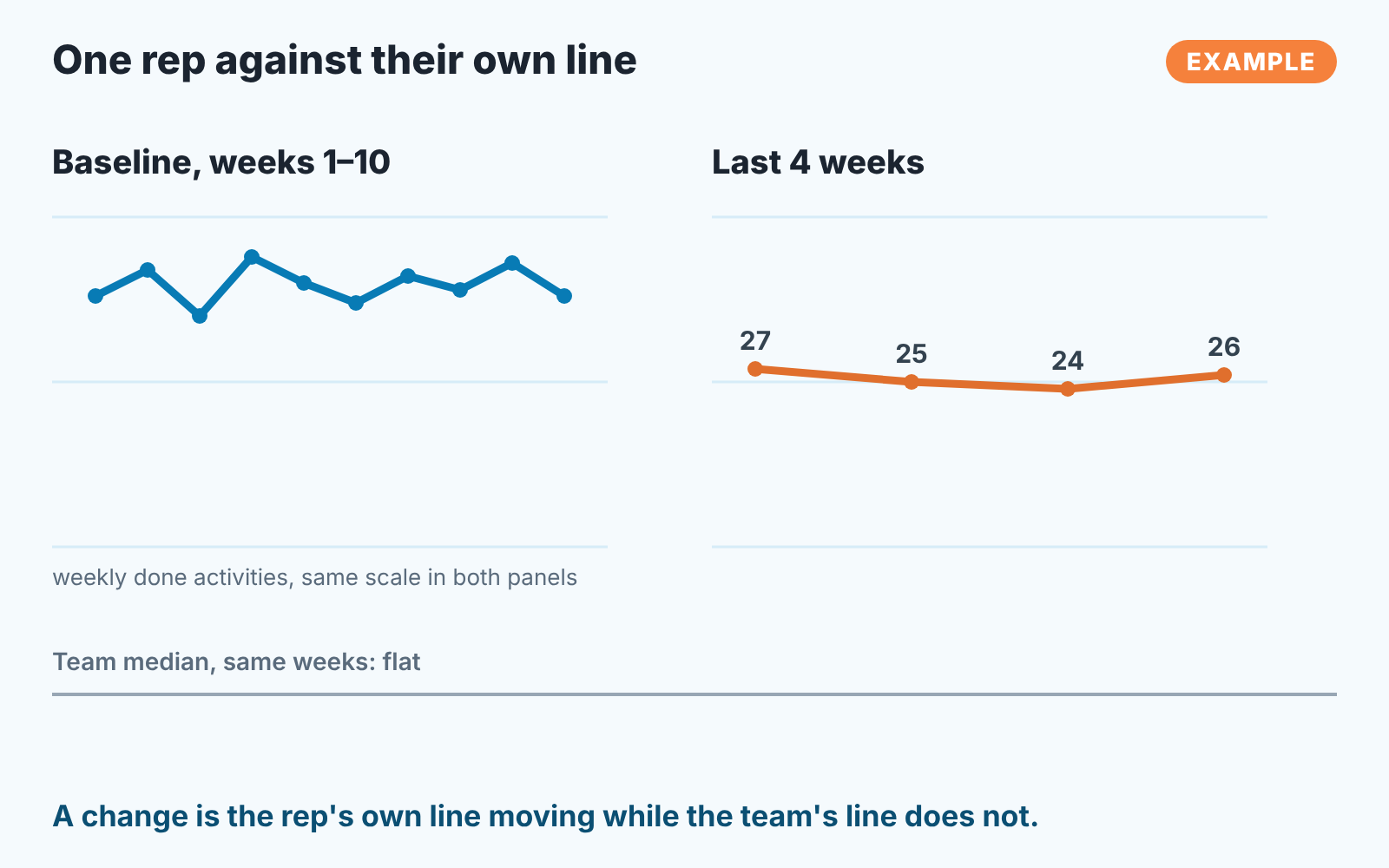
Then put the last four weeks next to it. You are looking for a shift that lasts. Everyone has a bad week. A rep who drops from, for example, forty logged activities to twenty-five and stays there for a month has changed something; a rep who did eighteen one week because they were at a trade show has not.
The third line on that chart is the team for the same weeks. This is the step people skip. If the whole team’s activity dropped by a third in October, the rep did not quiet quit. Something happened to the team: the inbound campaign ended, the CRM got a new mandatory field, the new pipeline review added two hours of prep a week. Pull the same five numbers for everyone and look at the shape before you look at the name.
A note on the window. Eight weeks is the minimum because it covers one full month-end push and the quiet week after it. Twelve is better if you have it. Going back further than a quarter usually pulls in a different territory, a different quota or a different manager and then you are comparing two different jobs.
Before you decide it is quiet quitting: rule out the process
Here is the test we apply before any 1:1 about activity. For each sign above, can the drop be explained by something other than the rep’s motivation? Go in order: the early causes are the cheapest to check and the most often true.
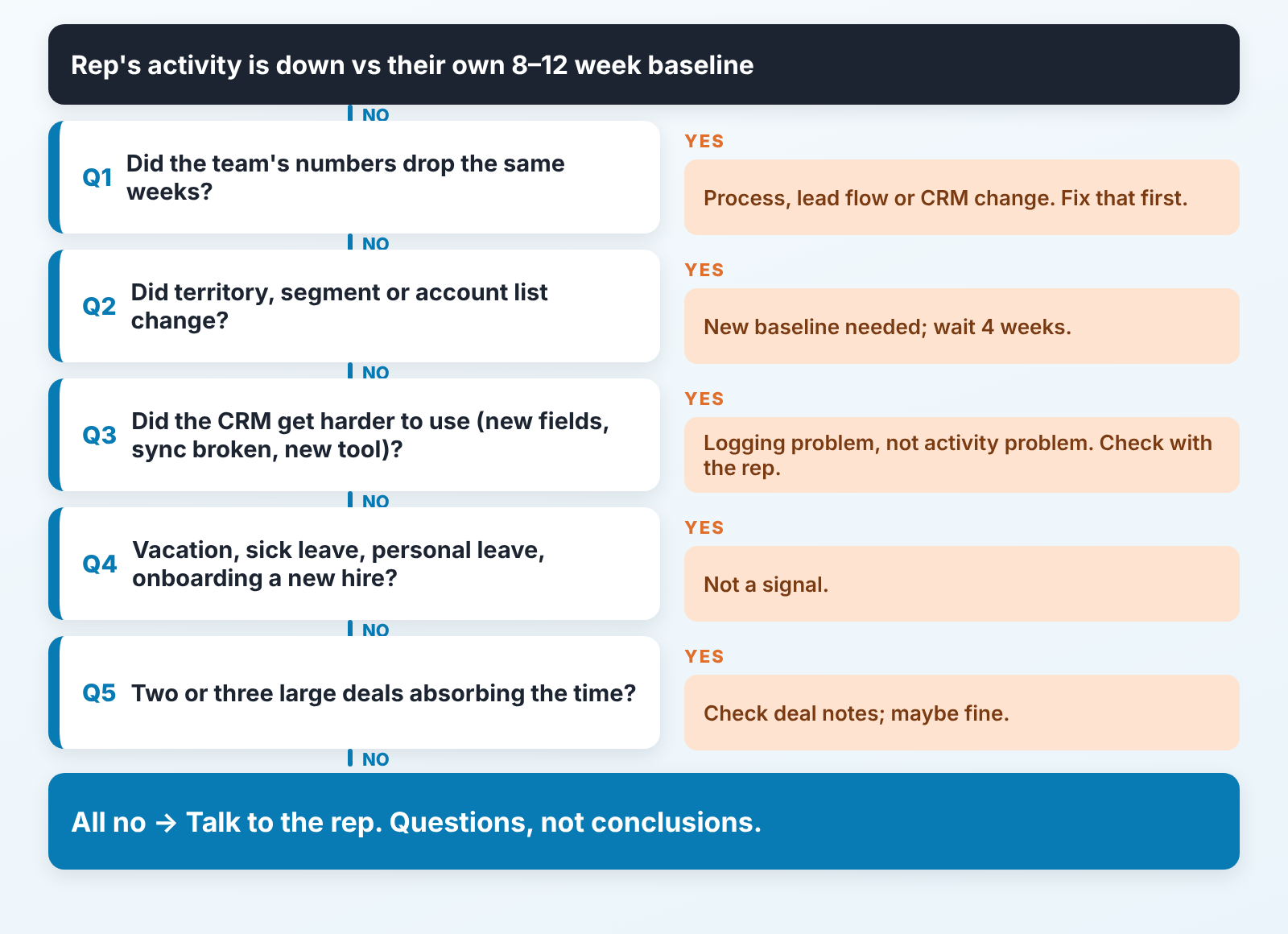
Start with the team. If everyone moved, stop and fix the team-level cause. Writing a rep up for a drop the whole team had is how you create the problem you were trying to detect.
Then ask whether the job changed. New territory, new segment, a book of accounts inherited from someone who left. A rep who took over, say, thirty orphaned accounts in September spends October reading notes and sending “I’m your new contact” emails. Fewer new deals and fewer stage moves are the expected shape of that month. After a handover like that the baseline resets, and you wait four weeks before reading anything. We have a separate piece on what happens to open deals when a rep leaves; the inheriting rep’s numbers are one of the side effects.
Did the CRM get harder? This is the cause nobody wants to hear, because it points at the manager or the ops person. Required fields added to the activity form. A phone integration that stopped logging calls automatically. A rule that every call needs an outcome, with no outcome that matches what reps actually do. Logged activity falls, real activity does not. The quickest check: ask the rep to walk you through logging one call, and count the clicks. If the honest answer is “I stopped logging the short ones”, you have an adoption problem, and the fix is in CRM adoption. A performance conversation will not fix it. If you use an activity outcome field, make sure it has the options reps need; we described the Pipedrive setup here.
Leave is obvious, and its the one that still gets skipped: two weeks off in an eight-week window drops the average by a quarter.
Big deals are less obvious. Sort the rep’s open deals by value. If the top two are late-stage, large, and have real notes from the last two weeks (proposal revisions, legal questions, a pilot), low activity counts can mean the rep is doing the right thing. The test is whether the notes exist. A big deal with no notes and a pushed close date is a different story.
Last, the leads. If marketing switched sources or the SDR team changed, calls stay flat and new deals drop, and that shape points at the lead source.
Only when all of these come back “no” do you have something that looks like a change in the person rather than the environment. Even then you do not know why. You know that this rep, in a stable environment, with a stable job, is doing visibly less than two months ago. That is the one sentence you take into the room. It is the same logic as deciding whether you have a rep problem or a pipeline problem, applied to one person over time instead of to the quarter’s number.
The 1:1 conversation: questions, not accusations
We think the wrong opening line costs more than any amount of wrong data. “I’ve noticed your activity is down” is an accusation with a chart attached. The rep hears “I’ve been watching you”, gets defensive, and the conversation becomes about the numbers instead of what changed. You will learn nothing, and you will have confirmed what quiet quitters often believe already: that the company sees them as a row in a report.
So open with the observation and the uncertainty, in that order. Something close to: “Your numbers have looked different for about a month, and I don’t know why. I’ve checked the obvious things on my side, the lead flow, the territory, and they’re stable. I’d rather ask you than guess.” Then stop talking.
The questions that work are about the job.
“What’s taking more time than it used to?”
“Which part of the week do you dread?”
“Is there anything in the process, the CRM, the handoffs, that’s gotten worse since the summer?”
“What would you drop if you could?”
“Is there something going on outside work that I should know about, or that I shouldn’t ask about?”
That last one is deliberate. You are giving the rep permission to say “there is, and it’s private”. A rep going through a divorce or a parent’s illness will often show the exact pattern above, and the right response is flexibility; a performance plan would be the wrong tool.
Listen for three kinds of reply. The first is a process complaint: the CRM, the leads, the meeting load. Good, that is fixable, and it means the rule-out step missed something. The second is a career complaint: no path, no raise, the promotion that went elsewhere, the comp plan change. Sometimes fixable, and if not, at least honest. The third is a shrug. “Everything’s fine.” Numbers down, no explanation, no complaint. That is the quiet quitting pattern. In that meeting, say what you see, say that you want it to change, and agree to look at it together in thirty days with a specific plan; pressing harder for an explanation in the room tends to end in a resignation letter.
What you don’t do: open with the chart, compare the rep to a colleague by name, or bring up anything from monitoring the rep didn’t know about. The first two lose the conversation; the third can lose you the rep. If you catch yourself preparing the meeting like a prosecution, our piece on the line between management and micromanagement is worth ten minutes.
A 30-day plan and what to change in the process
The plan that comes out of that meeting has two halves, and the second half is the one managers forget.
The rep’s half is small and specific. That means two or three things you both agreed on: for example, ten new conversations a week with named accounts from the list you looked at together, a next activity date on every open deal by Friday, and one coaching session on the stage where their deals stall. Write it down, in the CRM if it has a place for it, in a shared note if not. Put the day-30 review on the calendar before you leave the room, so it does not become one more thing the rep is waiting to be ambushed with.
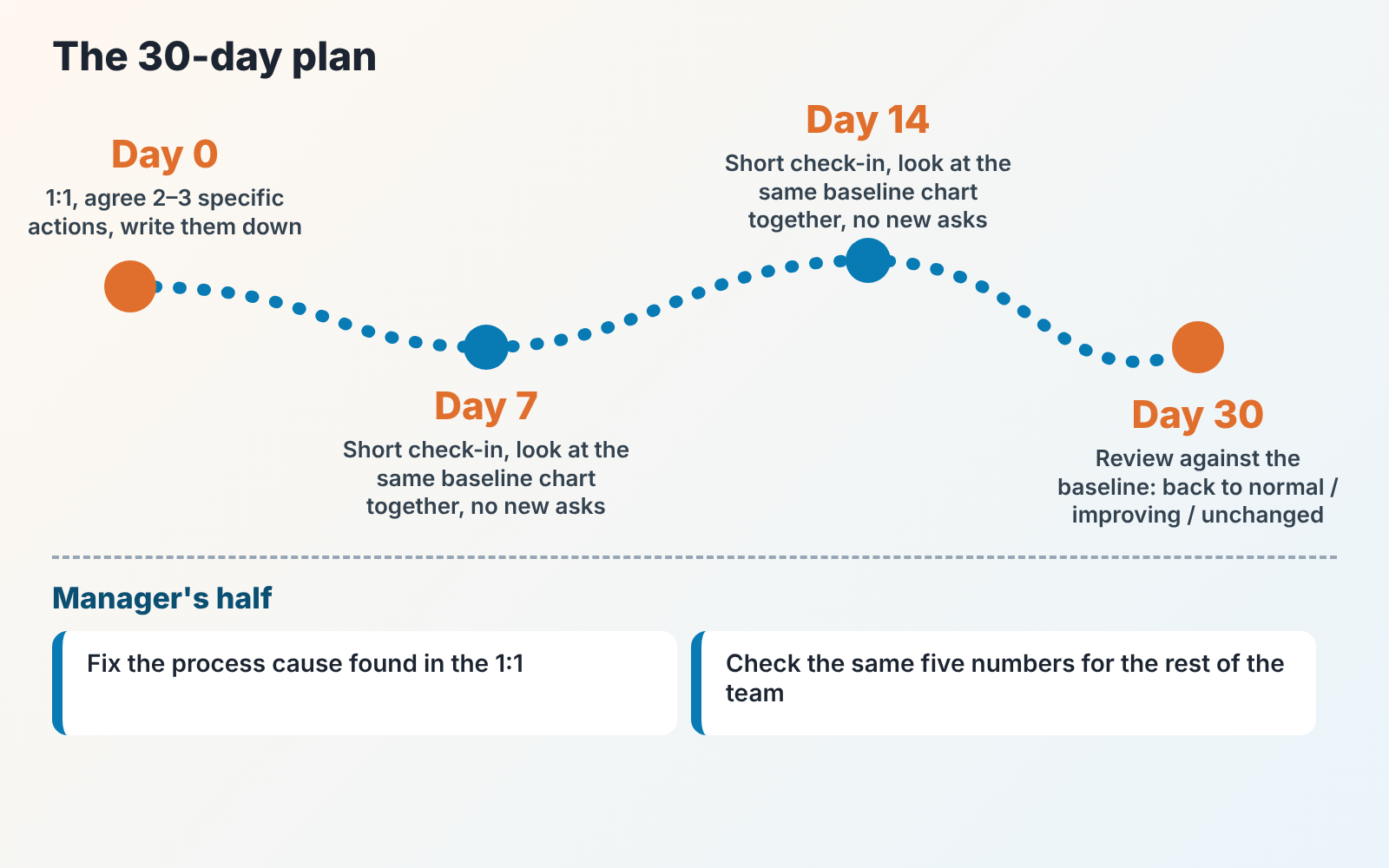
Your half is whatever the 1:1 turned up. If the rep said the activity form takes six clicks, cut it to two this week, and tell them you did. If they said the leads are worse, look at the lead source with the same baseline logic. If the Monday pipeline review has turned into a two-hour interrogation, shorten it; the weekly manager check we use is deliberately short for this reason. A rep who raised a real problem and then watched nothing happen for thirty days has learned exactly what quiet quitting is supposed to teach them.
At day 30 you look at the same five numbers against the same baseline. There are three outcomes. Back to baseline: say so, out loud, and drop the subject. Moving in the right direction: extend thirty days, same plan. Unchanged, with the process fixed and the rep aware: now it is a performance conversation, and it should sound like one. What matters is that you got there through a month of visible effort on your side, which a dashboard screenshot cannot show. Our accountability piece covers what that conversation looks like when the team can see it was fair.
This is where our own tool fits. We build SalesBond, a sales management layer on top of the CRM a team already uses; we started with Pipedrive. It doesn’t measure engagement and has no idea who is quiet quitting, but its Sales Dashboard has a Team Performance tab with per-rep execution, so the “which rep, which weeks” question doesn’t need a spreadsheet. The free CRM audit looks at the last 30 days of your CRM, sends a PDF with a managers section, and a second PDF a week later with what changed. Check your CRM with SalesBond if you want that picture without building the reports yourself; the conversation is still yours.
What the CRM cannot show and where monitoring goes too far
Can a CRM detect quiet quitting? No. It can show that a rep’s deal and activity numbers changed, and when. It cannot tell you why, and the reasons that matter most never get logged: the rep is exhausted after a year of carrying a territory alone, they were passed over, their manager (you) stopped doing 1:1s in June, something at home fell apart. The chart tells you when to ask the rep.
It also cannot tell quiet quitting from burnout, and the two need opposite responses. A burned-out rep is often still working hard, just badly: activity holds up or goes erratic, close rates fall, notes get shorter, the tone in emails changes. A quiet quitter does less, calmly. Both can show fewer stage changes. If the 1:1 turns up exhaustion, more pressure is the wrong medicine; a lighter load for a month and a real conversation about what the job has become is closer to right. Sales coaching helps the burned-out rep who has lost the thread of the process. It does not help the one who has decided to stop caring.
Then the boundary. There is a version of watching the CRM that is management: activity reports, pipeline reviews, next-activity dates, the baseline we described. The rep knows what is tracked, the tracking is about the work, and the same rules apply to everyone. And there is a version that is surveillance: login times, idle detection, reading a rep’s email threads, screen recording, location from the mobile app. Our position is that the second version doesn’t detect quiet quitting; it causes it. The moment a rep learns their keystrokes are counted, the discretionary effort you were trying to recover is gone , and it does not come back.
The legal side varies by country and often by state, and we are not the people to advise on it. If your plan involves anything beyond the activity and deal data reps enter themselves, talk to an employment lawyer in your jurisdiction before you set it up.
Which leaves the line from the Gallup article that managers would rather skip: “It’s clear that quiet quitting is a symptom of poor management.” Gallup adds that only one in three managers are engaged at work themselves. Its mirror image even has a name, quiet firing: a manager who stops investing in a rep until the rep leaves on their own. So run the method in the other direction once. For the same 8 to 12 weeks, how many 1:1s did you hold with this rep? How many of their deals did you look at together? When did you last tell them something they did was good? If the honest answer is “fewer than before”, the thing that changed in the rep’s environment might be you, and that is the cheapest fix on the the whole list. Start with next week’s calendar: put the 1:1 back, then read our sales performance management piece for small teams, which is built around that routine.