
Employee engagement is the degree to which a person puts their energy, attention and initiative into the work and into the goals of the company. William Kahn gave the first formal definition in 1990: engaged people “employ and express themselves physically, cognitively, and emotionally during role performances” (Kahn, Academy of Management Journal, 1990, cited in Wikipedia). Satisfaction is a separate thing. A rep can like the job and still coast. In a small company with a sales team the owner sees engagement in behavior: who proposes an improvement without being asked, who keeps the CRM current without reminders, who takes the hard deal when it comes up.
This article is for the owner with five to fifteen reps and no HR department. Almost everything else that ranks for this term was written for HR teams that run surveys across hundreds of people and buy a platform to read the results. You have a different situation. You can see every rep’s week. You also have to be the one who notices, because nobody else in the building has that job.
What employee engagement is, and how it differs from satisfaction, happiness and motivation
Kahn’s definition is academic, so here is the working version we use. An engaged rep spends discretionary effort on things nobody will check: the note written after a lost call, or the question in the deal review that makes the whole team think. Coursera’s shorter wording covers the same ground: “commitment, enthusiasm, and dedication to their organization” (Coursera, Employee Engagement: What It Is and Why It Matters).
Satisfaction describes how a person feels about the job, whether they like it or not. Wikipedia keeps the two apart in one sentence: engagement refers to work motivation, satisfaction to the employee’s attitude about the job (Wikipedia, Employee engagement). We have all met the satisfied, disengaged rep. Pleasant, punctual, hits the quota by a hair every quarter, never raises a problem and never fixes one either. That person will stay for years and will never move the team.
Happiness is mood. It changes with the weather and the last deal, so it tells you little about next month.
Motivation is the pull of a specific reward. A quarter-end bonus motivates for a quarter, and the behavior ends with the payout. Engagement shows up where no reward is attached to the task. If you want one test, watch what a rep does with a deal they have already decided is lost. The engaged one closes it properly, writes the reason and asks what to do differently next time. The disengaged one leaves it open and moves on.
Why one disengaged rep costs more in a small team
Employee engagement matters more in a small team because each rep carries a big share of the plan, and nobody except the owner is placed to notice when that share goes soft. In a corporation one disengaged employee barely shows in the totals. In a team of six reps each person carries about a sixth of the plan, and the pipeline behind that sixth belongs to one head. When the effort behind it drains, the number holds for a while. Today’s calls are next quarter’s deals, so you find out weeks later, when the forecast you believed turns out to rest on deals nobody was working.
The pipeline hides it well. Closing a deal as lost takes effort, a reason, maybe an awkward conversation with you. Leaving it open is free. A disengaged rep’s pipeline keeps it’s paper value while its real probability leaks away, and the forecast you take to the bank is wrong in a direction you cannot see.
Then there is the exit. A rep rarely resigns on the day they stop caring, and when they do leave you inherit a book of open deals with thin notes and no next steps. We described what that handover does to the inheriting rep’s numbers in what happens to open deals when a rep leaves. Most of that damage was done while the rep was still on payroll, which is the window employee retention strategies for a small business sales team are built for.
And the owner is usually the last to know. You are also selling, hiring, talking to the the accountant. The signals below fit in the time you actually have.
How an owner spots low engagement without an HR department
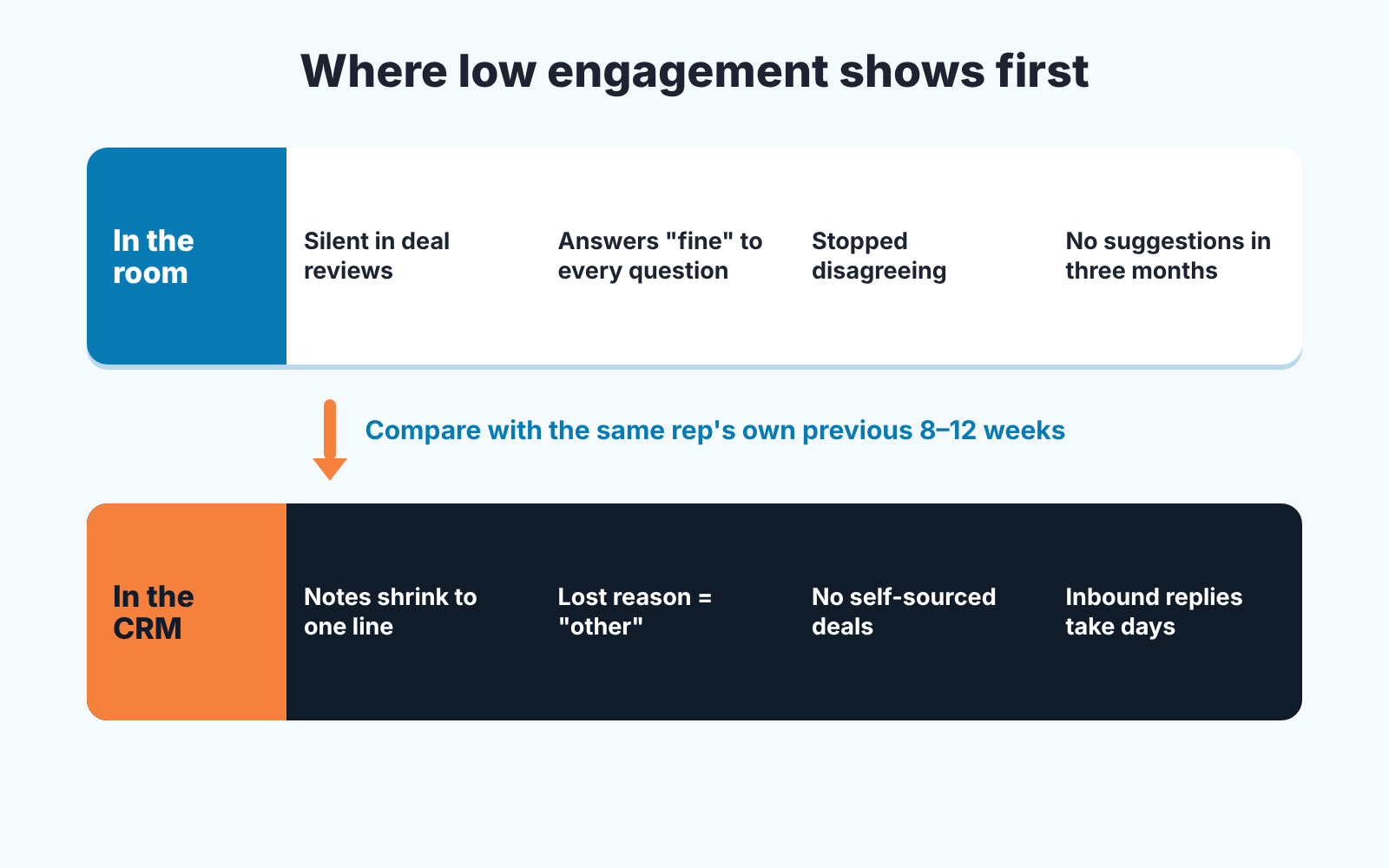
Start in the room. In the weekly deal review, who asks questions about someone else’s deal? Who says “fine” when you ask how the week went? Who has stopped disagreeing with you? A rep who used to push back and now nods is a louder signal than any dashboard. Write these observations down with a date. Memory flattens them into “she seems off lately”, which you cannot act on.
Then open the CRM. Our article on quiet quitting in a sales rep covers the six activity signs, from falling call counts to pushed close dates, and the baseline method: compare the rep with their own previous eight to twelve weeks and with the team over the same weeks, and check whether the process changed before you look at the person. For engagement we add four more:
- Notes get shorter. A rep who wrote four lines after a call now writes “called, follow up”.
- Lost reasons default to “other” or to whatever sits first in the list.
- The rep’s own prospecting dries up, and every new deal in their pipeline came in through inbound.
- Replies to inbound leads and assigned tasks slow from hours to days.
The CRM shows a change in behavior and says nothing about its cause. The same drop in notes can come from disengagement, from a territory full of dead accounts, or from a rep who is quietly interviewing elsewhere. Use the data to pick which conversation to have. You learn the reason in the conversation itself.
A disclosure here, because this is where our product touches the topic. We build SalesBond, a sales management layer on top of the CRM a team already uses; we started with Pipedrive. The free CRM audit reads the last 30 days of the connected CRM and sends a PDF with a section on managers, deal health, the pipeline bottleneck and a list of what to fix sorted by money; seven days later a second PDF shows what changed. That gives you the whole team in one document and saves the Friday evening of building filters. It will not tell you why a rep’s notes shrank. That question stays with you. Check your CRM with SalesBond.
A five-question employee engagement survey you run in one-on-ones
For a team of five to fifteen reps, the employee engagement survey that works is five questions asked face to face in a monthly one-on-one. Standard engagement surveys depend on anonymity, and with eight respondents anonymity is fiction. You will recognize who wrote “management does not listen” by the phrasing, and the reps know you will, so they write nothing useful. HR-platform articles such as Lattice’s list pulse surveys, stay interviews and eNPS among the ways to measure engagement (Lattice, What is employee engagement and how do you measure it). Of those the stay interview is the one that scales down to a team you see every day, cut to fifteen minutes and repeated monthly.
Same five questions every month, with every rep, answers written down in a notes file you keep outside the CRM:
- What did you do this month that you are proud of?
- What got in your way, and what would you change if you were in my chair?
- Where do you want to be stronger in six months, and what do you need from me to get there?
- Which deal taught you the most this month, won or lost, and what did it teach you?
- On a scale of one to ten, how much of your effort does this job get right now, and what would make it one point higher?
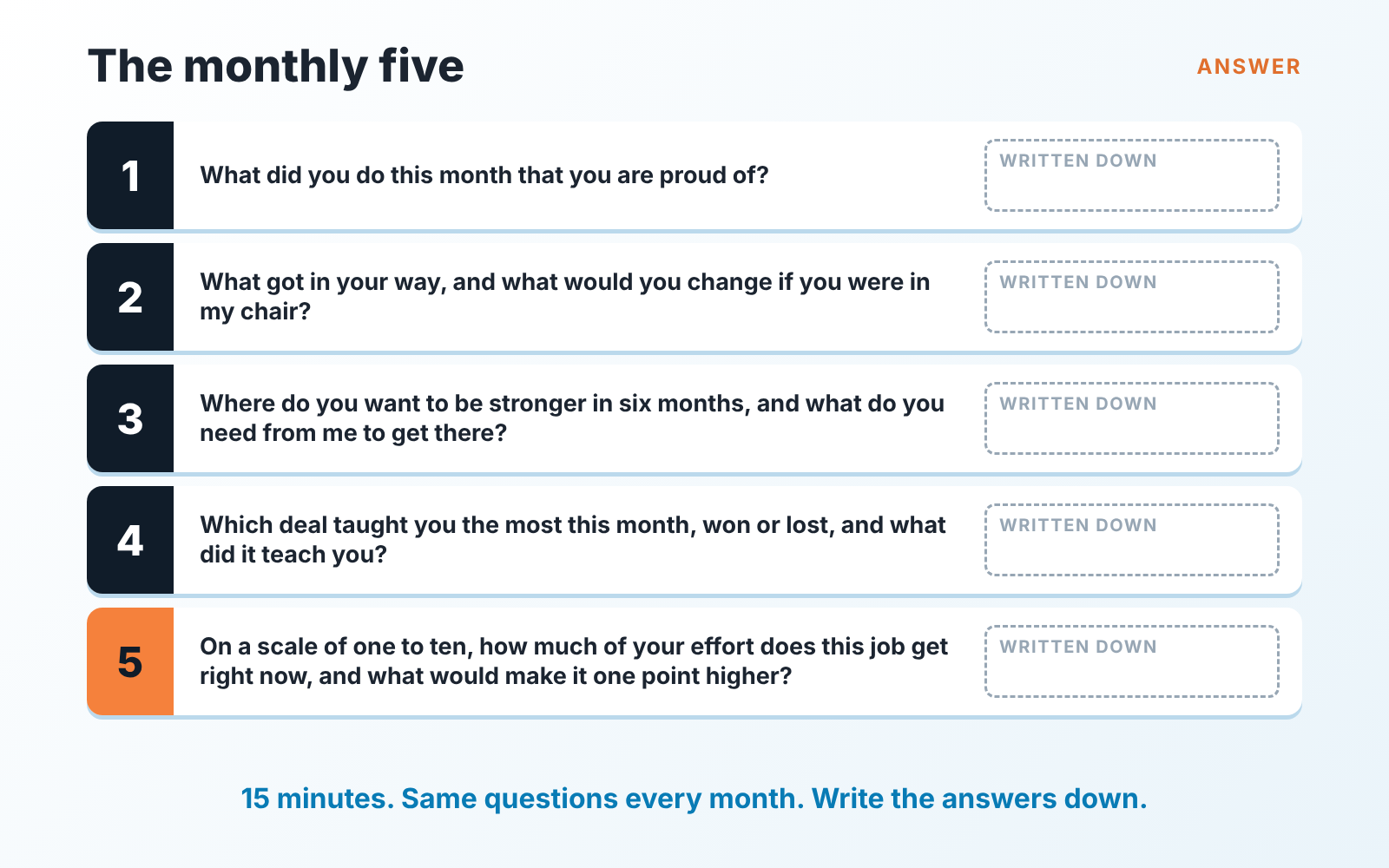
Read the answers across months, per person. The number in question five matters less than its direction and the sentence after it. “One point higher” is the action you take before the next conversation, and the rep will check whether you did. Question four tells you whether the rep is still learning from deals or just processing them. Question two is where most process problems surface, and asking it costs you about an hour a month across the team.
One warning from our own experience. The first round produces polite answers. Round two is better. Round three is where people start telling you things, because by then they have seen that something changed after round one. If nothing changed, round three is as polite as round one, and you have your answer about yourself.
Five employee engagement strategies an owner can run without HR
The five strategies that work in a team of 5–15 reps are goal clarity, feedback, growth, recognition and workload. All five are in your hands tomorrow morning, and none of them needs an HR budget.
Goal clarity comes first. Does every rep know, this month, which number they own and which three or four activities get them there? If the plan lives in your head or in a spreadsheet the team never opens, the honest answer is no. Write the month’s targets per rep where they can see them, and make the deal review about the gap to that target. If the incentive plan contradicts the target (bonus on new logos while you ask for renewals), the plan wins, every time; our guide to a sales incentive plan for a small team covers how to align the two.
The disengaged rep usually has not heard anything specific about their work in weeks. “Good job” and “pick it up” are both noise. Feedback that lands names a deal, a field and a date. Say, “The Henderson deal has had no next step since the 14th, what is the plan?” We wrote a separate piece on giving reps feedback from CRM evidence; the short version is that evidence points the conversation at the deal, so the rep has nothing personal to defend.
A rep who is learning nothing is on the way out, whether they know it yet or not. Growth in a small team rarely means a promotion. It means the next thing to get good at: running discovery alone, owning a segment, training the next hire. The 30-60-90 structure you used in onboarding works just as well in month fourteen. Pick the next skill together, give it a date, and check in on it.
Recognition works when it is specific, public and fast. A line like “Anna’s handover notes on the Keller account meant Tom closed it without a single call back to the customer”, said in Monday’s meeting, does more than a quarterly award. Recognize behavior you want repeated within a day or two of seeing it. The clean pipeline and the honest lost reason deserve it as much as the big close.
Then count. Open deals per rep, inbound leads per rep, this week. A rep with ninety open deals cannot work any of them well and stops trying, which from the outside looks exactly like disengagement. Close or reassign the dead weight before you judge thier effort. The same applies to admin: if the activity form takes two minutes per call, you are buying short notes with your own process.
Which strategy to start with depends on the rep, and the monthly five questions will tell you. If you suspect your own management style is one of the causes, this piece on management styles for an owner is the honest mirror.
Is it low engagement, quiet quitting or burnout?
These three get mixed up, and each one needs a different first move.
Low engagement looks like compliance. The rep is quiet, shows no initiative and keeps thin CRM records, often from the start or for a long stretch. Begin with the monthly five questions, then pull one of the five strategies above.
Quiet quitting is a drop. The rep used to be engaged and now does exactly the job description, and the CRM shows a measurable fall against their own baseline. Check that baseline and look for a process change first; then have the conversation.
Burnout shows up as exhaustion. A burned-out rep is often working more hours and producing less: plenty of activity, falling quality, mistakes in records, “I can’t keep up” in the one-on-one. Reduce the load this week, before anything else, because a pep talk makes it worse. One strand of research treats engagement as the opposite of burnout, which it defines through exhaustion, cynicism and lack of accomplishment (Wikipedia, Employee engagement).
A 30-day plan
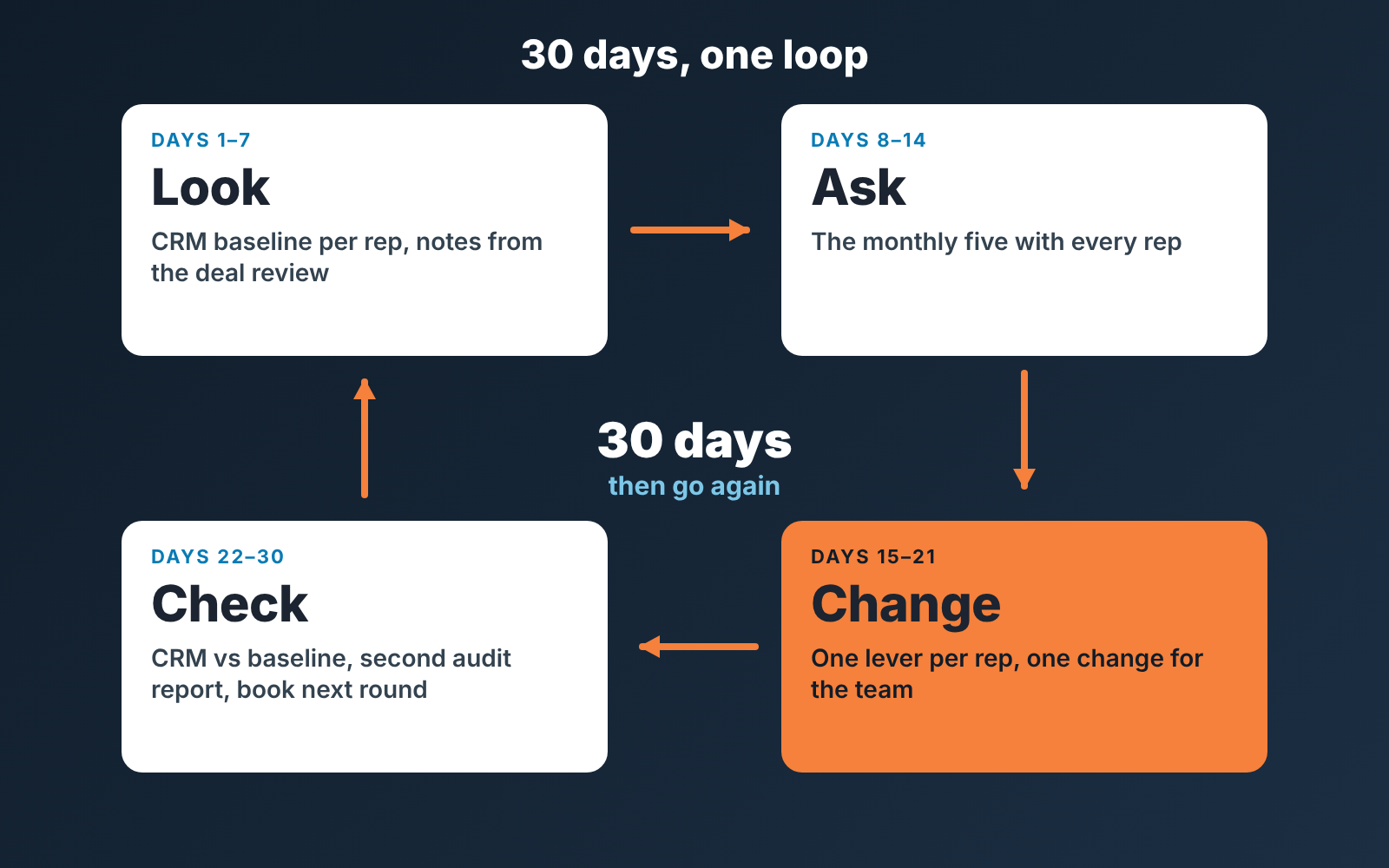
Here is the month we suggest to an owner who wants to start on Monday. Week one is for looking only: pull each rep’s last eight to twelve weeks from the CRM and write down what you see in the deal reviews. If you connect the free CRM audit now, its first report covers the last 30 days and the second arrives seven days later, in week two. Week two is the first round of the five questions, fifteen minutes per rep, with no fixing in the room. Week three brings one change per rep, taken from the “one point higher” answer, and one change for the whole team, usually a clarity fix such as targets per rep posted where everyone sees them. Week four is the check: the CRM against week one, and the next round of questions booked. Expect small movement in month one, and expect the reps to watch whether the week-three changes stick. If a single rep needs an individual plan, use the 30-day version in our quiet quitting article, which is built for that case.
Two mistakes we keep seeing
The first is spending on mood when the problem is clarity. Pizza Fridays, an offsite, a new coffee machine . These are pleasant and they move satisfaction for a week. A rep who does not know what number they own in November is exactly as lost after the offsite as before it. Team building has a place once the basics are in order; our take on team building for a small sales team says where that line is.
The second is using the CRM as a surveillance camera. Once you quote a rep’s empty Tuesday afternoon back at them, the team starts logging for you and the records stop telling you anything; we wrote about where that line runs in micromanagement in a sales manager.
Both get easier to fall into when the five questions run once, the answers come back polite and the team is declared fine; give the questions three rounds before you read anything into them.
This week, put the five questions in your calendar for every rep, and spend twenty minutes with last month’s deal reviews and CRM notes before the first one. If you want the CRM part done for you, start with SalesBond and use the first 30-day report as your baseline.