

A vision statement is one or two sentences about what the company wants to become in a few years. It answers “where are we going”; a mission statement answers “what do we do today” (Asana). For a small business with a sales team, a good vision is concrete, reachable in three to five years, and can be broken into a yearly target, a quarterly plan and a quota per rep.
Vision statement examples for small businesses
Most example lists are full of global brands. Two real ones are still worth a look, because they show the two shapes a vision can take. IKEA’s “To create a better everyday life for the many people” (Shopify) is the broad shape with no number. First Day, a gummy vitamin company, wrote “To help 1 billion people be healthier and solve modern health crises” (Shopify), which has a count in it. A small company should copy the second shape.
The six below are examples for illustration. The companies are invented, so treat the numbers as placeholders and the structure as the point. Each one follows year, segment, claim, number.
- Regional HVAC installer, 12 people: “By 2029 we are the installer property managers in our county call first, with 400 buildings under a service contract.” The sales team gets a segment (property managers), a geography (the county) and a count to work toward.
- B2B packaging distributor, 8 people: “By 2028, 300 food producers in the region reorder from us every month without a sales call.” The number counts repeat customers on a cycle. The team sells reorders, the owner watches retention, and a first order from a non-food company is a nice-to-have.
- Managed IT services firm, 15 people: “By 2029 we run IT for 150 law and accounting firms in the city, each on a three-year contract.” Two named verticals and a contract length tell the reps which leads to decline.
- Dental lab, 10 people: “By 2028 we are the lab 120 dental practices in the state send their implant cases to.” One product line and one count. The reps stop chasing denture volume that was never going to get the lab there.
- Commercial cleaning company, 14 people: “By 2029, 80 office buildings in the metro area have us on a multi-year contract, and half of them came from a referral.” The second half tells the team that a happy building manager is worth more to them than a new cold list.
- Vertical SaaS for independent gyms, 9 people: “By 2029, 1,000 independent gyms in the US run their memberships on us, and 90 percent renew.” The renewal figure keeps the team away from gyms that will leave in a year.
None of them uses “world-class”, “trusted partner” or “innovative solutions”, and every one can be checked on a given date by opening the CRM.
What a vision statement is
Shopify calls it “a short, compelling description of your company’s long-term goals” (Shopify). Asana calls it “a concise declaration of your company’s long-term aspirations” and says it “paints a picture of the future you’re working to create” (Asana). Both definitions are fine. Both were also written with large companies in mind.
For an owner with three to fifteen reps, we use a narrower working definition. A company vision statement is the sentence you say to a new hire on day one when they ask where the company is headed, and it contains at least one thing you can count. If it has no number, no segment and no year, your sales team will nod and go back to whatever they were doing.
IKEA’s broad vision works for IKEA (Shopify). A twelve-person installation company that borrows the shape of that sentence gets something that sounds good at the Christmas party and changes nothing on Monday.
Vision statement vs mission statement, values and goals
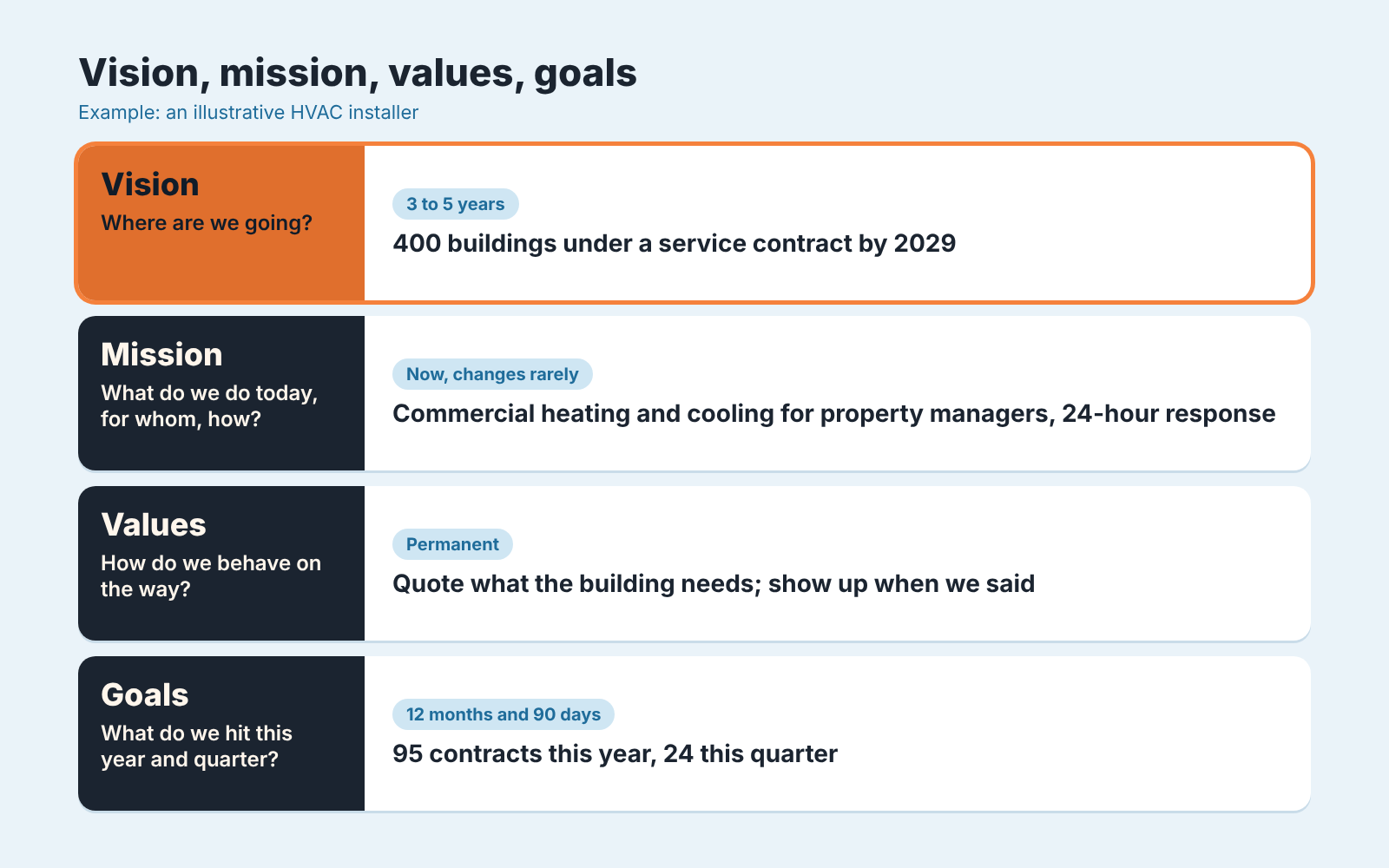
People mix these four up because they all end up on the same wall. The quickest way to keep them apart is the question each one answers. We’ll follow one illustrative company through all four, a regional HVAC installer with twelve people.
The vision answers “where are we going?” For a small firm it looks three to five years ahead. The installer’s vision names property managers in the county and 400 buildings under a service contract by 2029.
The mission answers “what do we do today, for whom, and how?” It rarely changes. Same company: “We install and service commercial heating and cooling for property managers in the county, with a 24-hour response.”
Values answer “how do we behave while we get there?” They are meant to stay put for good. The installer has three. Quote the repair the building needs. Show up when we said we would. Call ahead when we’re late.
Goals answer “what do we hit this year and this quarter?” They live for twelve months or ninety days. For the installer that means 95 new service contracts this year and 24 of them this quarter.
Shopify puts the vision horizon at “five to 10 years down the road” (Shopify). That is one source’s view, and for a company with a few reps we think it is too far. Three to five years is long enough that the vision survives one bad quarter and short enough that the people selling today will still be around to see it. Asana’s advice to review the vision “every one to three years, or whenever your company undergoes a significant strategic shift” (Asana) fits that shorter horizon well.
The mission statement deserves an article of its own, and we keep it to one paragraph here. The thing to remember is that the mission describes the present. You can’t measure a sales team against the present.
Why a small company with a sales team needs one
Watch a rep on a Tuesday afternoon. They have four leads to call back, a discount request from a long-time customer, and a cold inquiry from a kind of client the company has never served. Each of those is a decision, and each decision quietly answers the question “what is this company trying to become.” If the owner has never answered it out loud, the rep answers it with whatever is easiest to close this month.
That is the practical case for a vision in a small firm. It takes the “which customers first” decision away from the Tuesday afternoon and settles it once. In the HVAC example the property manager lead gets called first and the single-home inquiry goes into a second pipeline with no quota attached, and nobody has to ask the owner. We have written before about how an owner with four jobs and one weekly hour runs out of time for exactly these questions. A vision answers a good share of them in advance.
Hiring is the second reason. A candidate who hears “we want to be the installer every property manager calls first” can decide whether that is a job they want. A candidate who hears “we want to grow” has heard nothing. How you then manage the people you hire gets easier too, since you can point at the sentence instead of at your mood that week. The same sentence later feeds the value proposition your reps say on the first call. That one is written for the customer, and it is much easier to write once the vision exists.
The third reason is the one this article is mostly about. A sales plan has to come from somewhere. Owners who skip the vision usually set next year’s target as last year’s number plus a percentage they feel comfortable with. A vision with a number in it gives the target a reason, and reps work harder for a number with a reason.
How to write a vision statement in four steps
Block an hour. You will spend most of it on step two.
-
Pick the year and the number. Choose a year three to five years out. Then choose the one figure that would prove the company got there: customers under contract, locations, revenue, share of a named segment, repeat purchase rate. One number. If you need two, you have two visions, and the team will follow the easier one.
-
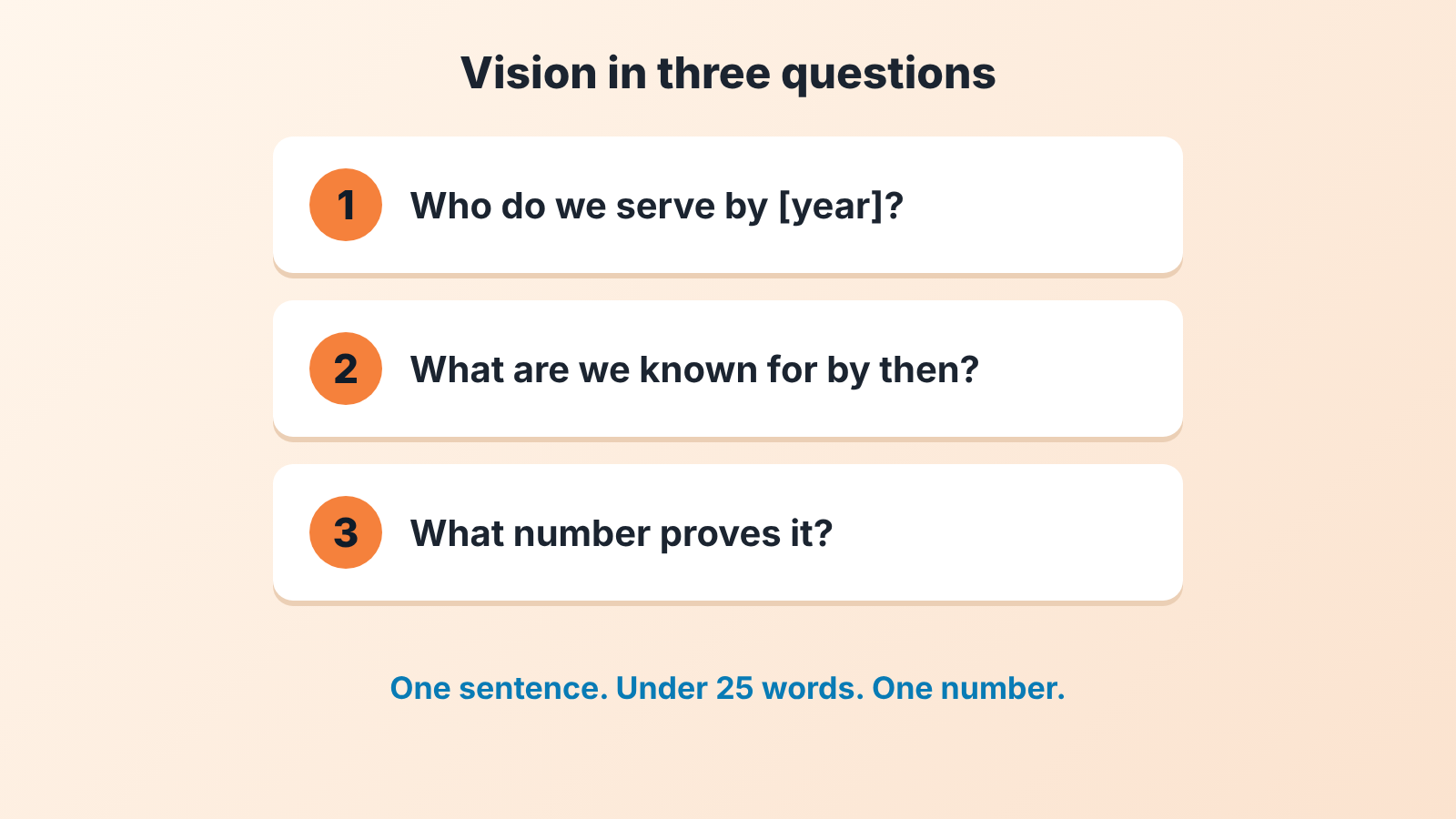
Answer three questions in writing. This is the whole vision statement template. Who do we serve by then (which segment, which geography)? What are we known for by then (the one thing a customer says about us to a peer)? What number proves it (the figure from step one)? Write each answer as a plain sentence.
-
Compress to one sentence under 25 words. Start with the the year, keep the segment, keep the number, cut the adjectives. “Leading”, “trusted” and “premier” go first; they are claims about how others see you and nobody in the room can check them. Read it aloud. If you run out of breath, cut again.
-
Test it on two reps and one customer. Ask the reps to repeat it back after one hearing. Ask the customer whether it sounds like the company they buy from. Three “yes” answers and the sentence is done. One “no” and you go back to step two, usually because the segment is too wide.
Write the vision yourself. When a committee writes it, each member trims the part they disagree with, and what is left is too general to steer a rep’s week. Collect opinions in step four, once there is something to react to.
From vision to the sales plan: the ladder
Most visions stay on the wall because nobody built the steps down to the quota. The ladder has five rungs. Walk down it once a year and check it once a quarter.
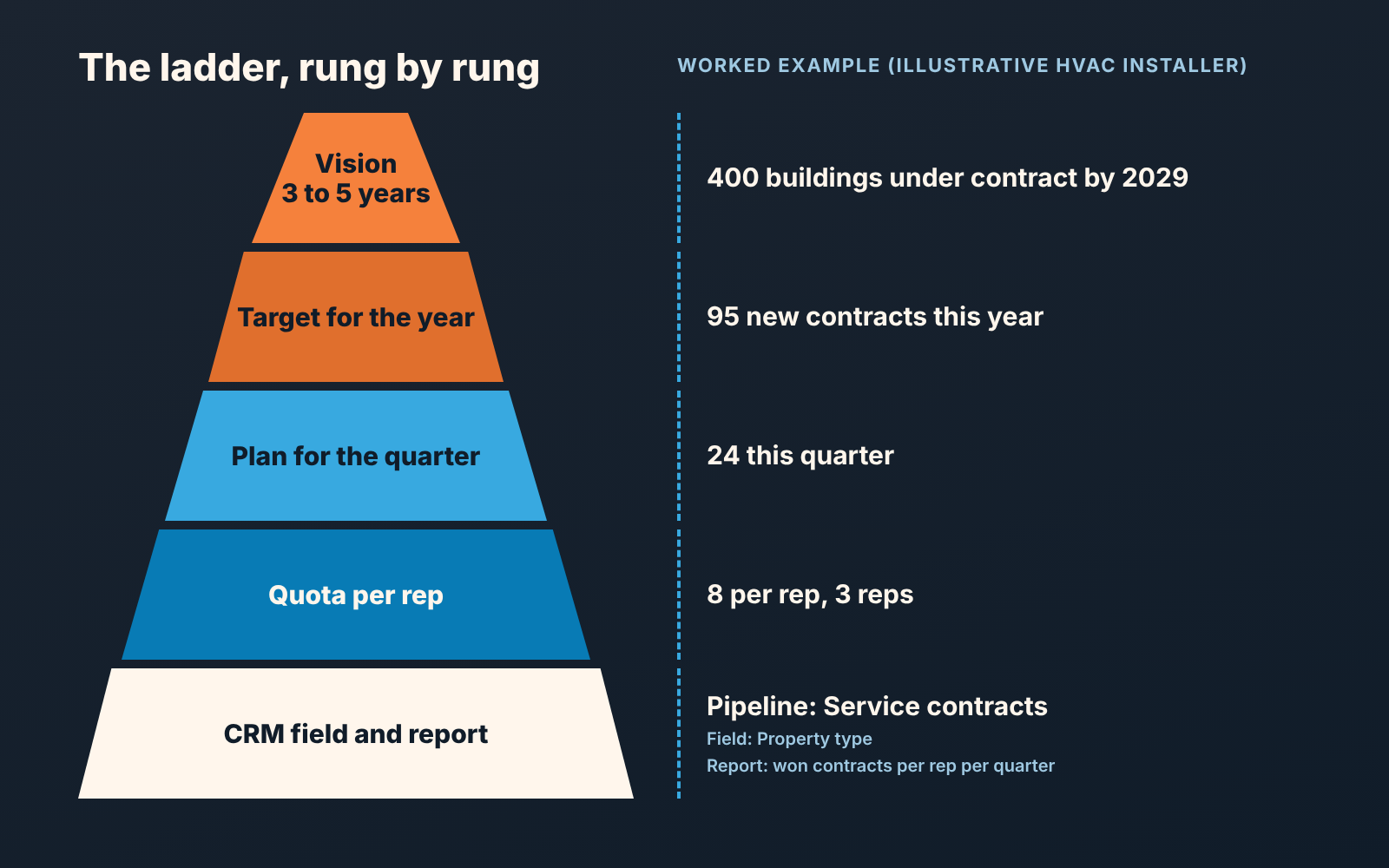
Rung one, the vision. Take the HVAC installer. 400 buildings under a service contract by 2029. Today, in this illustration, the company has 120.
Rung two, the target for the year. 280 contracts to add over three years is a little over 93 a year. Some buildings will leave, so the owner sets 95 new contracts for this year and writes the reason next to it. Now the target has a sentence behind it that any rep can read, and that sentence is the hard part of setting a sales quota in a small team. If you already run objectives this way, this is MBO with the vision as the top objective.
Rung three, the plan for the quarter. 95 a year is about 24 a quarter. The quarter also carries the decisions that have no number. Which segment gets priority (property managers), which leads go to the secondary pipeline (single homes), which marketing spend is allowed (county property management associations) and which is stopped.
Rung four, the quota per rep. Three reps, 24 contracts, eight each. If one rep also handles the secondary pipeline, give them six and move two to the others. Write the quota in the unit of the vision, contracts, and keep revenue as a second line. A rep who closes eight small contracts has done the job the vision asked for, even if a colleague’s two large one-off installs look bigger in the revenue column.
Rung five, the field and the report in the CRM. This is where most owners stop, and it is the step that makes the rest real. You need three settings in whatever CRM the team uses. A pipeline called Service contracts, separate from one-off installs. A required field on the organization or deal, Property type, with “Property manager” as one of the values, so the priority segment can be counted. One report: won deals in the Service contracts pipeline per rep per quarter, next to the quota of eight. In Pipedrive you can build this with goals and monthly targets, and other CRMs have their own version of the same chart.
Once the ladder exists, performance management in a small team gets simpler. The Monday conversation is about rung five, and everyone knows which rung it hangs from.
Rung five is also where the tool we build fits. SalesBond is a sales management layer on top of the CRM a team already uses. Its Sales Plan shows the target, current attainment, the forecast for the period and the gap between them, with the deals most connected to the plan listed underneath. Before you set rung two, it helps to know what the CRM actually holds, and SalesBond runs a free CRM audit for that. It looks at the last 30 days of your CRM and sends a PDF with money at risk, a CRM score, managers and deal health, the pipeline bottleneck and your top-10 clients. A second PDF follows a week later with what changed. For the HVAC owner, that audit is where the “120 buildings today” figure gets checked before it becomes the base of a three-year plan. Check your CRM with SalesBond.
Can your reps say it back?
Owners test this by asking “does everyone know the vision?” in a meeting. Everyone says yes. Use a harder test.
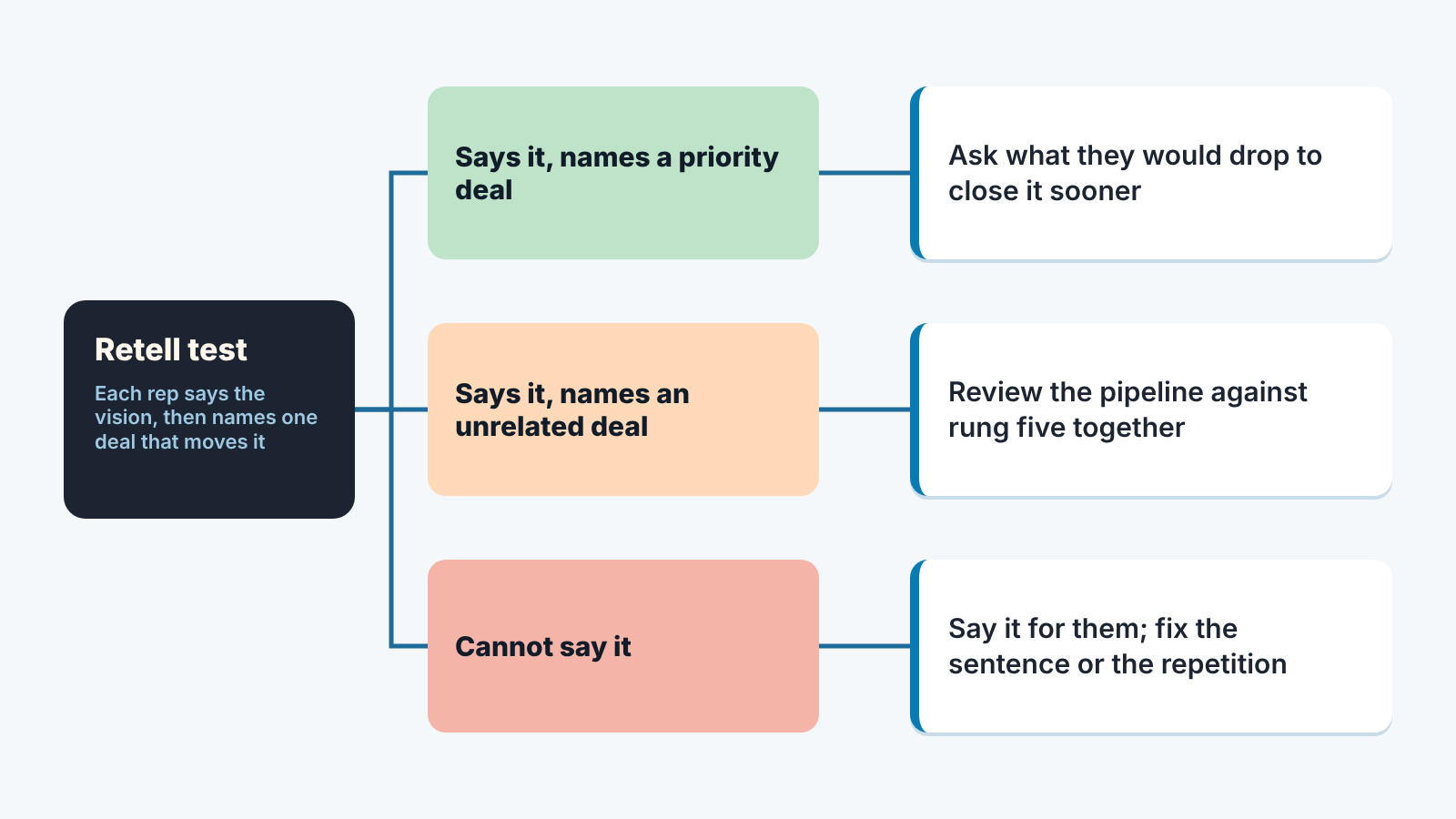
The retell test takes five minutes at the Monday meeting, once a month. Ask each rep, in turn, to say the vision in their own words and then name one deal in their pipeline that moves it. Three things can happen.
The rep says it close to word for word and names a deal in the priority segment. Good. Ask what they would drop from thier week to close that deal sooner.
The rep says it roughly right and names a deal that has nothing to do with it. This is the common case, and a useful one. The sentence has landed and the ladder is still missing. Go back to rung five and look at that rep’s pipeline together.
The rep cannot say it. Say it for them, without comment, and move on. If two reps cannot say it, the sentence is too long or you have said it twice in six months. Fix the sentence or say it more often.
A second check needs no meeting. Open the pipeline and count open deals in the priority segment against the total. In the HVAC example, if fewer than half of the open deals are tagged Property manager, the team is selling something other than what the vision describes. That count tells you the conversation is overdue, and the pipeline review is where it belongs.
Vision statement mistakes we see in small companies
The most common one is generic words. “To be the leading provider of innovative solutions” could hang in any office in the country. Run the swap test: if a competitor could pin the same sentence on their wall without changing a word, add the segment and the number until they couldn’t.
Next comes distance. A ten-year vision in a twelve-person company will outlive half the team and probably it’s main product. Stay with three to five years. If the big dream really is twenty years out, keep it in your head and give the team the first five.
Then the missing ladder. The vision is announced in January and the quotas are set in December from last year’s number plus ten percent. The reps notice the gap faster than the owner does, so build rungs two to five in the same week you finish the sentence.
A vision said once a year at the kick-off is forgotten by February. Put it at the top of the quarterly plan document, say it at the start of the monthly pipeline review, and run the retell test. In a team of twelve, the owner saying it again and again is how it spreads.
The last one is quieter. If the first reader you imagine is a bank or a web visitor, the sentence drifts toward impressive. Write it for the newest rep, the bank will read the same sentence and trust it more because it’s specific.
So put a date in the calendar now: the first Monday meeting of next month, retell test on the agenda. That leaves you a week to write the sentence and a week to build rungs two to five in the CRM. If on the day the reps can say the vision but can’t point to a deal that moves it, start the fix at rung five.