
Management by objectives (MBO) is a way of managing where a manager and an employee agree on a few specific goals, track progress against them, and review the result at a set date, usually with evaluation and pay tied to it. In sales it works when every objective can be read from the CRM instead of from memory. An objective is ready for MBO once you can point at the report that shows whether it was met.
What does MBO stand for?
MBO stands for management by objectives. The term goes back to Peter Drucker, who used it in his 1954 book The Practice of Management (Wikipedia: Management by objectives). The working version hasn’t changed much since: define objectives, outline the plan to reach them, then review and evaluate the result. The point is better motivation and a better conversation between employee and manager, because both sides agreed on the target in advance (Mailchimp: Management by objectives).
Two things in that description matter more than the acronym. The objectives are agreed between both sides, so an MBO objective is written in a meeting where the rep can say “that number is not possible from my territory” and be heard. And the review at the end has consequences, because the objective feeds the appraisal and usually the bonus. That second part is what separates MBO from the softer goal frameworks.
Is it slow? Yes. Writing goals together and talking about them regularly takes meetings that compete with everything else a manager does (Mailchimp). For a sales team we think the trade is worth it. The alternative is finding out in week eleven that a rep has been working the wrong deals since week one.
The five MBO steps, applied to a sales team
The classic sequence has five steps: organizational goals, individual objectives, an action plan, monitoring, then evaluation and reward (Mailchimp). Here is each one when the employee sells and the record of their work lives in a CRM.
- Start from the company number. The owner writes down what the business needs from sales this year: new revenue, maybe a product mix, maybe a margin floor. If that already sits in a one-page sales plan, use it as is (a one-page sales plan built from CRM numbers).
- Translate it into objectives per rep, in a meeting with the rep. Three or four at most. Each one names the CRM report or filter that will measure it, and if the rep cannot open that report themselves, the objective is not ready.
- Write the action plan under each objective. For revenue the plan is pipeline math: how many qualified deals need to enter each month at the rep’s current win rate. For behavior it is a habit, like “every open deal has a next activity scheduled before I close the CRM for the day.”
- Monitor on a fixed rhythm. Rep and manager look at the same CRM views every month, and nothing is recalculated by hand.
- Review at the end of the period and connect the result to evaluation and pay. This part is short because the evidence was visible all along; the discussion is about the why and about next period’s objectives.
Teams that skip step one write objectives that add up to less than the company needs. Teams that skip step four turn the review into an argument about whose spreadsheet is right.
MBO goals for one rep: three examples and where each lives in the CRM
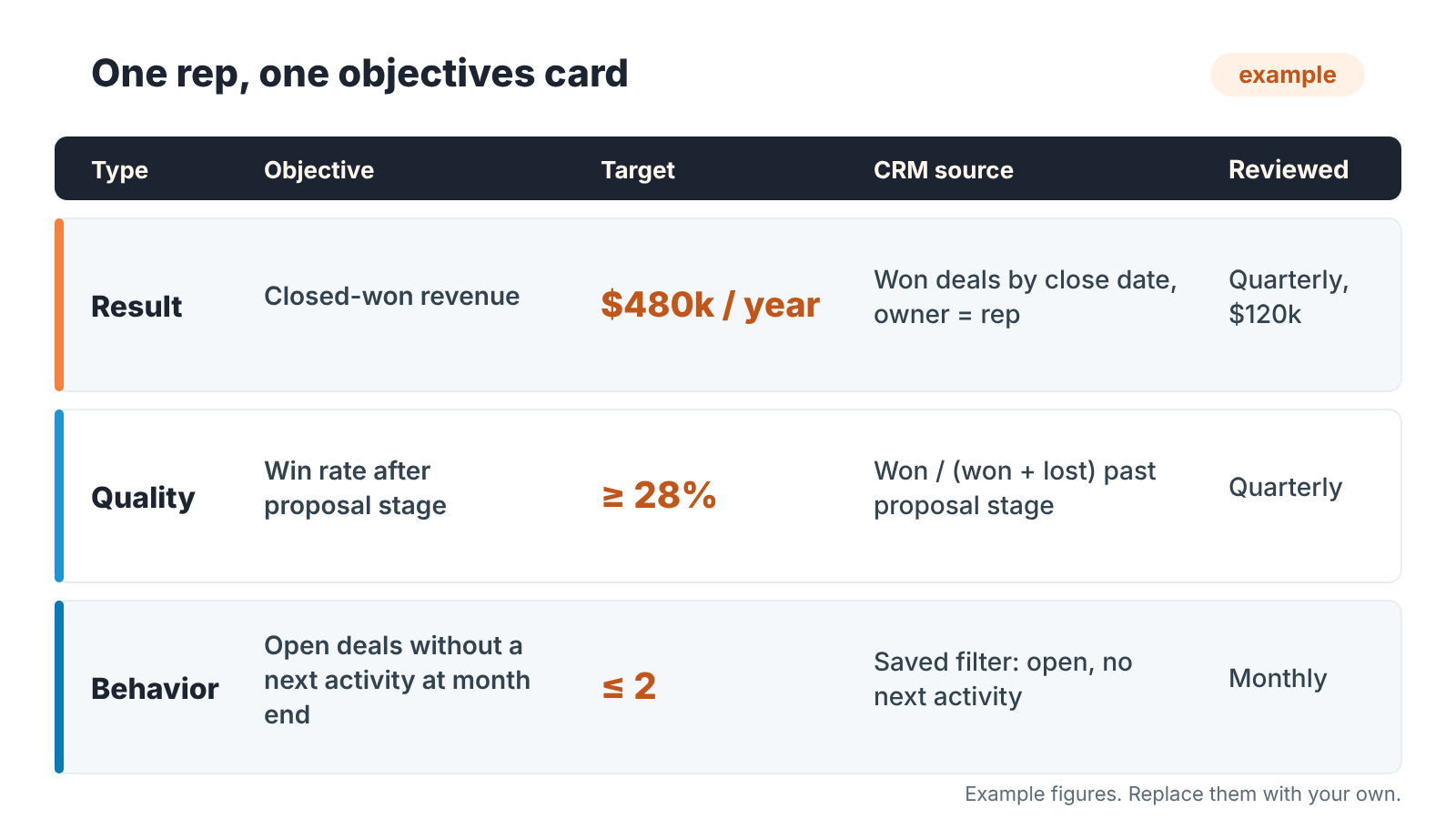
Most MBO guides stop at “employee” and “goal”. Here is the sales version. Our position: a rep’s objectives card should carry one result objective, one quality objective and one behavior objective, each with a CRM source written next to it. One number alone pushes reps to drag deals into the last week of the period. Three numbers of different kinds keep the pressure honest. The figures below are illustrative, so replace them with your own.
Result objective: closed-won revenue. Example: $480,000 closed-won in the year, reviewed quarterly at $120,000. Source: deals in the won stage with a close date inside the period, owned by the rep. It is the easiest of the three to build. The one decision is whether to count by close date or by won date, and you make it once (quota vs target vs goal vs forecast, and why the words matter).
Quality objective: win rate or deal margin. Example: win rate of at least 28% on deals that reached the proposal stage, or average discount no deeper than 10%. Source: won deals divided by won plus lost deals that passed the proposal stage, filtered by owner and period. Win rate suits a rep who closes small deals fast, margin suits one who controls price (how to read win rate in your pipeline shows the mechanics in Pipedrive; the logic is the same in any CRM).
Behavior objective: a next step on every open deal. Example: at the end of each month, no more than two open deals without a scheduled next activity. Source: a saved filter “open deals, owner = rep, no next activity.” Reps like this one least and managers value it most, because it predicts the revenue objective months ahead.
A fourth, development objective is fine (learn a new product line, run ten discovery calls with a senior rep listening) as long as it also has a measurable source, even a shared sheet.
MBO vs OKRs: which one carries the bonus
MBO carries the bonus and OKRs usually don’t, and that difference decides almost everything else.
An MBO objective is agreed between the manager and the rep, it feeds the appraisal, and an MBO bonus is paid on it. So a good MBO objective is one the rep can fully meet with solid work. OKRs are usually set by the team, sit outside the appraisal and are meant to stretch; hitting most of a key result counts as a good quarter. Put an OKR into a bonus plan and people quietly start writing safe ones, which defeats the purpose. We covered the OKR side for sales teams separately (OKRs for a sales team, with key results pulled from CRM data).
Quota sits closer to MBO than to OKRs, since both are commitments with pay attached. The difference is how they arrive. A quota is one number handed down; an MBO card is negotiated and carries more than one dimension, so the rep is paid for how the revenue was built as well as for the total.
For a small sales team our recommendation is MBO for the reps and, if the owner likes the format, OKRs at company level. Reps need to know what they are paid for. The company can afford one or two ambitious goals it might miss.
Quarterly reviews without moving the goalposts
Monthly monitoring is a glance. Once a quarter you sit down properly, and the meeting needs a fixed shape or it drifts into a pipeline review.
Before it, the rep opens the three CRM views from the objectives card and writes one line under each: on track, behind or ahead, with the number. The manager does the same without looking at the rep’s version. Where the two lines disagree, that is the agenda. Then three questions, in order: where are we against each objective, what in the action plan did or did not happen, and does any objective need to change for the rest of the year?
That last question is where MBO gets abused. An objective can be revised when the facts changed: a key account was lost to an acquisition, a product launch slipped. It is not revised because the rep is behind. If the number moves every time it gets hard, the bonus attached to it means nothing, and the rep knows it.
Write the outcome in two dated lines on the objectives sheet. At year end, those eight lines are the appraisal.
Where it goes wrong
Done properly, MBO tells the rep exactly what they are paid for and starts every one-to-one from numbers both people can see, which a quota alone doesn’t do. The failures we have watched in small teams come in three repeating shapes. None of them is the method’s fault.
The one-number card. Revenue is the only objective, so the rep’s rational move is to pull every closeable deal into the last two weeks of the quarter and let the pipeline behind it go quiet. The owner sees a spike, then a hole. The quality and behavior objectives from the card above fix this, because they change what the rep does in week three rather than week thirteen.
Goals nobody can see. The objectives are agreed in January, written in a document and opened again in December. In between the rep works from the pipeline, the manager works from the forecast, and neither mentions the objectives. The fix is step four: the CRM views that measure each objective are saved, named after the objective and looked at monthly. If your CRM has a goals feature, use it for the result objective, since it puts the number next to the pipeline where the rep already looks (goals in HubSpot, goals in Pipedrive).
Pay tied to a metric the rep cannot influence. Company margin, churn after handover, marketing-sourced pipeline volume. The rep can see the number and cannot move it, so the objective turns into a lottery ticket. Every objective should pass one test: can this rep, by changing their own behavior next week, move this number by quarter end? If not, it belongs on the manager’s card. The same test applies when you design the the bonus itself (a sales incentive plan for a small team).
A disclosure, since we are at the “goals nobody can see” problem: we build SalesBond, a sales management layer on top of the CRM a team already uses; we started with Pipedrive. Its Deal Health module checks every deal in the connected CRM against more than 20 rules, activity and progression among them, and shows the manager which deals break them, so the behavior objective does not depend on a filter someone has to remember to open. It does not write your objectives for you. That conversation still happens in a room. Check your CRM with SalesBond if you want to see it on your own data.
A one-page objectives sheet
Everything above fits on one page per rep, and it should, because a page is what a manager can keep open during a one-to-one.
At the top goes the rep’s name, the period and the company objective in one line, so the rep can see what their card contributes to. Below that, the three or four objectives as rows: the objective in plain words, the target, the CRM report or filter that measures it, and who owns the measurement (almost always the rep). Under the rows, a few lines of action plan per objective. At the bottom, four empty boxes for the quarterly checks: the number, one sentence, a date.
Leave weights and scoring formulas off the sheet. If the bonus plan needs weights keep them there and reference the sheet. Mixing the two makes reps negotiate weights instead of talking about deals.
Your next step is small: before the next one-to-one, open your CRM and try to build the three views for one rep. Whichever one you cannot build is the objective that isn’t ready yet.