
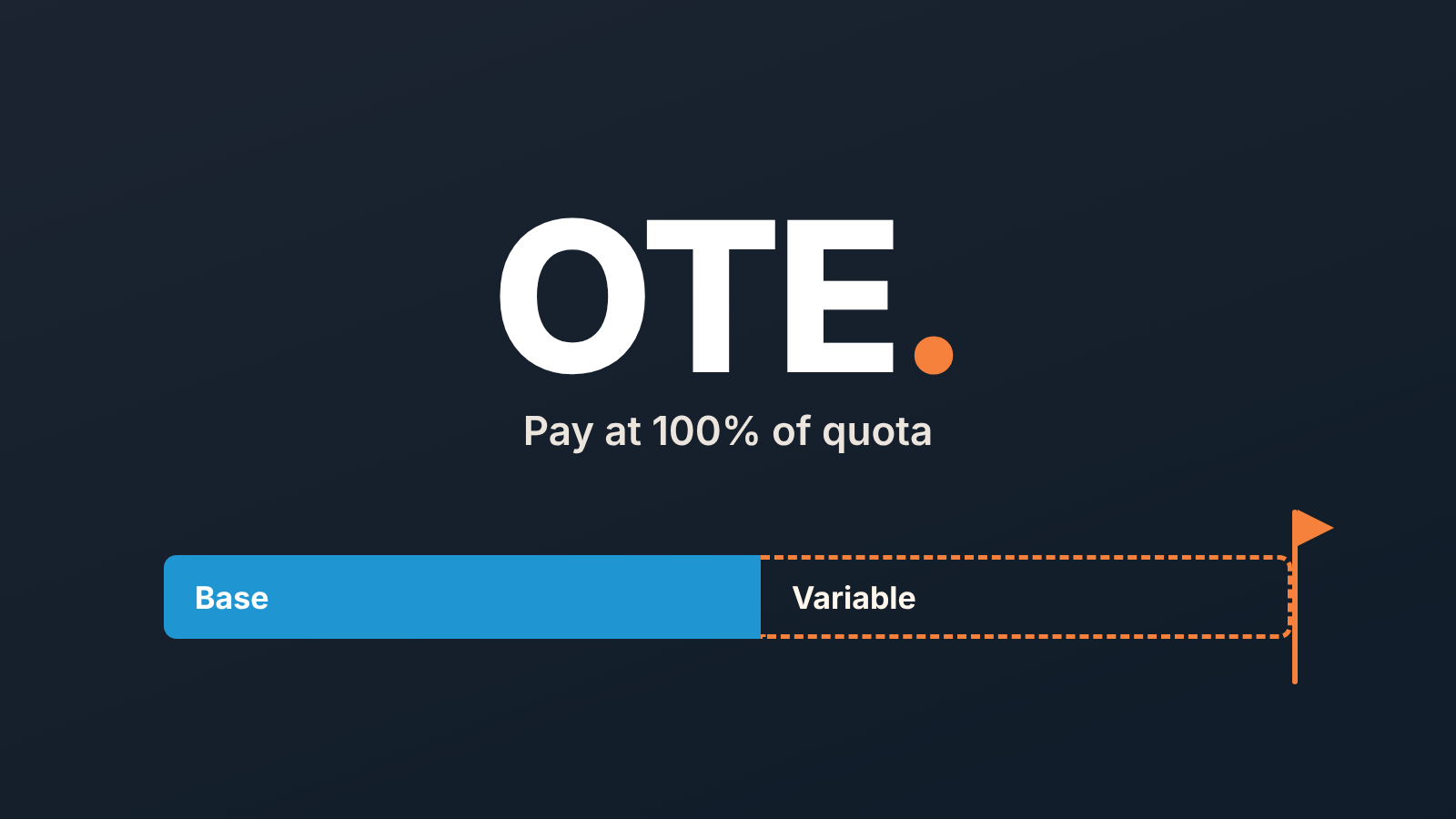
On-target earnings (OTE) is what a sales rep earns in total when they hit 100% of quota: fixed base salary plus the variable pay (commission or bonus) at target. It is not a guaranteed salary and not a cap, so the number makes sense only next to a quota the rep can actually reach with your average deal size, win rate and sales cycle.
Most OTE guides are written for the candidate reading a job ad. This one is for the owner writing it, because the mistake we see most often is an OTE decided before anyone opened the CRM.
What on-target earnings means (and what it does not)
When a job ad says “OTE salary” or someone asks for the OTE meaning, the answer is the same: pay at an agreed performance target. The fixed part is paid regardless; the variable part depends on the plan’s rules and the rep’s results (Jobstreet: understanding on-target earnings).
What OTE does not tell you is whether the target behind it is real. We read it as a promise about a quota. That is why this article spends most of its length on the quota.
The OTE formula: base + variable at 100% of quota
The formula itself is one line: OTE = base salary + variable pay at 100% of quota (Jobstreet). Base arrives every month whether the rep closes or not. Variable is commission, bonus or both, counted at exactly target attainment, no more.
Two details matter when you write this down for a small team.
Thresholds, accelerators and caps change what the rep takes home at 70% or 130%, but they do not change OTE. If you catch yourself nudging OTE up because “they’ll probably overshoot”, you are hiding a quota problem inside a pay number.
And watch the periods. OTE is usually quoted per year, quota is often set per month or quarter. Compare a yearly OTE with a quarterly quota and you get a ratio that looks fine and is off by four.
All the dollar figures below are illustrative. They show the arithmetic only. What a rep should earn depends on your market.
Pay mix: how much is fixed and how much is at risk
Pay mix is the ratio of base to variable that adds up to OTE, and a frequently cited “good” mix is 50/50 (Kennect: the OTE model). So a “$120,000 OTE” at 50/50 reads as $60,000 base plus $60,000 of variable pay that arrives only if the rep hits 100% of quota.
Which split fits which seat depends mostly on how much of the close the rep controls and how long your cycle is; we went through that choice in OTE for your first sales hire. For this article the mix matters for one reason. It sets the fixed cost you carry in a quarter when nothing closes, and that is worth looking at before you look at the upside. How the variable part is paid out (percentage of deal value, tiers, a bonus on quota) is a separate decision, covered in commission structures for a small team.
OTE vs quota: what each deal has to carry
Divide OTE by quota and you get the most useful number in this whole exercise: how much of every dollar of quota revenue goes to the rep’s total pay.
Illustrative: a $100,000 OTE on an $800,000 annual quota is 0.125. Twelve and a half cents of each quota dollar pays the rep, before payroll tax, tools and the manager’s time. Whether that is fine depends on your gross margin and what else the dollar has to cover. A software company at high gross margin can live with it. A reseller on thin margin cannot, and no amount of plan design changes the arithmetic.
Now run it per deal. Same example, average won deal of $16,000: the quota is 50 deals a year, so each won deal carries $2,000 of the rep’s OTE ($100,000 ÷ 50). Put that next to your margin per deal. If a $16,000 deal leaves you $5,000 after cost of delivery, the rep takes 40% of what you keep. Owners who see that for the first time usually raise the quota or raise the average deal. Either works, as long as one of them happens before the OTE goes into an offer.
Direction matters here too. Most teams start from “what does a rep cost in our city” and back into a quota that makes the OTE look affordable. We think it should run the other way: start from the deal, work out what you can pay per won deal, multiply by the deals a rep can realistically close, and see what OTE falls out. If that OTE is below what it takes to hire anyone, you have learned something about your pricing before hiring instead of after. Setting the quota this calculation starts from is its own job, covered in how to set sales quotas, and if quota, target and forecast are getting mixed up in your planning doc, this piece sorts them out.
Check if the quota is reachable: three numbers from your CRM
OTE is honest only if 100% of quota is a result your team has produced before, or one the pipeline can plausibly produce. Three CRM numbers tell you which. Pull them for the last twelve months, for the role you are planning for, not for a team average that includes the founder’s deals.
- Average won deal value. In Pipedrive that’s the deal value on deals marked won; in HubSpot, the Amount property on deals in the Closed Won stage. Look at the median as well as the mean if one or two outliers dominate.
- Win rate from the stage where a deal becomes real, not from first contact: won deals divided by deals that reached a qualified stage. Pipedrive’s Insights deal conversion report and a deals funnel report in HubSpot will show it, as long as your stages have been used consistently, which is a bigger “if” than most teams admit.
- Sales cycle from that qualified stage to won. In Pipedrive, the won time minus the date the deal entered the stage.
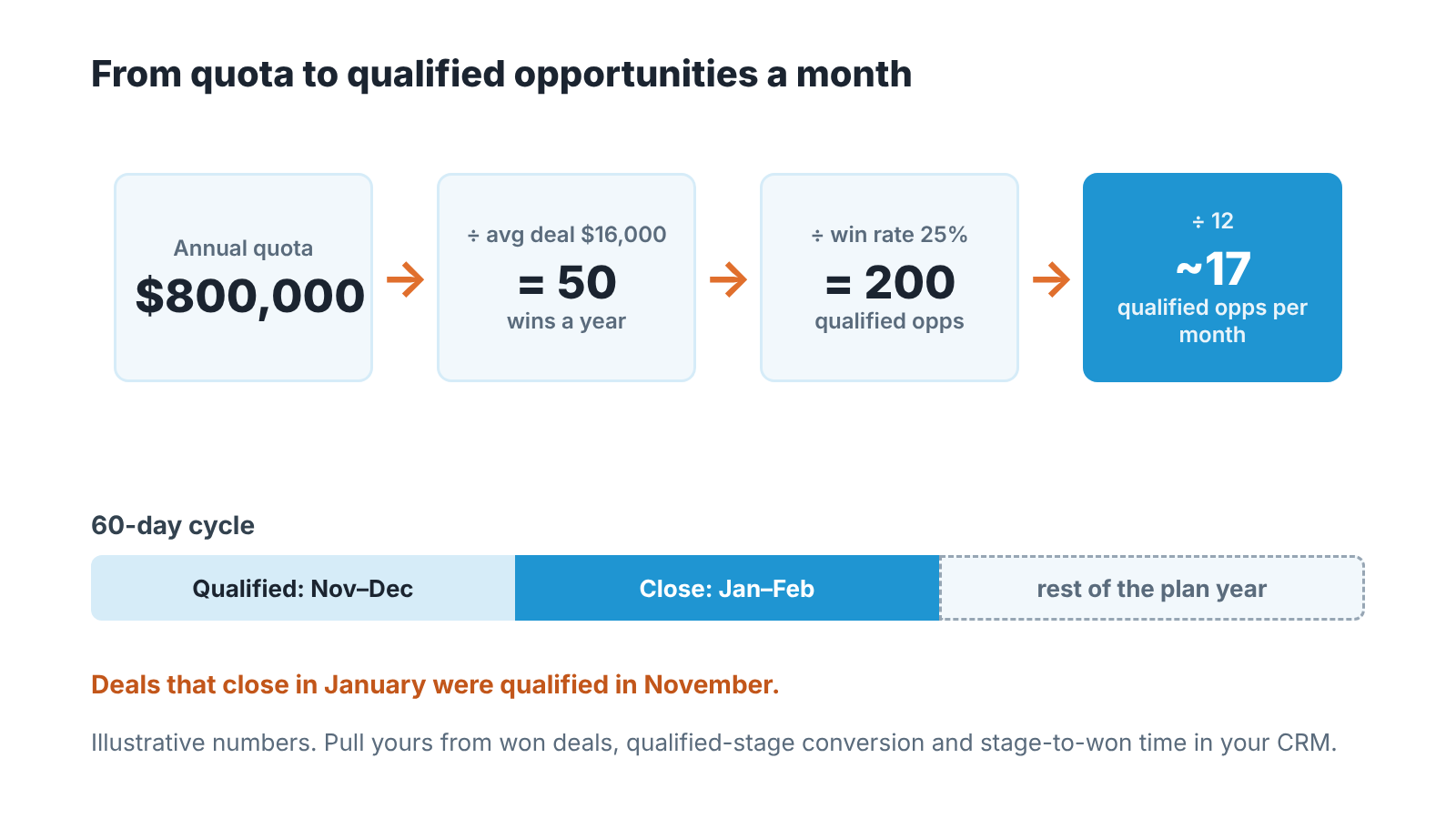
Then run the arithmetic backwards from quota. Illustrative again: $800,000 at a $16,000 average deal is 50 wins a year. At a 25% win rate from qualified, that is 200 qualified opportunities a year, roughly 17 a month, every month. With a 60-day cycle, the deals that close in January were qualified in November, so the first two months of the plan year are paid for by last year’s pipeline.
Now the only question that matters. Did this role actually produce 17 qualified opportunities a month last year?
If the CRM says 9, the quota is not reachable at the current win rate and deal size, and nobody will earn the OTE built on it. You then have three honest levers: a lower quota with a lower OTE, a higher win rate you can show a plan for, or a bigger average deal.
A disclosure, since this is the point where a tool comes up. We build SalesBond, a sales management layer on top of the CRM a team already uses; we started with Pipedrive. It monitors the health of deals and customers, explains the risks, and gives managers and owners a clear picture of execution, forecast and plan, so the check above becomes a habit instead of a once-a-year spreadsheet. The three numbers are in your CRM either way. Check your CRM with SalesBond if you would rather not pull them by hand.
For a new hire the twelve-month history does not exist and the quota has to ramp. How we stage that is in ramping a new rep in Pipedrive; HubSpot teams tracking per-rep targets can start from HubSpot goals for rep targets.
Three ways an honest OTE goes wrong
The first is reading OTE as fixed pay, from either side of the table. The candidate hears a salary and feels cheated at 80% attainment. The owner budgets the base and quietly treats the variable as money they will probably not have to pay. The plan should say in writing what is paid at threshold, at target and above, and when; Jobstreet lists the things to check, from commission timing to caps, accelerators and refunds.
The second is leaving cap, accelerator and clawback undecided until a big quarter forces the question. Settle them before the deal lands; the commission calculator with closed-won CRM examples shows how those rules move the cheque.
The third is the one this article is really about: setting the quota before the data. The hiring timeline is short and the CRM report takes an afternoon, so the quota comes from the revenue plan (“we need $2.4M, three reps, $800k each”), the OTE comes from the market, and nobody checks whether $800k is something a rep in this pipeline has ever done. Six months later the owner is explaining to a good rep why they are at 55%, and the rep is updating thier LinkedIn. Build the quota from last year’s won deals, win rate and cycle, and only then attach an OTE to it.
Before the offer letter goes out
Put the numbers on one page and read them as a story. OTE divided by quota tells you what share of each revenue dollar goes to the rep. OTE per won deal, set next to your margin per deal, tells you whether the business can afford a rep who hits target. And the qualified opportunities a month the quota needs, set next to what this role produced last year, tells you whether target is a place anyone has been. If those three hold up, you can defend the OTE to a candidate and to yourself. If one of them is a guess, the OTE isn’t the the problem yet, because the quota behind it hasn’t been set. Once it has, the next step is turning the variable part into a plan the team understands, which we covered in a sales incentive plan for a small team.