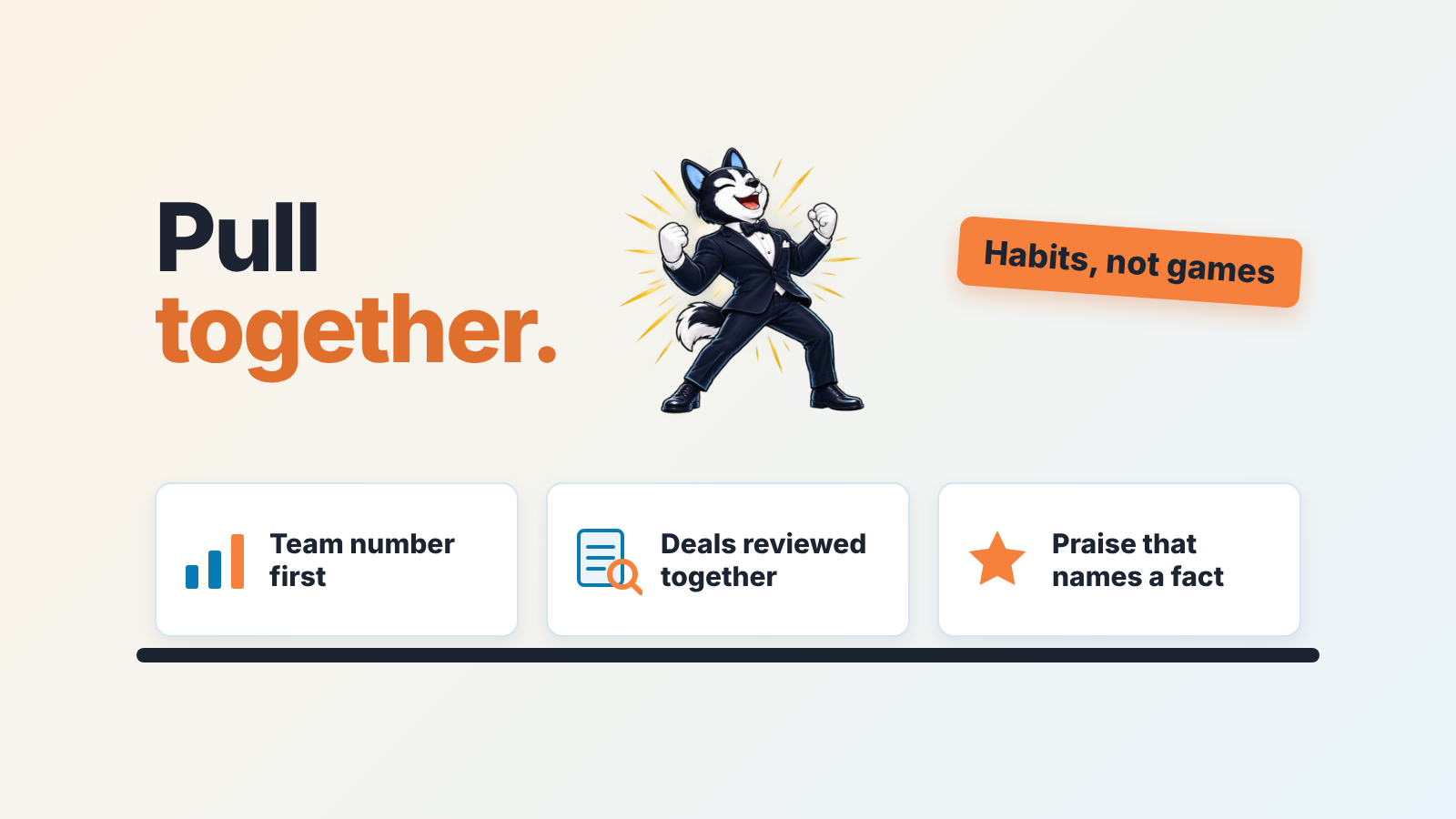
Team building is the set of things a manager does to turn a group of people into a team: one goal they share, trust in each other, and roles everyone understands. In a sales team the strategies that work run on the work itself, with a transparent target, deals reviewed together instead of alone, and recognition that points at something visible in the CRM, and a yearly offsite can sit on top of those habits.
This guide is for owners and sales managers of small businesses, the kind with three to ten reps and no HR department. If you came for ideas you can run this week, skip to sales team building activities by time and budget. The examples use Pipedrive, because that is where we started; the same ideas work in HubSpot, Salesforce and Zoho CRM under slightly different names.
What team building is (and is not)
Search “team building” and you get lists of games: 18 activities for small groups, 35 you can do in under 30 minutes, 13 ideas for company events. We read a stack of them while preparing this piece. They are fine for what they are. The problem is that they answer “what do we do on Friday afternoon”, and the owner’s real question is “why do my reps act like five separate businesses”.
So what are team building activities actually for? To make people more willing to help each other with real work than they were before. Everything else, the fun included, is a means to that. In a working sales team that means a goal the whole team owns on top of individual quotas, and enough trust that a rep will say “I’m stuck on this deal” out loud. A once-a-year event, a motivational speaker, a Slack channel for memes or a leaderboard can be part of the picture without doing that job alone.
More Business, writing for small business owners, puts the frequency question plainly: “Extensive team building doesn’t have to be something you do for your staff every week or even every month” (More Business: Team Building for Small Business Owners). We agree with the spirit and would sharpen it. The big event can be rare. The small habits have to be weekly, or the team forgets it is a team between events.
Sales team building activities by time and budget
Xero’s small business guide says what we would say to any owner who thinks team building means a budget line: “Team building doesn’t require a large budget or days away from the business” (Xero: Build a team). Below is what we have seen work in sales teams specifically, grouped by how much time you have. Everything here touches the actual work.
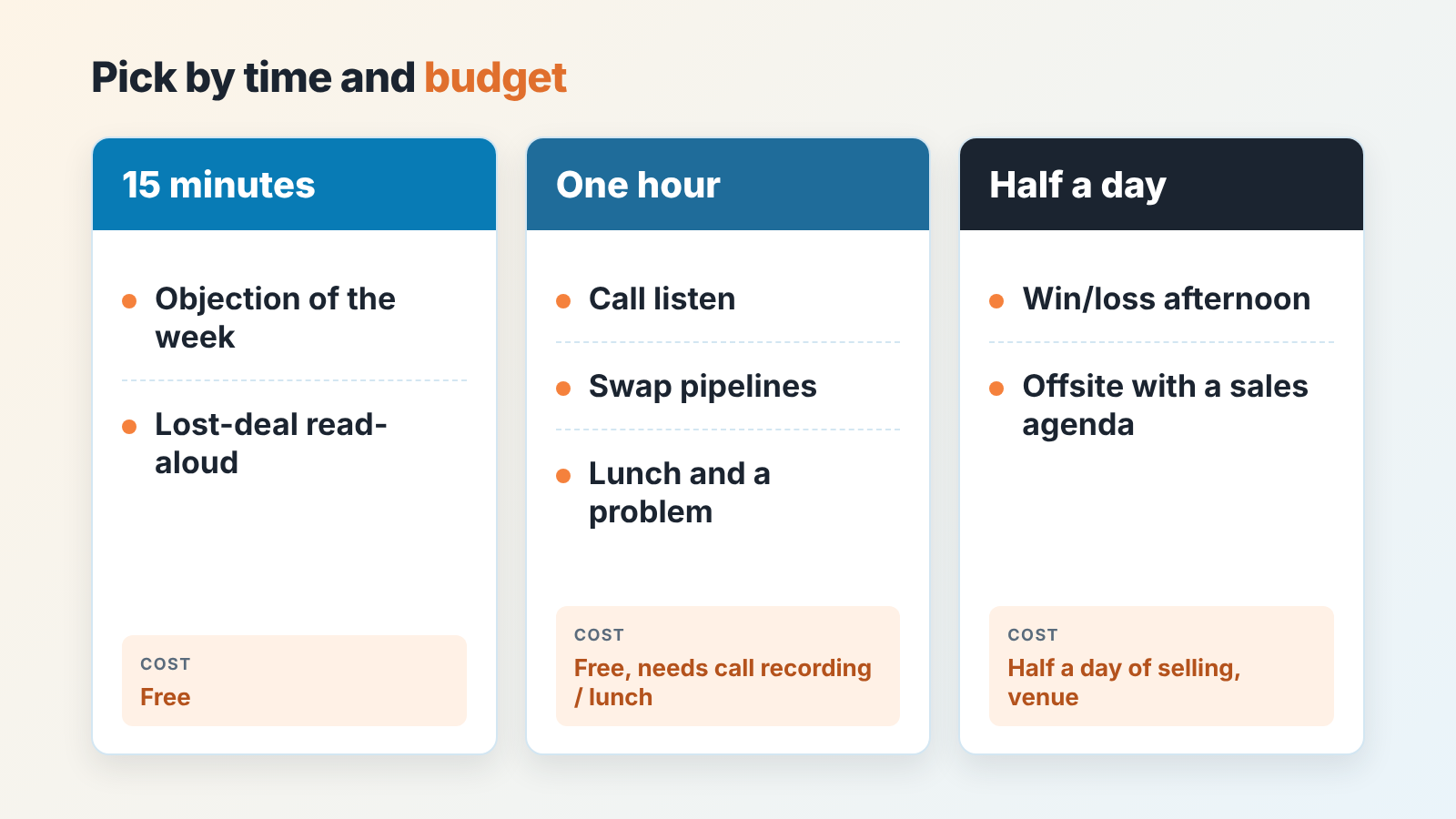
15 minutes
- Objection of the week. One rep brings the objection that beat them this week. The room gets five minutes to write their best answer, then everyone compares. What it builds is a shared playbook, and the sense that losing is something you can talk about.
- Lost-deal read-aloud. The manager reads one lost deal’s notes and lost reason with the name withheld and asks “what would we do differently?” Over time this is what makes lost reasons honest, and it takes the blame out of the room.
Neither costs anything except the quarter hour.
One hour
- Call listen. One recorded call, played with pauses. The rep on the call picks the segments, and everyone names one thing that worked before anything that did not. You get a coaching culture without hiring a coach, as long as you record calls.
- Swap pipelines. Each rep reviews a colleague’s open deals for thirty minutes and writes three questions per deal. Then they talk. A second pair of eyes finds the deals that went stale while nobody was looking.
- Lunch and a problem. Entrepreneur’s advice on group learning sessions works for sales too: one founder hosts them “over lunch because no one ever seems to say no to a free sandwich” (Entrepreneur: 4 Easy Ways to Build a Team-First Culture). Bring one process problem, like handoffs or lead routing, and leave with a fix the team owns.
Half a day
- Win/loss afternoon. Pull the quarter’s won and lost deals, split the team into pairs, and give each pair a segment to present. We described the method in win/loss analysis for a small team. The result is a shared picture of why you win.
- Offsite with a sales agenda. Entrepreneur’s point that “Breaking away from the office often results in breakthrough thinking” holds. Set the agenda as next quarter’s plan and the three biggest deals, and keep the social part to the evening. People follow a plan they helped write.
Both half-day items cost half a day of selling, and in a small team that is a visible number. Do them once a quarter, not once a month, and not when the pipeline is at it’s busiest.
Pick two of the short ones and run them for a month before adding anything. A team that runs “objection of the week” every Tuesday for eight weeks has changed more than a team that did one great offsite.
Why a sales team is a harder room than most
Most team-building advice assumes people already want to cooperate and just need a reason to talk. Sales is different in three ways, and an activity that ignores them makes things worse.
Individual quota. Each rep has their own number, and their manager asks about it every week. Nobody asks about the team’s number with the same intensity, so nobody feels it.
Commission. When pay depends on your own closed deals, helping a colleague with their deal is time taken from your own pipeline. A rep who shares a good discovery script is, in the narrow accounting of the month, giving away money. People notice that even if they would never say it.
Rivalry built into the tools. A leaderboard in Pipedrive or a wall-mounted dashboard ranks people by closed revenue. Rankings are useful for some things (we wrote about when a leaderboard helps a small team and when it does not). Even so, a ranking by its nature says “you are competing with the person next to you”.
None of this means a sales team cannot be a team. It means the manager has to build the cooperative part on purpose, because the compensation plan is quietly building the opposite. Every habit and activity in this piece is chosen with that in mind: it either creates a shared number, or it makes helping a colleague visible and rewarded.
Habits that do more than any event
Patriot Software’s advice for small business leaders starts with the leader: “A high-functioning team starts with the actions of its leaders,” and holding regular meetings is on their list of seven ways to build teamwork (Patriot Software: 7 Ways Small Business Leaders Can Foster Teamwork). That is the right starting point. Here is what it looks like in a sales team. (If you are setting up the meeting rhythm itself, we covered that separately in sales meeting cadence for a small team.)
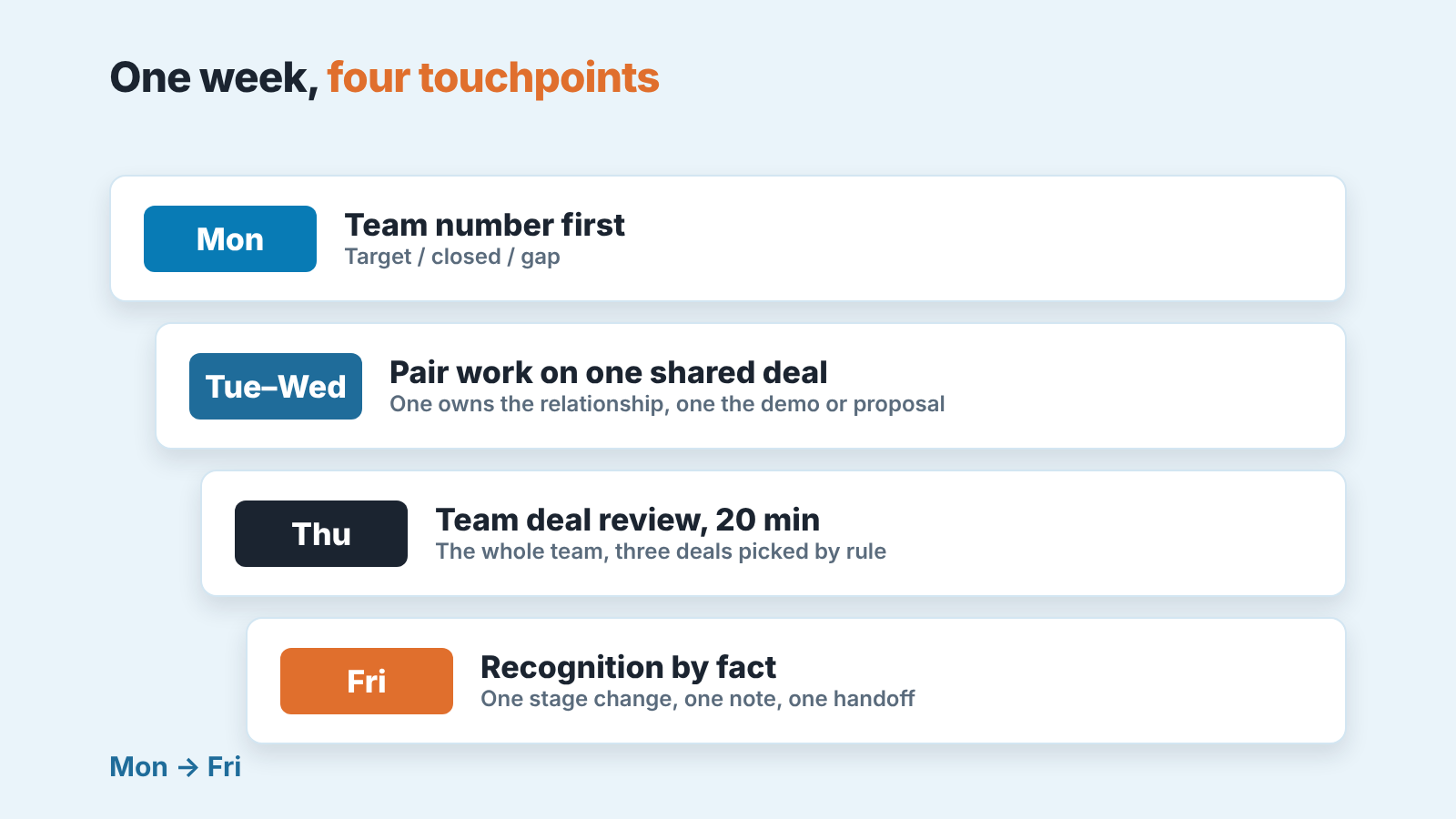
A team number that is talked about first. On Monday, before anyone’s individual pipeline, put the team’s month on the screen: target, closed so far, gap. In Pipedrive this can be a goal on won deals assigned to the whole team rather than to one user. The order matters, because a team number shown after everyone’s own pipeline gets skimmed.
One shared deal per week. Pick one live deal, not the biggest, and the owner walks the team through it for ten minutes: who the buyer is, where it is stuck, what the next step is. Then the room suggests things. The owner of the deal decides which suggestions to use, and nobody scores them. After four or five weeks reps start bringing deals they are genuinely stuck on, because they have seen it costs them nothing.
Recognition works the same way, if it names a fact. “Great job this week, Sam” means nothing after the third time. Compare it with an example like this one: “Sam moved the Hadley deal from proposal to negotiation after it sat for six weeks, and the note says how.” People remember that, and it teaches the rest of the room something. The source of those facts is the CRM: stage changes, activities logged, notes written. More Business says it simply: “If your team accomplishes a goal, take the time and effort to celebrate” (More Business). We would add: celebrate the specific thing, and say where you saw it.
Pairing on deals. Two reps on one deal, with a clear split: one owns the relationship, the other does the technical demo or the proposal. Agree the commission split up front, in writing, even if it is informal (how small teams structure commission has the options). In our experience, pairing does more than anything else here to turn competitors into colleagues, and it is the habit managers skip because of the commission conversation. Have the conversation.
Use the deal data: team deal reviews and shared wins
The CRM is the one place where everyone’s work is visible in the same format. That makes it the best raw material for team building in sales.
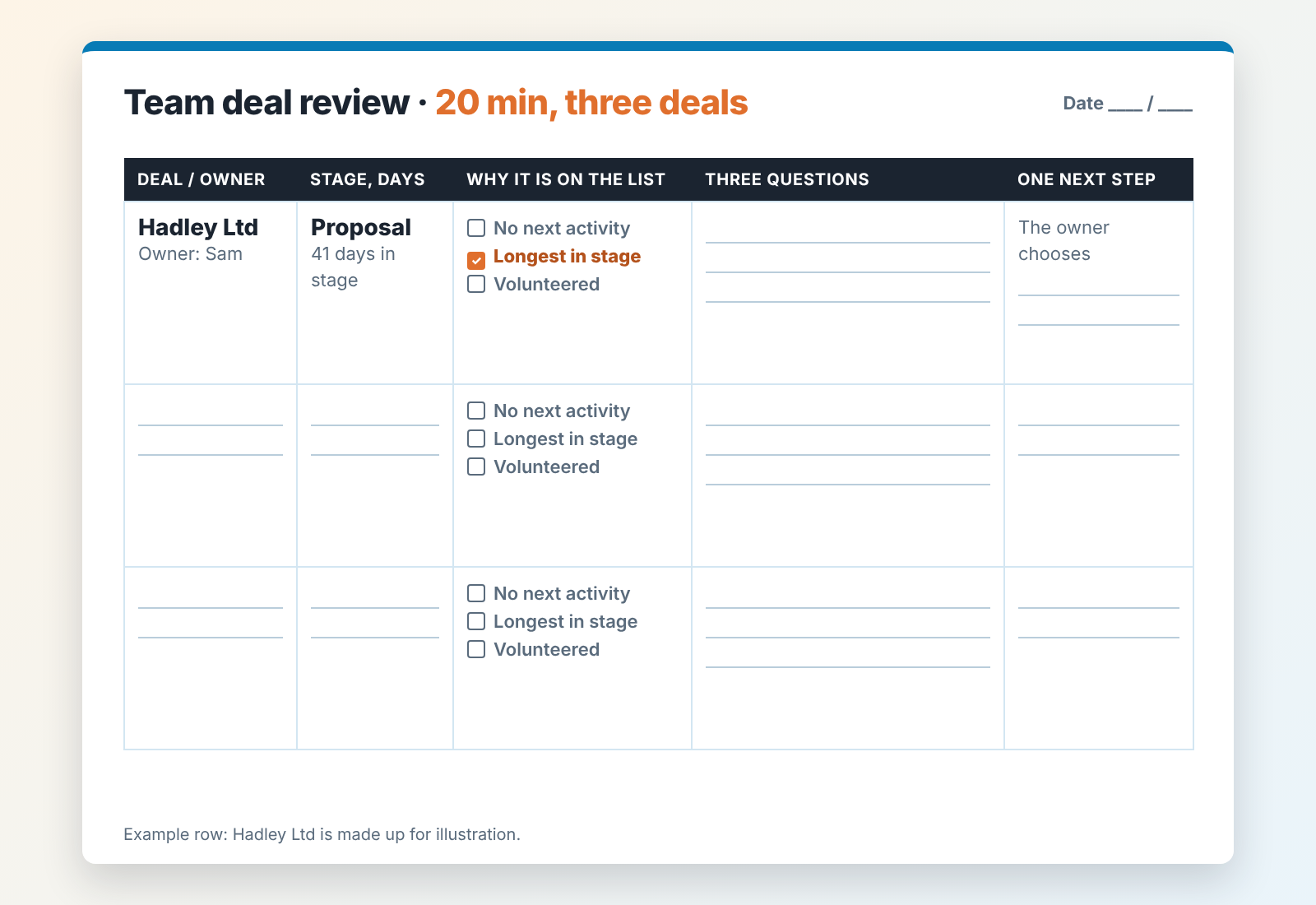
The team deal review. It is different from the pipeline review a manager runs with one rep. Once a week, twenty minutes, the whole team, three deals. The three are picked by rule: the biggest deal with no activity scheduled, the deal that has sat in one stage the longest, and one deal a rep volunteers. The rule matters because it removes the feeling of being singled out. Two saved filters in the CRM can do the picking. The manager’s job in the review is to ask questions; the weekly checks we describe in managing sales managers through the pipeline work the same way.
Shared wins with the mechanism attached. When a deal closes, the Slack message or the Monday mention should include one line about how: which objection was handled, which stakeholder was added, what the rep did differently from last time. That line is what makes the win useful to everyone else. Without it the message only adds a number next to a name.
Lost deals as a team problem. When one rep loses a deal, it is their deal. When the team looks at twenty lost deals and sees the same reason eight times, it is the team’s problem, and fixing it is team work by definition. The lost reason field has to be honest for this to work, and the read-aloud above is how it gets honest. For the method, see root cause analysis of lost deals.
This is the part of the article where the tool we build fits, so a disclosure. We build SalesBond, a sales management layer on top of the CRM a team already uses; we started with Pipedrive. Its Sales Dashboard puts plan, forecast and revenue at risk on one tab (Business Impact) and per-rep execution on another (Team Performance), which covers most of the Monday “team number first” screen without building filters yourself. And if you want to see what your CRM says about the team before you change any habits, the free CRM audit looks at the last 30 days and sends a PDF report: deal health, the pipeline bottleneck, how each manager’s deals look, what to fix first. A second PDF a week later shows what changed. Check your CRM with SalesBond. It gives you honest material for the first few deal reviews.
What to avoid: forced fun and rankings that humiliate
Some things done in the name of team building reliably do the opposite in a sales team. We have run or watched all of these.
Mandatory fun on personal time. A Friday 6 pm bowling night is an unpaid hour for the rep with a family and an awkward one for the rep who does not drink. If it is team building, it happens on work time. If people want to go out after, they will, and it will be better because nobody was told to.
The ranking that goes beyond closed revenue. Ranking reps by revenue is at least a number they chose to chase. Ranking by activities logged, calls made or “CRM hygiene score” in front of the room turns the CRM into a surveillance tool, and the first casualty is honest data. Reps start logging activities to climb the board instead of to remember what happened. If you want adoption, do it the way we describe in CRM adoption for a small team: make the CRM useful to the rep first.
Public pipeline reviews that are really performance reviews. If the weekly team meeting is where the manager goes through each rep’s deals and asks why they are not closing, nobody will bring a stuck deal voluntarily again. Keep the the one-to-one for that. If a rep’s number is a problem, that is a performance improvement plan conversation, held privately.
Games with a winner. Pub quizzes and sales contests are fine in small doses. As the main form of team building they reinforce exactly the thing you are trying to soften: that every room is a competition.
An event instead of a conversation. A manager who knows two reps are not speaking and books an escape room has delayed the problem by a week. Have the conversation first (conflict resolution in a sales team covers the usual fights over leads and credit), then book the room if you still want to.
Remote and hybrid teams
Most of the above transfers. A few things need changing.
The weekly rhythm has to be more explicit, because nobody overhears anything. In an office, a rep hears a colleague handle an objection well and learns from it by accident. Remote, that accident never happens, so “objection of the week” and the call listen stop being optional. For a remote team we would run the fifteen-minute activities twice a week.
Pairing works better remote than in the office, in our experience, because it gives two people a reason to talk every day. Assign pairs for a month, rotate, and let them pick teh channel.
Recognition in writing lasts longer. A short post in the team channel on Friday with three facts from the week (one stage change, one good note, one handoff that worked) is read by everyone, including the person who was on a call during the meeting. It also becomes a searchable record of what good looks like.
The shared screen replaces the shared wall. In an office the team number can sit on a monitor. Remote, it has to be the first thing in the Monday call and pinned in the channel, or it does not exist. Whatever dashboard you use, the test is whether a rep can open it without being told to and see the team’s gap as well as their own. We went through what Pipedrive does and does not show a remote manager in managing a remote sales team.
Keep the half-day items in person if you can, even if it means once a quarter and a train ticket. The ones that depend on a room full of people reading each other, like the win/loss afternoon, lose the most on video.
How do you know it’s working?
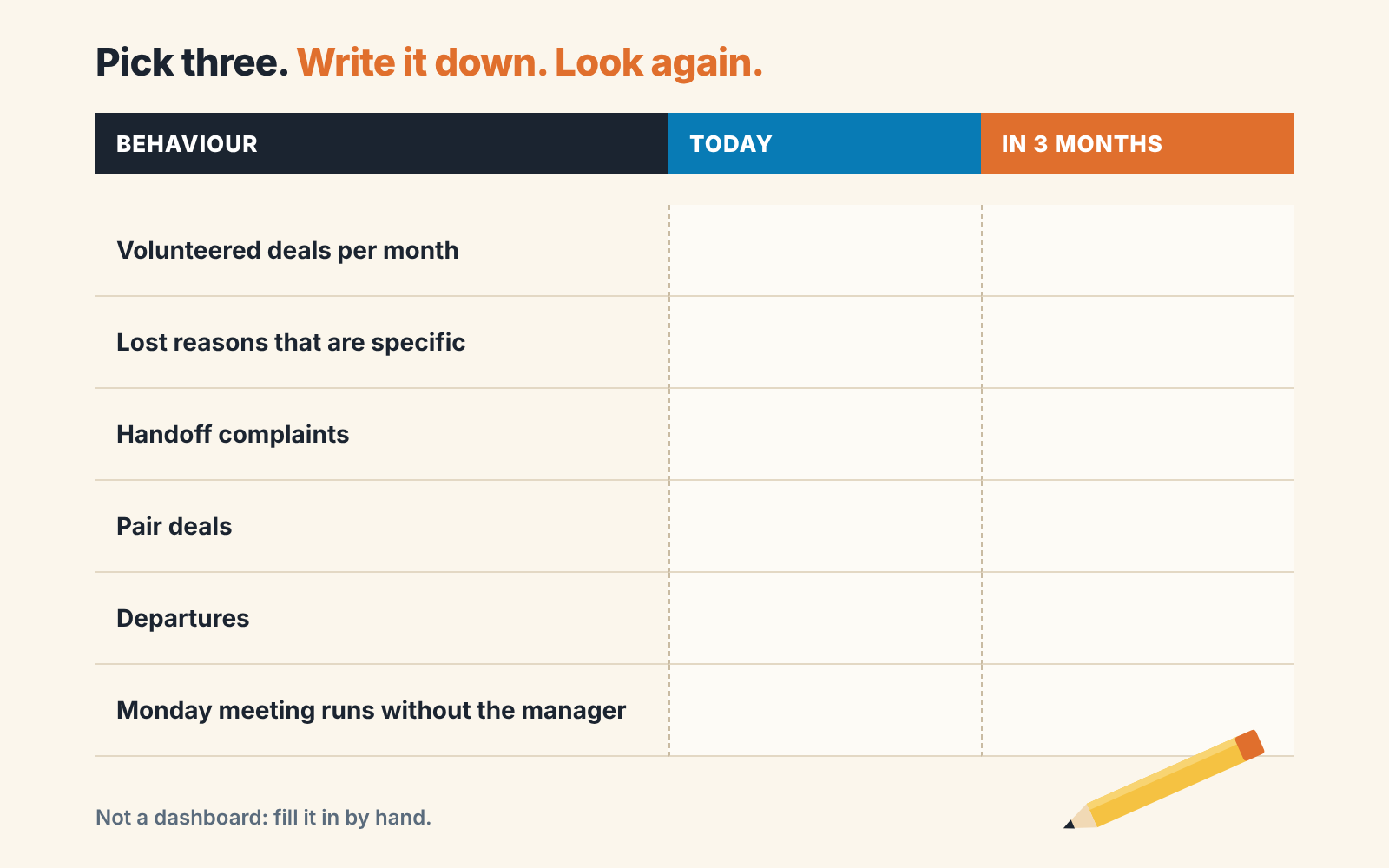
You will not get a clean metric, and we would be suspicious of any article that gives you one without a source. What you can do is watch a handful of behaviours over a quarter. Pick three from this list, write down where they stand today, and look again in three months.
- Reps bring stuck deals to the team review without being asked. Count volunteered deals per month.
- Lost reasons in the CRM get more specific: “price” becomes “lost to incumbent on price after we failed to reach the CFO”.
- Handoffs stop generating complaints.
- Pair deals exist, and the number of deals with two people’s activities on them is above zero and growing.
- People stay. Rep turnover in a small team is a small number, so one departure is a signal to look at, too small to call a trend. Still ask in the exit conversation whether the team was a reason to stay or a reason to leave.
- The Monday meeting runs without the manager for a week and nothing breaks.
One more thing on money, since owners ask. Almost everything here costs nothing but the manager’s attention and a few hours of selling time per quarter. The expensive version of team building, the offsite with a facilitator, rarely sticks on its own, because it is the only one the team does not own.
So start small. Next Monday, put the team number on the screen before anyone’s own pipeline, then walk through one shared deal. Do it for eight weeks before you decide whether it worked. If you want a baseline first, sign up for SalesBond and run the free CRM audit on the last 30 days, so the first team deal reviews have something real to look at.