Kaizen is the Japanese word for “improvement”, and in business it means small, regular improvements to how work gets done, made by the people doing the work, instead of a big reform once every few years. For a small business with a sales team it comes down to a two-week cycle with a 15-minute team meeting every Monday. Pick one bottleneck in the funnel, change one thing, and check the result in the CRM before you decide whether to keep it.
What kaizen means
The word is written 改善 and simply means “improvement”; outside Japan it became a management idea, the belief that a lot of small changes add up to a big result, and Masaaki Imai made it famous in his book Kaizen: The Key to Japan’s Competitive Success (Wikipedia: Kaizen). The Lean Enterprise Institute defines it as “continuous improvement” through small, incremental changes to processes (Lean Enterprise Institute: Kaizen). America’s SBDC, writing for small business owners, calls it “a Japanese business philosophy of continuous improvement of working practices” and notes that large Japanese companies like Toyota promoted it long before it reached corporate culture worldwide (America’s SBDC: Small Business Owner’s Guide to Kaizen).
Two things in those definitions matter more than the Japanese.
First, the improvements are small. A new CRM or a new comp plan is too big. A changed field, a shorter email, a rule about when a deal moves to the next stage.
Second, the people closest to the work make them. SBDC tells owners to let team members make the improvements and to “celebrate even small wins”. In a sales team that means the reps who send the proposals. The owner who reads the pipeline report on Friday is further from the work.
Everything else written about kaizen, including most of what ranks for the word, is about factories. Waste on the line, flow between stations, safety. That literature is good, and you do not need it. A sales funnel in a CRM is a process with stages, and a process with stages can be improved one stage at a time.
Why small wins beat a big transformation for a small team
A small team cannot absorb a change that touches everything at once, and cannot tell which change worked.
Here is what the big-change version looks like in a ten-person company. The owner reads about a sales methodology, spends a weekend building a new pipeline with nine stages and fourteen required fields, announces it on Monday, and by the third week the reps have found the two stages they actually use and the fields sit empty. Nothing was measured, because nothing was comparable to the month before. We have watched this more than once. The methodology was rarely the problem; the owner just had no way to see which of the many things they changed was the one that helped.
Kaizen flips the trade. One change is cheap to make, cheap to explain at the Monday meeting, and cheap to roll back. If it fails, you lost two weeks on one stage of the funnel. If it works you have a rule you can write down, and the next change starts from a slightly better baseline.
There is a second reason that is specific to sales. A sales team runs on a monthly or quarterly number, and any change that risks that number gets quiet resistance. A change to one stage, for two weeks, measured on one metric, does not threaten the quarter. Reps will try it. They will not try a reorganisation.
Five principles, in plain words
Most kaizen explainers carry a list of principles aimed at a plant manager. The small-business version from America’s SBDC has five points, and they translate to a sales team almost without edits (SBDC).
Know your main processes and write them down. SBDC’s first step is to document your major business processes, with a warning we would frame on the wall: “It is dangerous for a business to rely on expertise that only one person has in their head.” In sales, the process is the pipeline. If the stage names in the CRM do not describe what a rep actually does to move a deal, you cannot improve the process, because nobody agrees what it is. We wrote separately about turning sales process steps into CRM stages.
Let the team make the improvements, and notice the small wins. The owner’s job is to pick the bottleneck and hold the rhythm. The rep’s job is to propose the fix. When a two-week change works, say so on Monday, by name.
Say yes by default. SBDC calls this a “Yes” culture. When a rep suggests “what if we send the pricing before the call instead of after”, the manager answers “try it for two weeks and we’ll look at the stage conversion” and keeps “that’s not how we do it” out of the reply.
Details matter, but start with the cheap ones. SBDC pairs attention to detail with the Pareto principle: look for the low-hanging fruit, where the smallest amount of work gets the biggest result. In pipeline terms, the stage where deals sit longest is usually where the cheapest fix lives.
Make it part of everyday work. The last SBDC point is the one most teams skip: “Make it a part of everyday work at your business.” A quarterly offsite can start the habit, but the changes themselves have to happen in ordinary weeks.
Pick the bottleneck: one stage, one number in the CRM
Do not start with the problem that annoys you most. Start with the stage where deals wait longest.
Every CRM with a stage-based pipeline can show you how long deals spend in each stage and what share of them move forward. In Pipedrive that is two Insights reports: the deal duration report, which breaks the average sales cycle down by stage (Pipedrive: deal duration), and the funnel conversion report, which shows the conversion rate between pipeline stages (Pipedrive: deal conversion). We walk through the days-in-stage view in Pipedrive and the HubSpot time-in-deal-stage report in more detail; Salesforce and Zoho CRM have their own pipeline reports for the same question. Pull the data for the last 60 or 90 days, long enough that one big deal does not skew it, and look for the stage with the biggest gap between “deals in” and “deals out”, or the longest average time.
That stage is your bottleneck for the next two weeks. Then pick one number for it. One. Some that work well because the CRM already has the data:
- conversion from that stage to the next, as a percentage of deals entering it;
- median days a deal spends in that stage;
- share of deals in that stage with no next activity scheduled;
- time from lead creation to first logged activity, if the bottleneck is at the top.
Write the number down before you change anything. This is the baseline, and the whole method falls apart without it (more on that in the mistakes below).
A practical note on data quality. If reps move deals through stages in batches on Friday afternoon, time-in-stage is noise and you should pick a different number, or make “deals move the day they move” your first kaizen change. Our article on running a pipeline review with your sales managers covers how to make the stage data trustworthy in the first place, and CRM adoption covers what to do when the CRM is only half used.
This is also where we should say what we build. SalesBond is a sales management layer on top of the CRM a team already uses; we started with Pipedrive. Its free CRM audit looks at the last 30 days of a connected CRM and sends a PDF report that includes the pipeline bottleneck, deal health and what to fix; seven days later a second PDF shows what changed. For a team starting kaizen, that first report is a ready-made baseline, and the second one is a quick “did anything move” check. Check your CRM with SalesBond if you would rather not build the reports by hand. The method works just as well with the CRM’s own reports, it just takes an hour longer.
The kaizen process, week by week: observe, change, measure, keep or drop
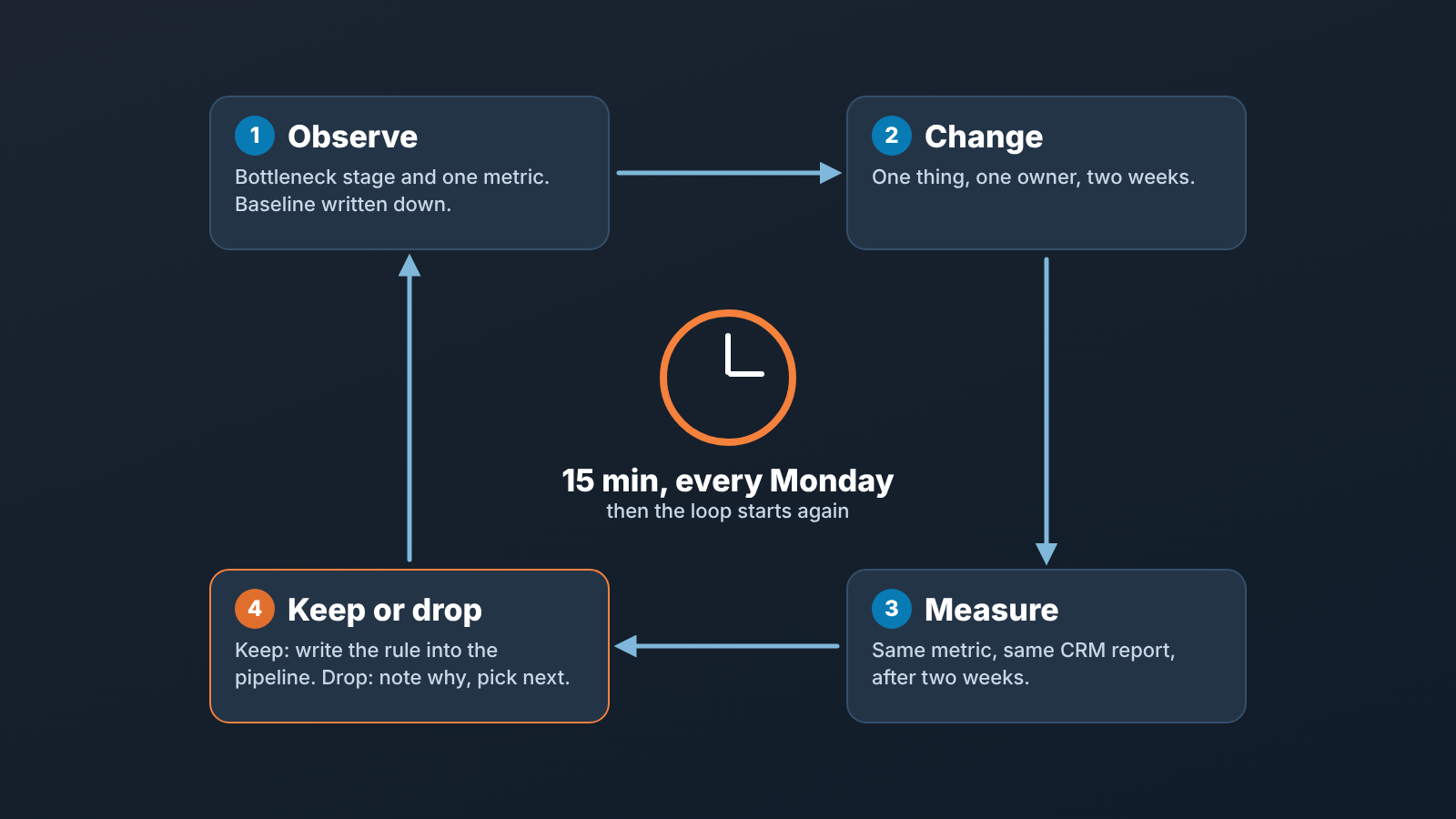
The loop is short enough to fit on an index card.
- Observe. Monday, 15 minutes with the team. Show the bottleneck stage and the baseline number. Ask the people who work that stage what slows deals down there. You are looking for one answer.
- Change one thing. Agree one change and one owner. Examples that are small enough: a template for the follow-up after a demo, a rule that a deal cannot enter “Proposal sent” without a next activity, a 24-hour limit on first response to a new inbound lead. Write the change in the CRM where reps will see it, in the stage description or a pinned note; an email gets buried.
- Run it for two weeks. Do not touch anything else in that stage. Do not start a second change in a different stage either, however tempting. Two weeks is long enough for a handful of deals to pass through most B2B stages and short enough that the team remembers what was changed.
- Measure. Pull the same number from the same report, same date range length, two weeks later. Compare it to the baseline. Expect noise with small deal counts, so look at the direction and at what reps say happened as well as the decimal.
- Keep or drop. If the number moved the right way and the reps would keep doing it anyway, write the change into the pipeline definition as a rule. If it did not move, drop it, note in one line why, and pick the next change. A dropped change is information you did not have two weeks ago.
Then the loop starts again, with the same stage if it is still the bottleneck, or with the next one if it is not.
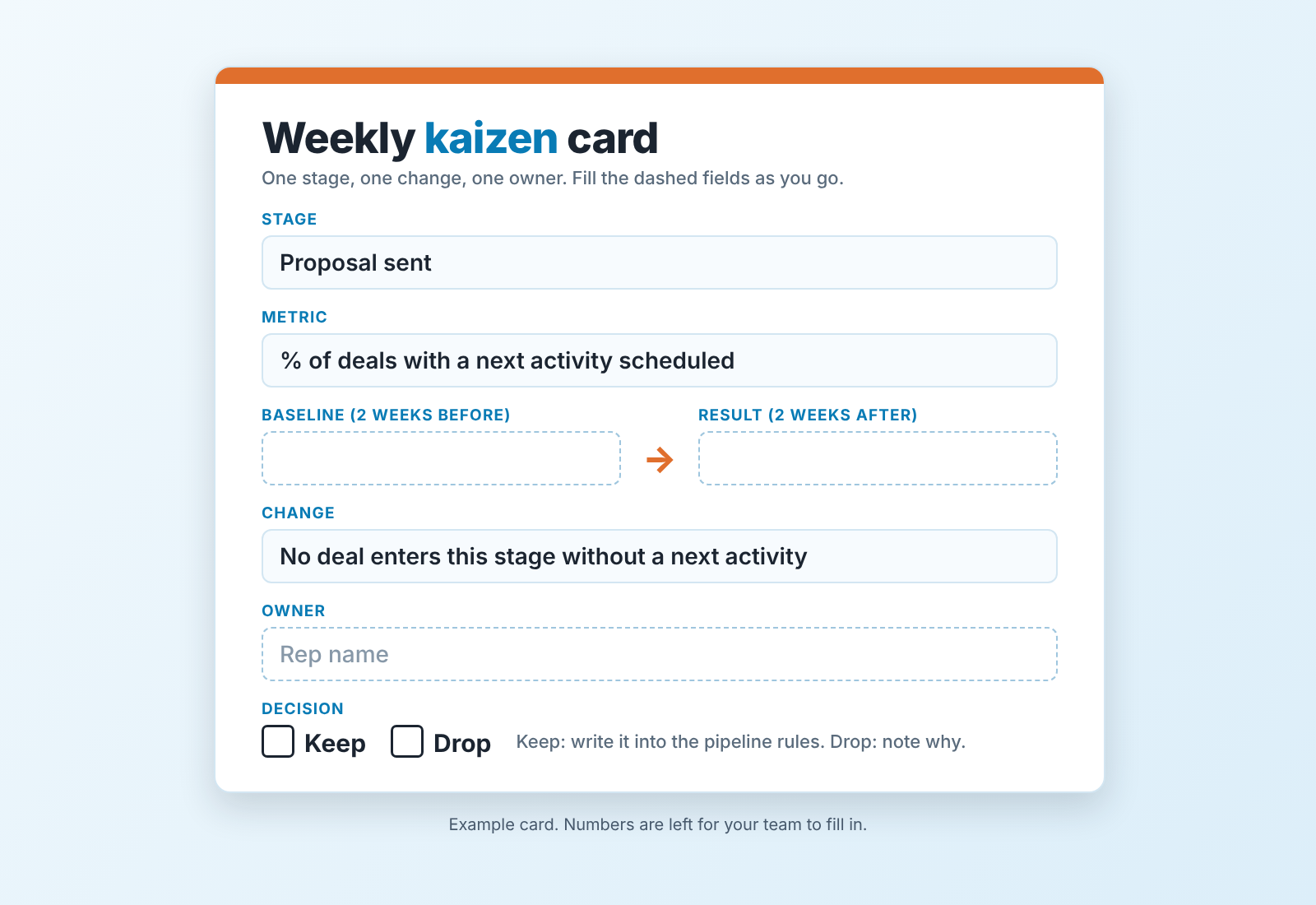
One more thing about the Monday meeting. Keep it to 15 minutes and keep it to the card. The moment it becomes a pipeline review, the kaizen part dies, because pipeline reviews are about this quarter’s deals and kaizen is about next quarter’s process. Separate meetings, or at least a hard line between the two halves.
Daily kaizen vs a kaizen event
A kaizen event is a focused, multi-day push by a team to fix one process; daily kaizen is the habit of small changes inside normal work. The lean world uses the same word for both, and small teams get confused by it.
The Lean Enterprise Institute describes a kaizen event, also called a “kaizen blitz” or “kaizen workshop”, as an effort that commonly lasts five days, during which a team identifies and implements a significant improvement in a process (Lean Enterprise Institute). In a factory that is a team on the floor for a week re-laying a workstation.
Daily kaizen has no special event at all.
For a sales team of three to fifteen people, almost everything should be daily kaizen, run on the two-week cycle above. You do not have a week to take the team off the phones, and your processes are not that big. The one honest use of an event in sales is the pipeline redesign itself: if the stages in the CRM are so wrong that no number is trustworthy, take a half day, redraw the stages with the reps, and then go back to two-week cycles. Do that once a year at most. If you find yourself wanting an event every month, something in the weekly loop is not being kept.
Three examples from a sales pipeline
Each of these is a pattern we see in small-team CRMs. The numbers are left for your CRM to fill in; we are not going to promise a lift we have not measured on your data.
Deals go stale after the proposal. In the CRM it looks like the longest time-in-stage at “Proposal sent”, with plenty of deals there whose close date has been pushed more than once. The change for two weeks: a deal may not enter “Proposal sent” without a scheduled next activity with the customer. Compare the share of deals in that stage with no next activity, and the median days in stage. This is the most common bottleneck we see, and the cheapest to fix, because the CRM already knows which deals have no next activity. In any CRM that list is a saved filter. In SalesBond, Deal Health checks every deal against its activity rules and shows the violation with a recommended action. The kaizen part is the rule that stops deals entering the stage without a next step in the first place.
Deals with no next step anywhere. A filter for open deals with no scheduled activity returns a big share of the pipeline. The change: every rep clears their own “no next activity” list before Monday’s meeting, and the list goes on the screen at the meeting. The number to compare is a plain count of open deals without a next activity, Monday to Monday, which anyone can check in a minute. That makes it a good first cycle.
Slow first response to inbound leads. Here the time from lead creation to the first logged call or email is measured in days, and this is the one where the owner usually learns something unwelcome, such as that leads arrive on Friday evening and the first call happens Tuesday. The change: new inbound leads are called within one working day, and the lead stays with whoever called first. Compare median hours from lead created to first activity, and conversion from “New lead” to “Qualified”. Measure before you set the rule. A one-working-day target with a baseline of four days is a different conversation from the same target with a baseline of 26 hours.
If a stage is slow because deals are being lost there rather than stalled, thats a different question, and the right tool is a proper root-cause analysis of lost deals or a win/loss review. A kaizen cycle changes how a stage runs and will not tell you why those particular deals were lost.
The three mistakes that kill it
The first is too many changes at once. The owner reads this, gets enthusiastic, and runs three changes in three stages in the same fortnight. Then one number improves, one gets worse, and nobody knows which change did what. One change at a time is the only thing that makes the measurement mean anything. If the team is impatient, shorten the cycle to one week on a high-volume stage rather than adding a second change.
Then there is the missing baseline. The change goes live on Monday and two weeks later someone tries to remember what the number was before. It was not written down, and by then everybody is sure it was worse than it was. Write the baseline on the card, with the date range it came from, before the change goes live. If the CRM report for the baseline takes more than ten minutes to produce, that is itself a sign the pipeline data needs work before kaizen can run on it.
And no owner. Name one rep or one manager per change, because a change assigned to everyone has nobody to bring the number on Monday. That person notices by Wednesday if the change is not being followed, says so, and brings the “after” number to the next Monday. In a small team the owner of teh change should rotate, so that kaizen does not become one enthusiast’s hobby.
The owner of a change is never its subject, and this is where teams confuse kaizen with a performance plan for a person. Kaizen is about the stage and leaves the rep out of it. If the bottleneck turns out to be one person’s deals, that is a coaching conversation or, in the worst case, a performance improvement plan, and it should be had separately. Mixing the two makes reps hide problems from the Monday meeting, and that ends the method.
Kaizen, lean and Six Sigma, and who actually runs this
Kaizen is a habit of small, team-led improvements; lean is the wider improvement system it is usually taught inside, and Six Sigma is a set of process-improvement techniques that use statistical methods to remove the causes of defects and reduce variation (Wikipedia: Six Sigma). They travel together, but they are not the same thing. For a sales team of ten, you want the kaizen habit. You almost certainly do not want a Six Sigma project, and most of lean’s toolkit assumes a physical process you do not have.
How long before it shows? The honest answer is one cycle for the first keep-or-drop decision, which is two weeks, and a quarter before the pipeline numbers look different enough that you would notice without looking for it. Anyone who promises a number faster than that is selling something, and we include ourselves in that warning.
Who runs it? The owner or head of sales holds the rhythm: the Monday slot, the bottleneck choice, the baseline. The reps propose and own the changes. If you have a sales manager between you and the reps, the manager runs the meeting and you read the card. What does not work is the owner choosing the change alone. The whole point of the method, going back to SBDC’s advice to let team members make the improvements, is that the fix comes from the person who does the work.
Start next Monday. Pull the stage report, find the slowest stage, write one number on a card, and ask the team what they would change. Two weeks later the first keep-or-drop decision goes on the the card.
Start with SalesBond if you want the first baseline and the seven-day comparison delivered as a PDF while you concentrate on the change itself.