
The Peter principle says that in a hierarchy people keep getting promoted until they land in a job they cannot do, and there they stay. In sales it has one classic shape: the best rep on the floor becomes the sales manager, loses their own deals because they no longer sell, and loses the team because managing was never the thing they were good at. The owner ends up with a weaker pipeline and an unhappy former star, and the vacancy is still open.
That is the whole problem, and this article is about the decision behind it, because “promote the top seller” is a choice an owner of a ten-person company makes in an afternoon, usually on gut feel. There is a cheaper way to make it: look at what the CRM already shows about the candidate, run a trial with a date and a few measures, and build a path for a great seller that does not run through management at all.
What the Peter principle actually says
Laurence J. Peter’s formulation, from the 1969 book The Peter Principle, is that in a hierarchy every employee tends to rise to their level of incompetence (Corporate Rebels: Mass incompetency in business). The principle carries his name because it was his idea: Peter did the research and Raymond Hull wrote the text of the book with him (Wikipedia: Peter principle). They meant it as satire. It caught on anyway, because it described something everyone had seen: you get promoted for being good at job A, and job B is a different job.
It is often mixed up with two other ideas. The Dunning-Kruger effect is about self-assessment, people with limited skill overrating how good they are; the Peter principle is about how organisations promote, whatever the person thinks of themselves. The Dilbert principle, Scott Adams’s joke built on Peter’s, says companies push their least competent people into management to keep them away from real work.
So is the Peter principle still relevant, or just an old joke? Half a century later it turned into a measurement. Alan Benson, Danielle Li and Kelly Shue studied the performance of sales workers at 214 firms and found that companies promote on current sales performance at the expense of traits that better predict how someone will do as a manager, and that the cost is high (NBER working paper 24343, “Promotions and the Peter Principle”; published in the Quarterly Journal of Economics, 134(4), 2019). The number that gets quoted most comes from the full paper: among newly promoted managers, doubling a person’s pre-promotion sales corresponds to a 7.5% decline in the sales of each of the people they then manage (NBER w24343, full text).
Read that again with your own team in mind. The better the rep, the more likely you are to promote them, and the worse, on average, their team then sells. Not always. On average. Which is exactly the kind of odds an owner should not bet the pipeline on without looking at the candidate first.
Why the best rep so often fails as a manager
Nobody becomes a worse person on promotion day. What changes is the job, and the thing that made the rep great is largely irrelevant to it.
A top rep wins because they are good at a conversation with a buyer. They read the room, push at the right moment, hold price, close. The manager’s job is almost entirely other people’s conversations: making sure eight reps have the next call booked, noticing that one of them stalls after the proposal every time, telling a friend from last month’s team that their forecast is fiction. Fairygodboss, summarising the HBR view, names this as one sign of a promotion gone wrong: the skills that got the person promoted do not transfer to the new role (Fairygodboss: 4 signs someone’s been promoted past their level of competence).
There is a second, quieter mechanism. Take a typical case, not any one company’s story. The best rep usually got there by keeping the best deals. As a manager they still have the instinct, so they take the big account “to make sure it lands”, step into every late-stage call and coach by demonstration and never let a rep fail safely. The team learns that the manager will rescue the deal. Six months on nobody under them has closed anything hard on their own.
And a third: the owner has now lost their best seller. Even in the best case, where the new manager turns out fine, the revenue that person produced has to come from somewhere. It rarely comes from the manager’s own book, because they are in one-to-ones all day.
We think most of this is predictable before the promotion happens. The evidence is already in the CRM.
Before the promotion: what the CRM shows
A title says nothing about whether a rep can manage. Their deal records say quite a lot. Coaching, delegating and documenting are things a rep either does already or does not, and each one leaves a trace in any CRM, no special report needed.
What we look at:
- Other people’s deals. Is the candidate a follower or participant on colleagues’ deals, and did they leave notes there? A good sign is that those deals moved afterwards. A rep who never touches a deal that is not theirs has never coached.
- Deals they handed to another rep. Did those keep moving, or go quiet the week after?
- Their own notes, next activity dates and required fields. Could a stranger pick up their deal tomorrow, or is the record a company name and an amount?
- Stage conversion over the last two or three quarters: steady with a visible method, or a few huge wins with a lot of silence between them.
Two of these matter more than the others. If the candidate’s own deals are undocumented, they will not be able to read anyone else’s, and the first thing a manager does on Monday is read the pipeline. If they have never once passed a deal to a colleague, they have never felt what it is like to watch someone else handle it worse than they would. Management is mostly made of that feeling.
The handover test is the one we trust most. Pick a real deal, mid-size, mid-funnel, and ask the candidate to pass it to a junior and coach from the side. Then watch the record. Did the next activity get scheduled? Did the candidate leave a note the junior could act on, or did they just take the next call themselves? You learn more from one handover than from an interview.
A word on what not to read into. A top rep with a thin record usually never needed the CRM, because the deals closed anyway. That is a reason to hold the promotion, and it says nothing against them as a seller. The sales manager job description for a small company lists what the role owns in the CRM, and it is worth showing to the candidate before anyone says yes.
The player-coach trial: 90 days with a date on it
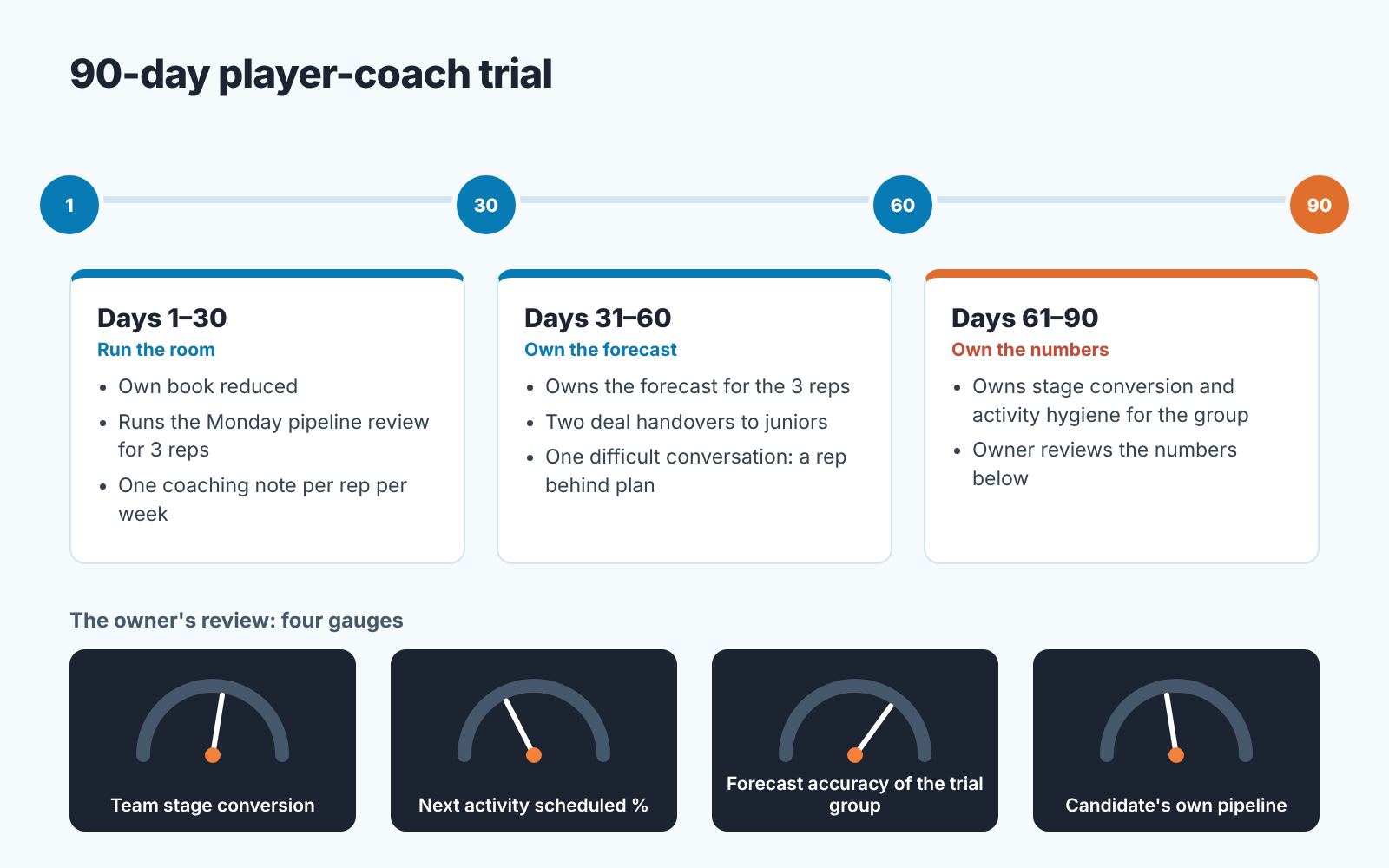
A player-coach trial is a fixed period, here 90 days, in which the candidate keeps selling a reduced book and runs part of the manager’s job for a small group. If the record is mixed, which it usually is, do not decide. Run the trial, written down. The point is to see whether teh team sells better with them coaching it, and whether they want the job once they have done it.
What the trial should contain, in our experience:
- A scope that is real and small. Three reps to start with. The candidate runs their weekly pipeline review, owns their forecast and gives them written feedback from the CRM. How to do the feedback part without it turning into opinion is in giving reps feedback from CRM evidence.
- A reduced personal quota, agreed up front, so nobody can later say the candidate’s own numbers fell “because of the trial”. They will fall. Say so on day one.
- Measures taken before the trial starts: stage conversion for the three reps, the share of their open deals with a next activity scheduled, how far their forecast was from the actual last quarter. Without the “before”, the “after” is a feeling.
- One hard conversation, scheduled on purpose. Somebody in the group will be behind plan at day 45; you don’t need to wait for it by coincidence. The candidate has the conversation, the owner sits in once.
- A date for the decision and a sentence about what happens if the answer is no. “You go back to your full book with a senior title and a raise” makes the trial honest. Without it, the candidate will fake enthusiasm to avoid losing face, and you will have learned nothing.
At day 90 you look at three things. Did the group’s numbers move for the better, in the measures you took beforehand? Did the candidate’s own deal records get better or worse as they coached? A manager who stops documenting under load will not start again. And did they, in their own words, enjoy the weeks when they closed nothing themselves? Someone who says “honestly, I missed the deals” has told you the answer, and it is a good answer. You keep your best seller.
The player-coach format has its own article with the mechanics in one CRM: player-coach sales manager in Pipedrive. The trial described here is the same shape, with a deadline.
A senior-rep path that does not go through management
The reason owners promote the top seller is rarely that they think the rep will be a great manager. It is that the rep asked for more, and management was the only “more” on offer. That is a structure problem, and its cheaper to fix than a failed manager.
A senior-rep track gives the best seller a bigger title, a bigger number and a bigger share of the hardest accounts, without a single direct report. In a small company it can be simple: first pick from inbound above a certain size, a say in pricing on their own deals within a corridor the owner sets, and a paid mentoring role with no authority attached. The senior rep teaches the the Tuesday call-review session. They do not sign anyone’s plan.
This track also quietly answers the Peter principle. The research is about firms promoting on sales performance because sales performance is what they can see (NBER w24343). If the path for a great seller rewards selling, you stop needing the manager title as the only way to say “you matter here”. And when a management vacancy does open, the candidates are the people who showed the coaching and documenting behaviours described above. That may or may not be your top closer.
One caution from our side. The senior title has to come with something the person wants, or it is a consolation prize and everyone knows it. Money and account choice are what make the title count.
Signs the Peter principle has already hit your team
Maybe you are reading this after the fact. The rep has been manager for a few months, something is off, and the question is whether to wait or act. Look at the CRM again, because the signs show up there before anyone says anything.
The manager’s own deals are still the biggest in the pipeline. They took the large accounts “temporarily” and never gave them back. The group’s next-activity coverage has slipped, because nobody runs the weekly review the way the previous manager did, or the review has turned into the manager narrating their own week. Forecast accuracy for the team is worse than when the reps forecast for themselves. Deals that used to go to the manager for a late-stage rescue now just sit, because the manager is on calls.
Then the people signs. Reps go around the manager to the owner with questions they used to bring to the floor. The rep who was second-best starts updating their LinkedIn. The manager is in the office later than anyone and producing less than they did as a rep.
In sales, the non-transfer of skills that Fairygodboss lists looks like a manager who still solves every problem by selling harder. If that is what you see, the manager is still doing the rep’s job.
What you do about it depends on which thing broke. If the manager cannot read and run the pipeline, that is fixable: the owner sits in on reviews for a month and writes down what the role owns, which is the subject of sales leader vs sales manager: what the role owns in the CRM. If the manager does not want the job and only took it because it was offered, the kind thing is the senior-rep path above, offered without drama and with the money attached.
How to avoid the Peter principle
Promote on evidence of managing; selling numbers prove something else. That is the short answer, and the rest is how to collect the evidence in a company small enough that the owner knows every deal.
The CRM check above is a start; the trial is the proof. Make the “no” outcome of a trial a good outcome, with a title and a raise, so the trial stays honest. Build the senior track before you need it, so your best rep is not forced to ask for the only promotion that exists. And when a new manager starts, take the measures on day one: their group’s stage conversion, activity coverage and forecast error. Three months later you are comparing numbers.
This is where our own tool fits, so a short disclosure. We build SalesBond, a sales management layer on top of the CRM a team already uses; we started with Pipedrive. The before-and-after measures above are close to what the free CRM audit in SalesBond produces: it reads the last 30 days of the connected CRM and sends a PDF report covering deal health, the pipeline bottleneck and what to fix, then a second PDF a week later showing what changed. Run it before the trial starts and you have the “before” on paper. Once the new manager is in place, Deal Health keeps checking every deal in their scope against the enabled rules and shows, per rep, where the problems are, so the owner sees the group’s pipeline quality without reading every deal. Check your CRM with SalesBond if you want the first PDF before you make the decision. Whether your rep will make a good manager is still for the trial to show.