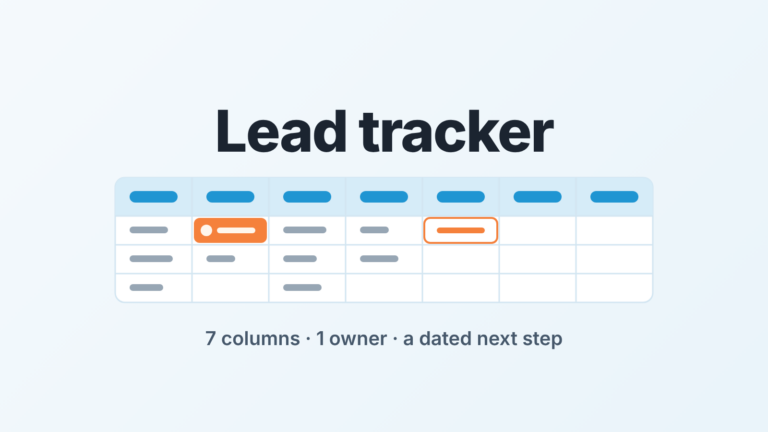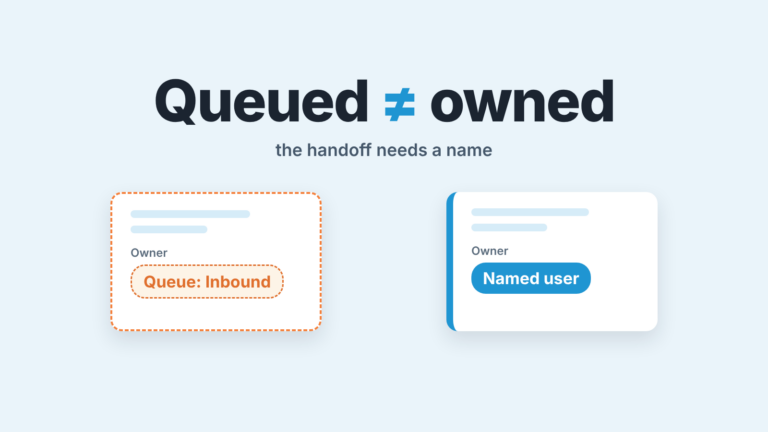
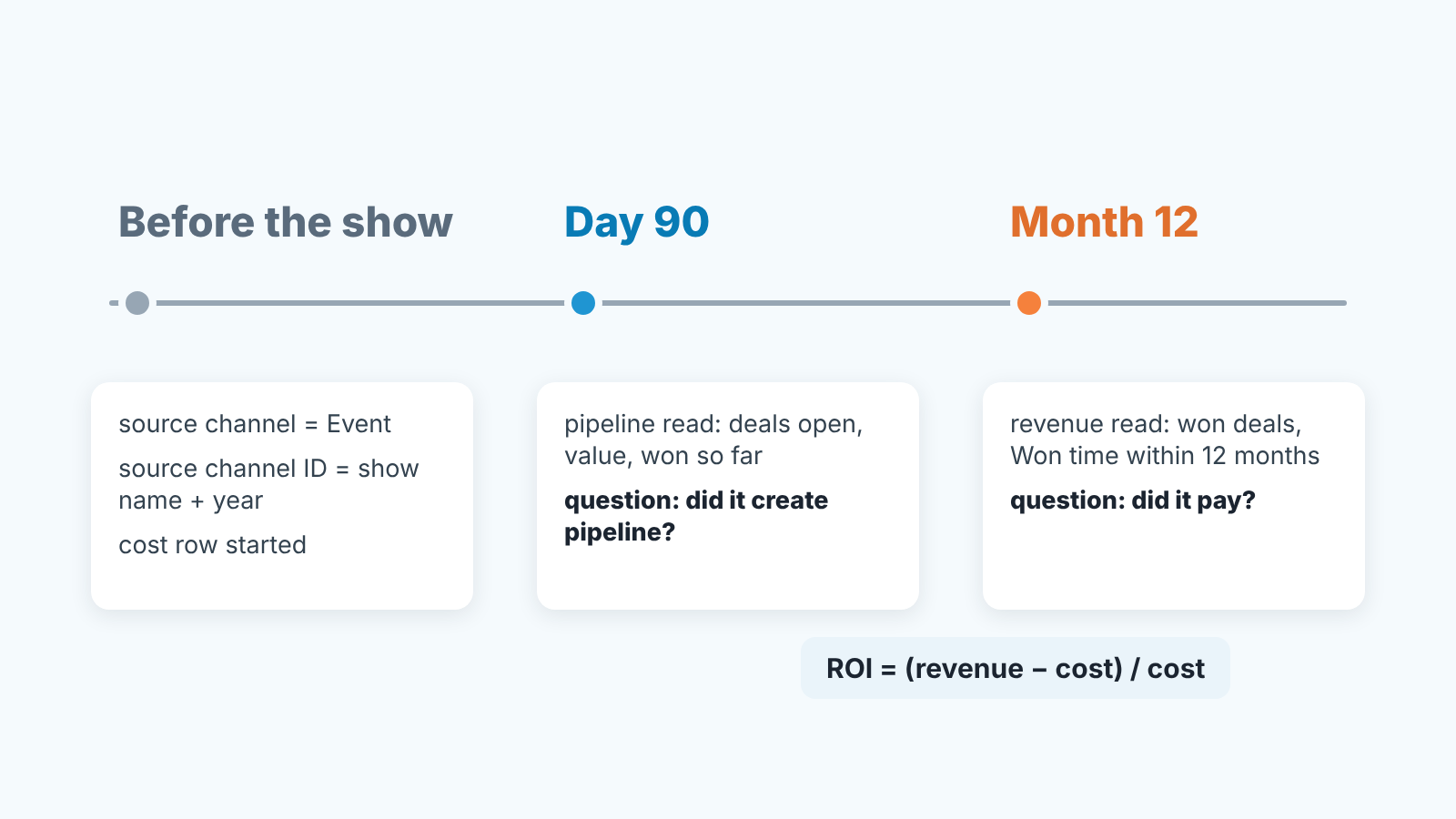
Trade show ROI is the revenue from the deals that came from the event, minus everything the event cost, divided by that cost. For a small team the hard part is not the arithmetic. It is the tag: write the event’s name into the deal’s source fields in Pipedrive before you leave for the show, then read closed revenue from those deals twice, at 90 days and at 12 months. Without the tag there is nothing to read, and the question “was it worth it” gets answered by whoever argues loudest.
Six weeks after the show, and nobody can answer the owner’s question
Monday planning in November. Anselm, who owns the company, asks the question he has been saving since the September show: so, did it pay for itself? Signe, who runs sales, has an honest answer: “I think so”. Rutger closed something from the show in October. Philippa has three deals she is fairly sure started at the stand. The cards were scanned and worked in the first 48 hours, the way we described in the business card scanner routine, so the contacts are in Pipedrive. What is missing is any way to pull them back out as a group, and the booth invoice sits in Anselm’s inbox.
The follow-up was fine. What was missing happened before the show, and it can’t be added later without reading forty deal timelines by hand. Below: where the show lives in Pipedrive and how to pull its deals out a year later, so next time the question takes five minutes.
The trade show ROI formula, and the two numbers it needs from you
Every guide to trade show ROI, ours included, prints the same formula (Attendir’s trade show ROI guide is a clear version of it):
ROI = (revenue from the event's deals − total event cost) / total event cost × 100
The formula is not the work. The two inputs are, and neither one lives in your CRM by default.
Total cost is the easier input, because the invoices exist. The mistake is stopping at the invoices. Booth, travel, hotel and print are direct costs. The days two reps spent away from their pipeline are a cost too, and Attendir is right to count staff time. We keep the number in a sheet with four columns: event, direct cost, time cost, date. One row per show, filled in the week after while the receipts are still on the desk. Here is an illustrative row, with numbers made up for this article:
- Booth space and stand: $4,500
- Travel, hotel and meals for two people: $2,300
- Printed material and shipping: $400
- Time: two reps for three days plus two prep days, eight person-days at $250 a day: $2,000
Total: $9,200. The $250 a day is a rough loaded daily cost; use your own. What matters is that the time line exists, because leaving it out makes this show look about a fifth cheaper than it was.
Revenue is the harder input. You need the show’s deals as a set you can pull a year later without anyone’s memory.
Tag the event before you leave
That set exists only if somebody wrote the show’s name on every record on the day it was created. We fill the source fields exactly as in the 48-hour card routine: source channel is Event, and the show goes in source channel ID. The one rule that matters for a read a year from now is the string. Write the name with the year, the same way on every record, and pin it in the team chat before the trip so Rutger and Philippa copy it instead of typing it from memory. “Packaging Forum 2026”, not “PackForum” on day two. You will go again, and in 2027 you want two separate sets.
Keep Event as one channel value and leave it alone. Pipedrive’s help says deleting a source channel removes it from all records, open, won, lost and archived, and deletes its associated source channel ID with it (Pipedrive: lead source in deals). One tidy-up of the channel list and every show name goes with it.
Before you leave: start the cost row, agree the source string, confirm Event is on the channel list, and note who goes and for how many days.
What counts as “from the show”
Our rule is narrow on purpose: a deal is from the show if the first contact with that person or company happened at the show. A scanned card counts. A conversation at the stand that turned into a meeting the next week counts. That is it.
What does not count is “influence”. A prospect you were already talking to, who stopped by the stand and signed the following month, was going to sign or not on the strength of the conversation already running. Credit the show for that deal and every show will look wonderful, because you meet existing prospects at all of them. Zoho’s guide offers multi-touch attribution for this (Zoho Backstage), which suits a marketing team with a model and a budget; a five-person team is better off counting first-contact deals only and knowing it undercounts a little. An undercount you can explain to the owner beats an overcount you cannot.
The rule has a practical consequence on the day. When Philippa meets someone at the stand who is already in Pipedrive she does not retag the existing deal with the show’s name. She logs the meeting as an activity and leaves source alone. Source answers “where did this deal come from” once, and a coffee at the stand doesn’t change the answer.
One edge case comes up every time: someone you met at the show introduces you to a colleague in another department a month later. We tag the colleague’s deal with the show too, because without the show that door was shut. We draw the line at one hop. A card that only got a contact note, never a lead or deal, stays out of the month-12 read until it becomes one.
Day 90 and month 12: two reads, not one
Anselm’s question has a second problem besides the missing tag: November is too early to ask it.
Zoho’s guide puts most B2B sales cycles between 30 and 180 days and says to judge an event months later (Zoho Backstage). Use your own range instead. If you have followed how to calculate sales cycle length in Pipedrive, you already have a median in days from deal created to Won time, and it tells you how much of the show’s revenue can have arrived by any date. With a 140-day median, a 90-day read is a pipeline read only.
So we take two reads, and they answer two different questions.
Day 90 answers: did the show create pipeline? Pull the deals carrying the show’s string and look at the count and the open value. In our illustrative example: 38 contacts scanned, 9 deals open worth $31,000 in total, 1 deal already won at $4,100. If the team’s win rate on deals of this kind is around 25% (how we read win rate in Pipedrive), the open pipeline is worth roughly $7,750 in expected revenue on top of the $4,100 banked. Against the $9,200 cost, that is a show on track to pay for itself, not one that has. Day-90 ROI, if someone insists, is ($4,100 − $9,200) / $9,200, which is about −55%. Print that number for an owner without the the pipeline next to it and you will never be sent to a show again.
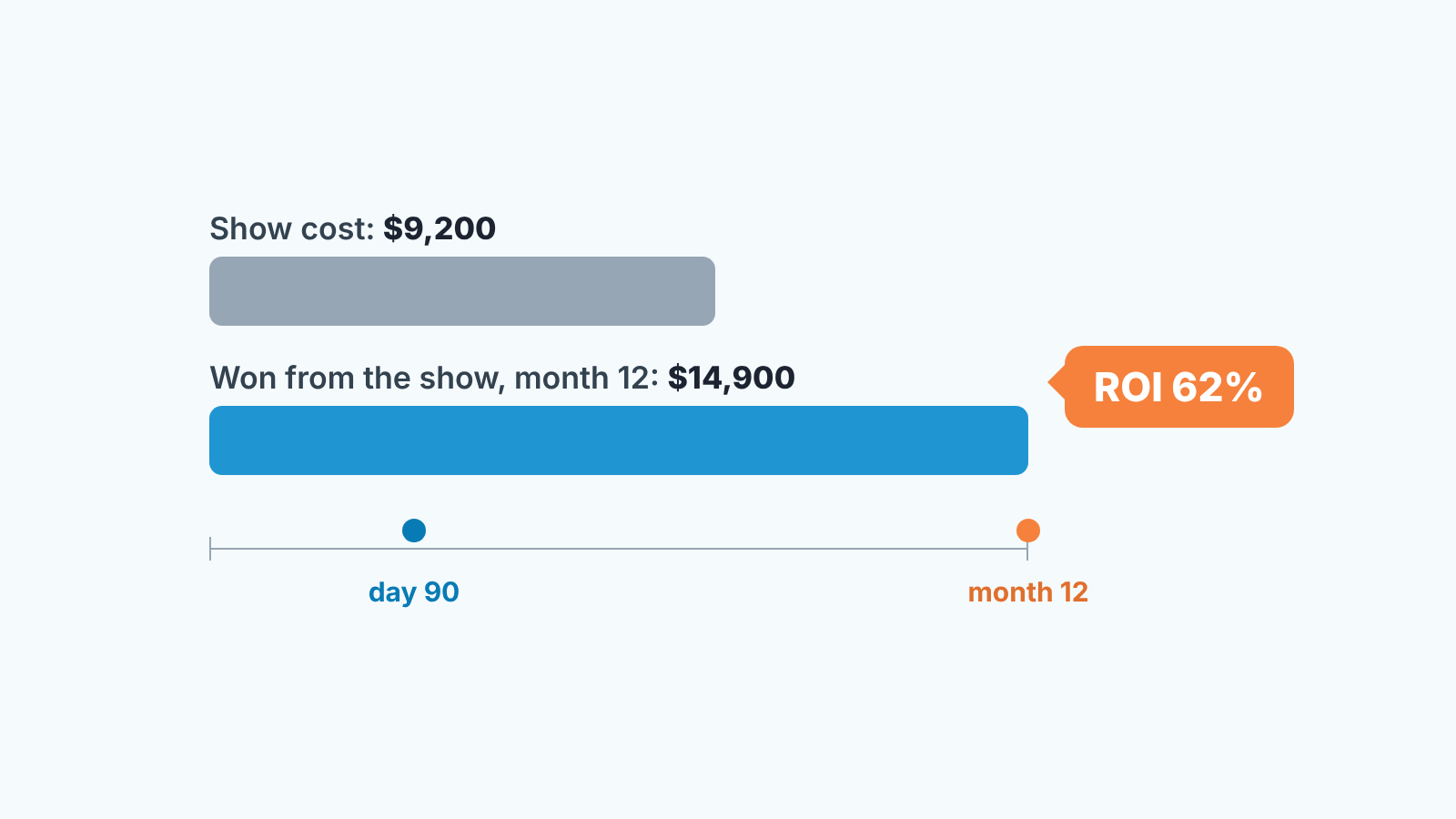
Month 12 answers: did it pay? Same set, won deals only, Won time within the 12 months after the show. In the example: three deals won, $4,100, $6,200 and $4,600, so $14,900 of revenue from the show. ROI is ($14,900 − $9,200) / $9,200, which is 62%. Most other open deals were lost; the one still open goes into next year’s count if it closes.
Attendir suggests the same split, and here is what it buys you: the first read checks the show, the second checks the show plus the follow-up, so a good day 90 and a bad month 12 point at the follow-up, not the show.
Pipedrive’s help lists Insights for tracking source performance and gives, as an example, finding which web form ID brings the most won deals; we treat a show name in source channel ID the same way. In practice we filter deals with source channel Event, add the source channel ID column and export to the cost sheet, and the show’s string does the rest there. (The help describes source channel ID as a fixed backend ID for default channels such as Chatbot. Typing a show name into it for our own Event value is our convention, not a documented feature.)
Cost per won deal vs cost per lead
Both come out of the same sheet, and we never let one stand alone.
Cost per lead is total cost divided by the records you tagged. In the example, $9,200 over 38 contacts is about $242 a lead. It is available the day after the show, which is it’s charm and its danger. Event organizers love it because it looks cheap next to paid ads, and it says nothing about whether any of those 38 people wanted to buy.
Cost per won deal is total cost divided by the won deals at month 12. $9,200 over three deals is about $3,067 per won deal. Put that next to the average won deal from the show, $14,900 over three, about $4,967, and the show looks like what it was: an expensive channel that produced a handful of real customers at a cost below what they paid in the first year. Whether that is good depends on what your other channels cost per won deal.
The trap is comparing the show’s cost per lead with another channel’s cost per won deal. We have watched it happen in a budget meeting. It makes the show look like the cheapest channel the company has.
The decision sentence: go again, go differently, skip
At month 12, Signe writes one sentence into the sheet, next to the ROI, and reads it out at the next planning meeting. One of three:
Go again. ROI is positive, the day-90 pipeline was real, and cost per won deal is in the same range as the other channels. Book the same stand and change nothing except the year in the source channel ID string.
Go differently. The day-90 read was strong and month 12 was weak, so the show worked and the follow-up did not; or one cost item dominated and can be cut, such as a stand twice the size the team could staff. Go, with the specific change written next to the sentence so next year’s read tests that change instead of giving the show a vague second chance.
Skip. Day 90 was thin and month 12 confirmed it. Say so plainly. A show that cost $9,200 and produced one $4,100 deal is not a failure of the reps, it’s a channel that does not fit, and the sentence frees the budget for one that might.
An owner remembers a sentence, not a score. Anselm will not remember 62%; he will remember “go again, same stand”. And next November the question will take Signe five minutes, because the deals from the next show already carry its name.
A short note on where we sit in this. We build SalesBond, a sales management layer on top of the CRM a team already uses; we started with Pipedrive. It reads the deal data the team keeps, so a show tagged as a source is visible to it and an untagged one is not, same as for everyone else. The tag is still your job. Check your CRM with SalesBond if you want to see what else the deal data is already telling you.