

Annual recurring revenue is the yearly value of subscriptions and other revenue you expect to repeat; one-time fees such as setup or implementation do not count. From CRM deals, ARR = the sum of the yearly recurring amount on won deals whose contracts are still active, minus the yearly value of customers who left. Keep that recurring amount in its own field on each deal, so renewals are not counted twice.
The formula is the easy part. The work is deciding, deal by deal, what goes into that field.
How to calculate ARR from CRM deals
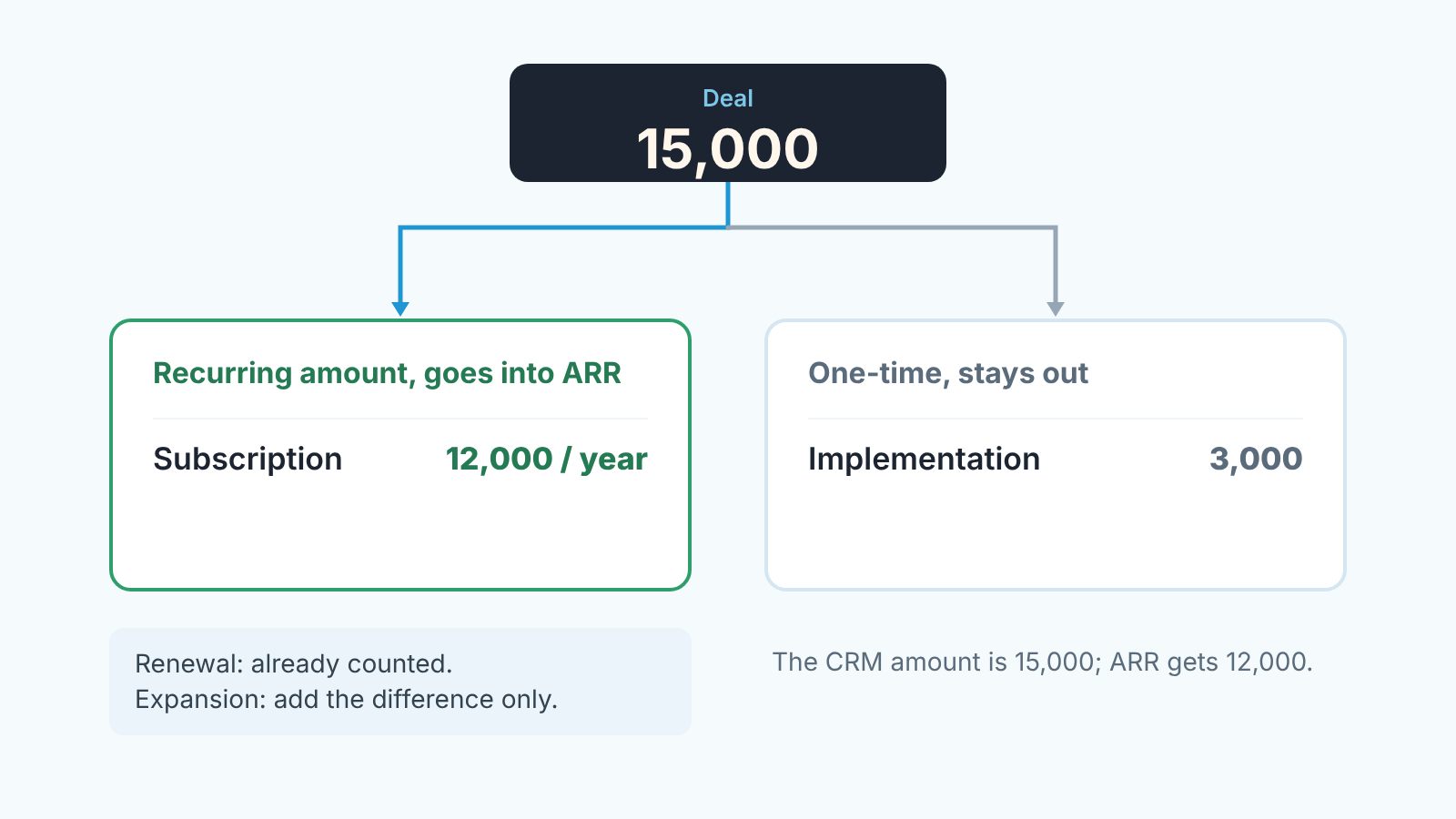
- Take the recurring part of each won deal: the subscription, without the setup fee or the training days.
- Bring it to one year. A monthly fee times twelve; a three-year contract for 36,000 is 12,000 a year.
- Add it up across deals whose contract is live today.
- Subtract the yearly value of contracts that ended or were cancelled.
Stripe’s guide describes the same adjustment: add new subscriptions and subtract “the annualized value of lost subscriptions” (Stripe: what is annual recurring revenue). Zuora calls ARR the recurring value of a contract “normalized for a single calendar year” (Zuora: annual recurring revenue).
So what does “two million ARR” mean? It means the contracts live today add up to two million a year of repeating revenue, a figure that leaves out last year’s billing and whatever the pipeline hopes to close.
What counts and what does not
Goes into ARR:
- subscription fees on a contract that is live today, whatever the billing cadence;
- annual and multi-year contracts, at their value for one year;
- expansions: more seats, a higher tier, an add-on;
- renewals, but only as “still here”, never as new money.
Stays out:
- implementation, onboarding, training, data migration and any other one-time service;
- a paid pilot with no commitment past the pilot;
- usage overages and one-off project work.
Zuora’s glossary excludes “one-time fees, usage-based overages, and non-recurring charges” in so many words. A minimum usage fee the customer is contractually bound to pay is a different thing; it repeats, so it can go in.
The month-to-month plan with no term is where people argue. Zuora says subscriptions with terms of less than one year “shouldn’t be recorded in ARR” and belong in MRR. We count them at twelve times the monthly rate and mark them, because a customer on a monthly plan for three years repeats more reliably than many annual contracts. The mark matters. ARR that can leave on thirty days’ notice is a different business, and its better shown on its own line.
Discounts, free months and pilots
You will find two answers on discounts: leave them out and count the list price, or count what the customer actually pays. We count the discounted price, because that is the contract you have, and discounts are where most of the counting mistakes live.
A reduced price is the price. If the list rate is 12,000 a year and the customer signed at 9,000 for year one, ARR is 9,000. Putting 12,000 in the recurring field because “that is what they will pay next year” is a forecast dressed as a fact. When the renewal comes in at 12,000, the extra 3,000 shows up as expansion, which is exactly where it belongs.
Free months are a one-time concession, and the rate stays the same. A customer on 1,000 a month with the first two months waived is still a 1,000-a-month customer; the recurring amount is 12,000 and the free months are 2,000 of revenue you chose not to bill. The test is simple. Ask what the invoice says in month three. That is the rate.
Pilots are not ARR until the pilot converts. A three-month paid trial at 1,000 a month is 3,000 of revenue and zero ARR, because nothing has been agreed beyond month three. The day the customer signs the real contract, the recurring field gets filled and ARR moves, and from then on the converted pilot also counts in the growth side of the rule of 40, which for a SaaS owner shows which growth and margin numbers live in the CRM.
Renewals: the deal that looks like a new sale
Same customer, same amount, a green “won” badge, and a rep who quite reasonably wants credit for it. That is why a renewal is the most dangerous deal for anyone summing a recurring field.
The rep can take the credit in commission while ARR stays where it was. The 18,000 contract that renewed for year two was already in ARR all of year one; add it again and the customer is counted twice.
The fix is a deal type field with three values: new, renewal, expansion. The renewal keeps its amount for the rep’s numbers and carries zero in the recurring field. Expansions are the mirror case: a customer who went from 12,000 to 18,000 added 6,000 of ARR, so the recurring field gets the 6,000 difference.
Churn has to be recorded too. If a cancelled customer stays “won” in the CRM forever nothing ever gets subtracted, and ARR only goes up. A “lost after won” status or a contract end date on the deal is the minimum. Before setting it up, it helps to see what the CRM already holds, and SalesBond’s free CRM audit reads the last 30 days of the connected CRM and sends a PDF report with repeat customers and top-10 clients among its sections, then a second PDF seven days later showing what changed.
ARR calculation example: ten CRM deals
Ten deals with 92,500 closed-won add 63,000 of net new ARR and 15,750 of October revenue. These are example numbers, not a benchmark: all ten deals are from October, the snapshot is 31 October, and the revenue column is what each deal earned that month.
| # | Deal | Amount in CRM | Recurring amount, per year | New ARR | New MRR | Revenue in October |
|---|---|---|---|---|---|---|
| 1 | New annual subscription, paid up front | 24,000 | 24,000 | 24,000 | 2,000 | 2,000 |
| 2 | New monthly plan, 500 a month, no term | 500 | 6,000 | 6,000 (marked month-to-month) | 500 | 500 |
| 3 | Annual subscription 12,000 plus implementation 3,000 | 15,000 | 12,000 | 12,000 | 1,000 | 4,000 |
| 4 | Renewal, year two of an 18,000 contract | 18,000 | 0 (already in the base) | 0 | 0 | 1,500 |
| 5 | Expansion, extra seats on an existing contract, +6,000 a year | 6,000 | 6,000 | 6,000 | 500 | 500 |
| 6 | Paid pilot, three months at 1,000, no commitment | 3,000 | 0 | 0 | 0 | 1,000 |
| 7 | Annual, list 12,000, signed at 9,000 for year one | 9,000 | 9,000 | 9,000 | 750 | 750 |
| 8 | Annual at 1,000 a month, first two months free | 12,000 | 12,000 | 12,000 | 1,000 | 0 (free month) |
| 9 | Churn: 6,000-a-year customer cancelled, contract ends 31 October | — | 0 | -6,000 | -500 | 500 (last month billed) |
| 10 | One-time consulting project | 5,000 | 0 | 0 | 0 | 5,000 |
| Total | 92,500 | 63,000 | 5,250 | 15,750 |
An owner will hear all three totals quoted as “what we did in October”.
Closed-won amount, 92,500, is the bookings number: deals as the reps entered them. It belongs on the leaderboard and in commission.
ARR added is 69,000; less the 6,000 that churned, net new ARR is 63,000, or 5,250 of MRR. The renewal adds nothing. Splitting that MRR into new, expansion and churn starts from what MRR is.
Revenue, 15,750, is higher than one twelfth of the ARR added, because implementation and the consulting project are real money in October and zero in November, while the pilot keeps earning 1,000 a month until it ends and still adds nothing to ARR.
All three are correct; the trouble starts when one is read as another, like quoting 92,500 as growth in recurring business.
Where the number lives in the CRM
The deal amount is the rep’s number. ARR needs its own.
The minimum setup works in any CRM: one more numeric field on the deal, “recurring amount per year”, filled when the deal is won. Deal 3 above has 15,000 in the amount and 12,000 in the recurring field. Deal 10 has 5,000 and zero. Deal 4, the renewal, has 18,000 and zero. The ARR report sums the recurring field on won deals whose contract has not ended and ignores the amount field entirely.
What HubSpot’s amount, MRR and ARR properties do with a setup fee or a multi-year deal is worked through in HubSpot ARR, MRR and deal amount. Pipedrive’s version of the same choice is recurring products vs installments. Decide it before the first deal is entered.
ARR, bookings and revenue: three numbers for the owner
For the owner, ARR answers “what does the business start next year with, if nobody sells and nobody leaves”, and it moves only when a contract starts, grows, shrinks or ends.
Bookings are what the reps closed, at full deal amount. Run rate is a different number again, built from recent won deals; annual run rate from CRM closed-won deals covers it.
ARR is not revenue. Stripe’s guide says total revenue “will typically be higher than ARR”, and the October table shows why: the pilot, the project and the implementation count as revenue and stay out of ARR. If the cash plan is being built off the won column, start with bookings vs billings vs revenue.
If you set up one thing this week, make it the recurring field and the deal type. Fill them on every deal won from now on, and by next quarter ARR is a number you can defend.