

A memorandum of understanding (MOU) is a document in which two or more parties write down what they intend to do together and on what terms, usually without a commitment to buy. For a seller, a signed MOU is a reason to move the deal forward. The deal stays open, and the amount stays out of revenue, until a contract or a purchase order exists.
General information for sales teams, with definitions taken from public sources checked on November 15, 2026. For what your own MOU commits you to, ask a lawyer.
What an MOU means in business: one B2B deal
Say a six-rep team sells a $48,000-a-year service to a regional logistics company (an example; so is every dollar figure and percentage below). After the second demo the buyer’s operations director says legal will need four to six weeks, and offers to sign an MOU in the meantime. The rep comes back to the pipeline meeting with good news. What does the team hold now?
By Wikipedia’s article on the memorandum of understanding, in business an MOU is typically a legally non-binding agreement that outlines the terms of a mutual understanding and each party’s requirements and responsibilities, and it is often a first step toward a formal contract. Georgia Tech’s Office of the General Counsel, writing for its own institution, goes further: its MOU guidance calls an MOU “a formal yet non-binding agreement” and says MOUs “should lack financial commitments” and shouldn’t include deliverables.
So the team in the example holds a signed statement of intent and roles with no payment obligation attached, and possibly no price at all. The $48,000 is still just the figure the rep typed into the amount field.
MOU vs LOI vs contract vs SOW: one table
One of these four documents changes what you can count. That’s the contract, or the purchase order issued under it. An MOU or a letter of intent shows a buyer willing to be seen moving toward a deal (useful in a pipeline review, and still unpaid). A statement of work describes what you’ll deliver once the commitment exists.
| Document | What it records | Binding? (per the source) | Price and dates | What to do in the CRM |
|---|---|---|---|---|
| MOU | Present intentions, roles and objectives (Georgia Tech) | Typically non-binding in business (Wikipedia) | Often absent; Georgia Tech says its MOUs should lack financial commitments | Keep the stage. Fill the MOU fields, set a dated next step |
| LOI | An understanding the parties intend to formalize in a legally binding agreement (Wikipedia: Letter of intent) | Not binding in its entirety, though many LOIs contain binding provisions such as non-disclosure or exclusivity (Wikipedia) | Reads like a short written contract, often in tabular form (Wikipedia) | Same treatment as an MOU; note any exclusivity period |
| Contract | Terms that bind all parties, including performance of duties (Georgia Tech) | Yes (Georgia Tech) | Often goods or services exchanged for payment (Georgia Tech) | Closed-won, by whatever rule your team has written down |
| SOW | Scope of work, period of performance, deliverables schedule (Wikipedia: Statement of work) | Often: Wikipedia notes that “in many cases” an SOW is a binding contract; ask legal | Period of performance and what is due when (Wikipedia) | Delivery scope on the won deal or the project record |
The labels overlap more than the table suggests. Georgia Tech’s page says an MOU is “also referred to as a Letter of Intent (LOI) or Letter of Agreement (LOA),” and Wikipedia describes the LOI as similar to an MOU. So in the CRM, record what the document contains and ignore its title. We covered the LOI on its own in how to track a letter of intent as a deal stage, and delivery scope in the statement of work on a deal.
Is an MOU legally binding? MOU vs MOA
According to Wikipedia’s MOU article, a business MOU is typically non-binding, and whether a given document binds depends on what its text contains. The article names the elements that matter: offer and acceptance, consideration, and the intention to be legally bound. So the heading on the first page settles nothing. A rep shouldn’t be the person reading those elements into a document. Send it to legal and write their answer on the deal.
What happens if one side walks away from an MOU? Georgia Tech’s guidance says an MOU should not create legal obligations that result in liability for non-compliance, and that MOUs rely on the parties’ cooperation and good faith to settle disputes. That describes how an MOU is meant to be drafted. A real one can still carry clauses that legal treats as binding, such as confidentiality or exclusivity (Wikipedia’s LOI article notes that many LOIs contain binding provisions of that kind). The answer for your document depends on its wording, so ask legal before anyone on the sales side promises or threatens anything.
A memorandum of agreement (MOA) is a close relative. Georgia Tech’s FAQ says MOAs are often similar to MOUs but typically involve more formality and detail, with more concrete terms, responsibilities and roles, and that both serve as preliminary steps before a binding contract.
Why buyers ask for an MOU (and when it’s a stall)
Why would a buyer want paper that commits nobody? Often for ordinary reasons. Georgia Tech lists the purposes of an MOU as clarifying intentions, setting a preliminary framework before a detailed contract is drafted, and keeping communication transparent. In a sale that’s a champion who needs something to show a boss, or a legal queue that’s four to six weeks long.
It turns into a stall when the MOU arrives as the answer to a harder question. You asked for a signature date. You got an MOU. Or you asked who approves the budget and the document came back signed by someone two levels below that person (check the signer’s title against the contact roles on the deal). Sometimes a request for proposal is still open with other vendors and nobody can say how the MOU relates to that selection.
One question sorts most cases, and a rep can ask it tomorrow: “What happens on your side the day after we both sign this?” A buyer who is moving names a person and a date. If the answer is vague, the deal is exactly where it was before the signing, with one more document attached.
Where it goes in the pipeline: stage, probability, next step
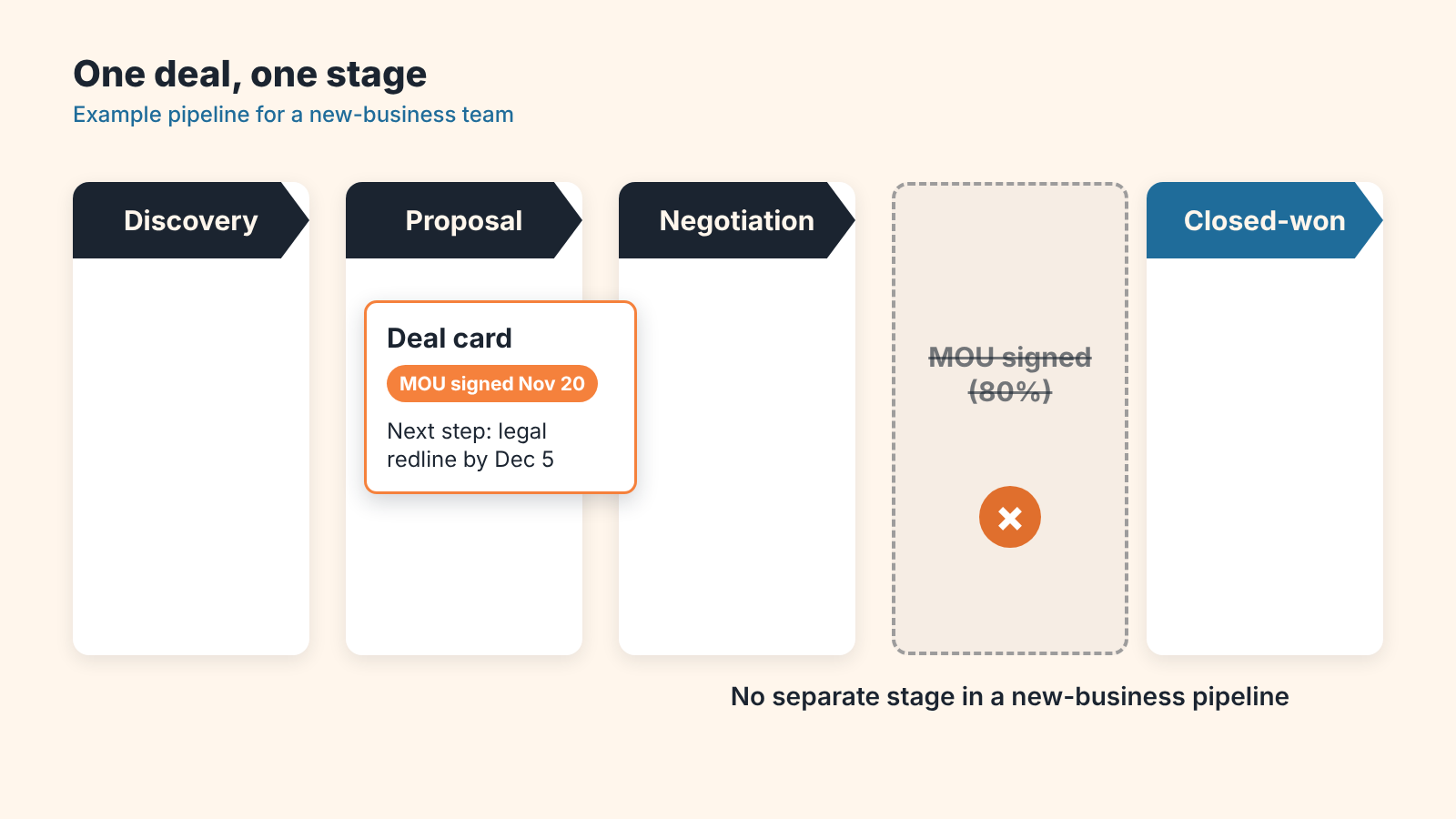
Back to the $48,000 deal. The usual advice is to add an “MOU signed” stage between proposal and contract and give it a high win probability, because a signature feels like most of the way there. We wouldn’t do that in a new-business pipeline, and the reason is what the stage would hold.
A stage should describe a step every deal passes and a change in what the buyer has committed. Most deals never have an MOU. The ones that do have gained, going by the sources above, a statement of intent with no financial commitment. Give that its own stage at 80% and the stage fills with deals that have nowhere to go. The paper is signed, nobody has drafted a contract, and the rep has a reason to stop pushing.
So leave the deal in the stage it earned by your existing exit criteria. Record the MOU as fields on the deal (next section). Then set one dated next step that belongs to the contract, such as “Buyer’s legal returns redline by December 5,” with a named person on the buyer’s side. The probability stays at the stage’s own figure (40% for Proposal in the example below).
There’s one exception. If you run a separate partnership or reseller pipeline where every deal goes through an MOU by design, a stage is fair there, because it’s a step all of them pass.
What to record: date, parties, what is promised, expiry
Seven fields on the deal cover it, and they double as a check on whether the MOU can move anything. If a rep can’t fill a field, that’s the question for the buyer’s next call.
- MOU signed date.
- Who signed for the buyer, with their role, and a yes/no on whether that person controls the budget.
- What each side said it would do, in two lines of plain text. “Buyer shares shipment data for a pilot; we scope integration” is enough.
- Price or price range mentioned in the document (yes/no, plus the figure if there is one).
- Target date for the contract. An MOU with no such date is the one to worry about.
- Expiry or review date, if the document has one.
- Legal’s note on anything they consider binding, such as confidentiality or exclusivity. Legal fills this in; the rep doesn’t interpret.
Attach the file or a link to it. A manager reviewing the the deal in three weeks should be able to read the two-line summary and the target date without opening the PDF.
Forecast rules: do not count an MOU as revenue
Take three open deals with signed MOUs, weighted by the example team’s own stage probabilities.
| Deal | Amount | Stage | What the MOU contains | Stage probability | Weighted amount |
|---|---|---|---|---|---|
| A | $48,000 | Proposal | No price, no contract date | 40% | $19,200 |
| B | $30,000 | Negotiation | Price range, contract targeted for December 19 | 60% | $18,000 |
| C | $72,000 | Discovery | Signed by a department head, budget owner unknown | 20% | $14,400 |
| Total | $150,000 | $51,600 |
Treat “MOU signed” as nearly closed at 90% and the same three deals forecast at $135,000. That’s $83,400 more than the stage-weighted figure, and none of it rests on a commitment to pay.
The rules we’d write down for the team fit in one paragraph. An MOU never changes how much of the amount counts; the stage does that. A deal with an MOU stays in the pipeline, and it moves into commit only when it has both a target contract date and a named budget owner. Until both exist it sits in best case (some teams call the category upside). By that rule deal B is worth a conversation about commit, and A and C stay where they are. If the target contract date or the MOU’s expiry passes with no contract draft, review the deal that week and reset the close date honestly. Closed-won waits for a signed contract or a received purchase order, whichever your team has agreed on.
Deals that sit in one stage after the paperwork is signed are a pipeline-quality problem as much as a legal one. SalesBond’s free CRM audit works from the last 30 days of your connected CRM and sends a PDF report covering money at risk, deal health and the pipeline bottleneck, then a second PDF seven days later showing what changed. If MOU deals have been parked, the pipeline bottleneck part of that report is the place to look first. Check your CRM with SalesBond.
Before the next forecast call, filter open deals where “MOU signed date” is filled and “target contract date” is empty. How many of them are in this quarter’s number?