

Lead time is the time between a customer placing an order and receiving the product or service. For a sales owner, the one that counts is the lead time a rep promised on the quote (the “about three weeks” a buyer hears on a call and remembers). So put it in the deal as a date. Check it every week, because a late delivery can cost you the customer’s next order, and that’s the expensive part.
OneMoneyWay’s business dictionary defines it as “the time taken from receiving an order to delivering the final product or service” (OneMoneyWay: Lead time). Two words, by the way, when you use it as a noun.
Lead time, sales cycle, cycle time: which clock is running?
A rep says “we’re at about six weeks” in a pipeline review. Six weeks to close the deal, or six weeks to ship the order? Those are two separate clocks, and a team that mixes them up will sooner or later quote the wrong one to a customer.
The sales cycle runs from first contact to a Won deal (we cover how to measure it in sales cycle length in Pipedrive). Lead time starts where that clock stops, at the order, and runs until the customer has the goods or the service is live. A deal can have a 60-day sales cycle and a 10-day lead time. Or the reverse. You’ll also find sales blogs that use “lead time” for the days from a new lead to a closed deal. That’s the sales cycle under another name, and this article doesn’t use the term that way.
There are several kinds of lead time, too. The kind a sales owner tracks is customer lead time, which runs from the customer’s order to the customer’s delivery. Pipedrive’s lead time guide (as read in November 2026) lists six types and calls this one order lead time (Pipedrive: What does lead time mean?). Supplier lead time sits upstream of it. OneMoneyWay describes it as the time a supplier takes to deliver raw materials or components to the business, and when it grows, your customer’s wait grows with it.
Cycle time is the third term, and it belongs to production. According to Edworking’s guide, cycle time is “the time taken to complete one production cycle”, while lead time “encompasses the entire process, including any waiting times or delays” (Edworking: How to calculate lead time). So a machine can finish a unit in two hours and the customer still waits three weeks, because the order sat in a queue first.
How to calculate lead time: one subtraction
Need the lead time formula? It’s one subtraction. Elmasys writes it for order fulfilment as “Order Delivered Date – Order Received Date = Order Lead Time” (Elmasys: Lead Time, a comprehensive guide). Edworking breaks the same number into parts: “Lead Time = Processing Time + Transit Time”. A sales team can run the first version from its own CRM, since both dates are deal data.
Say a distributor of commercial kitchen equipment pulls its last five delivered orders (an invented example, so don’t benchmark against it). If you sell through distributors yourself, we’ve laid out how such a pipeline looks in CRM for manufacturing.
If the term is new to you, here is what a distributor is and how its deals differ from a reseller’s.
| Order | Order received | Delivered | Lead time, days |
|---|---|---|---|
| A | March 3 | March 24 | 21 |
| B | March 10 | March 29 | 19 |
| C | April 1 | April 25 | 24 |
| D | April 14 | May 5 | 21 |
| E | May 4 | May 31 | 27 |
Sorted, the five values are 19, 21, 21, 24 and 27. The middle one, 21 days, is the typical lead time. The longest is 27. You’ll plan with the typical figure, and you’ll use the longest one to decide what a rep is allowed to write on a quote.
Five orders is a small sample. It’s enough to start. Recalculate once a quarter or sooner if a supplier changes.
So before next week’s pipeline review, pull your last five delivered orders and do the subtraction. How far is the typical figure from what your reps say on calls?
What a rep can promise on the quote
Back to the distributor. Its reps say “about two weeks” on calls, out of habit. None of the five orders in the table arrived within 14 days. Every one of those customers was told a date the company had never hit.
A rep under pressure will quote the number the buyer wants to hear. So give them a number they can defend, and a format for writing it down.
- Quote a range taken from delivered orders. For the example above, “three to four weeks” covers all five.
- Name the event that starts the clock. “Three to four weeks from signed order and deposit” removes the argument about whether the count began on the day of the phone call.
- Say calendar or business days.
- State whether the date is the day the order ships or the day it arrives (“ships by” or “arrives by”). The deal field below should mean the same thing, or the two drift apart by the transit time.
- Anything faster than the typical figure needs a yes from whoever fulfils the order (warehouse, production, onboarding) before it goes on the quote, and that confirmation gets a note in the deal.
- If the quote has a validity date, the lead time expires with it. A quote that’s been open for six weeks carries a delivery promise based on six-week-old stock and capacity; we wrote about setting that date in quote expiry and validity in Pipedrive.
When the customer comes back after the quote has lapsed, reissue it with a fresh delivery range and keep the old version on the deal (see revised quote versions in Pipedrive).
Where the promised date lives in the deal
“Three to four weeks” in a PDF attachment helps nobody after the deal is won. Nobody can filter on a PDF. The promise has to be a field.
Start with one custom date field on the deal, Promised delivery date. The rep fills it. It’s the order date plus the upper end of the quoted range, entered once the order is confirmed (in the kitchen-equipment example, an order received on June 1 with a “three to four weeks” quote gets June 29).
Why the upper end? Because that’s the last day on which the customer still got what they were told.
A second date field, Actual delivery date, is filled by whoever ships or activates the order. Empty means the customer is still waiting. Some teams add a delivery status with a few options (scheduled, shipped, delivered); it’s useful when partial shipments are common and optional otherwise. If the order itself lives in an ERP, the actual date usually comes from there, and ERP vs CRM: where the deal ends and the order starts covers who owns which record.
Make the promised date required at the move to Won. No order should leave sales without one. Then put it in the handoff note along with the clock-start event, the way we describe in the closed-won handoff in Pipedrive. The person fulfilling the order should read the same date the customer read.
The weekly check: promised date passed, nothing delivered
One saved filter does the work. It has three conditions (the deal is Won, Promised delivery date is before today, Actual delivery date is empty) and it takes a couple of minutes to build.
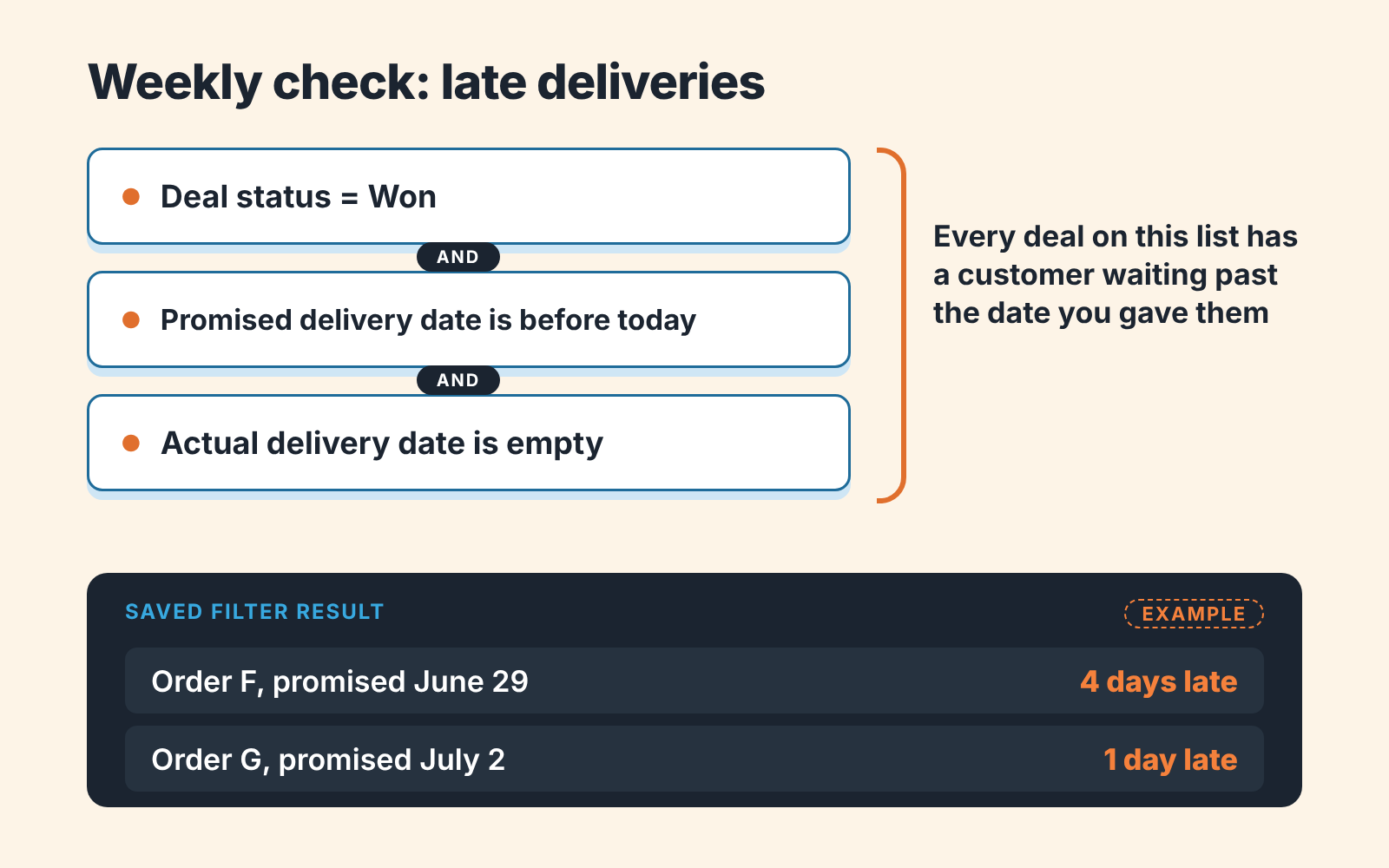
Run it on the same day every week (Monday morning works, before the pipeline review). Each deal on the list has a customer waiting past the date your company gave them. What’s the first move? The deal owner calls the customer before the customer calls you, with a new date that fulfilment has already confirmed.
A second filter catches the problem earlier. Open deals with a quote older than its validity date are carrying a delivery promise that may already be impossible, and they deserve a look before the customer signs.
Then take the late ones into the 1:1 with the rep. Start with where the promised date came from: the delivered-order range, a confirmation from fulfilment, or the rep’s own estimate. Then check what started the clock and when that event really happened, since a deposit that landed nine days after signature explains a lot of “late” deliveries. Ask whether the customer heard about the delay from your side first. And look for a pattern. A second miss with the same product line or supplier means the quoted range needs to change for everyone.
Keep the conversation on the the date and its source. A rep who quoted the approved range and still got a late delivery has done their job, and the question moves to operations.
Should you pad the promise or shorten the wait?
Most advice says to under-promise, adding a week of buffer to every quote so you look good when the order arrives early. We’d drop that as a default. A padded date loses quotes to the competitor who states the real one, and reps learn quickly that teh official number has slack in it, so they start shaving it on calls. After a few months nobody in the company knows the true lead time, including the people padding it.
A range from delivered orders does the same protective job in the open. The customer sees the likely date and the worst recent case, and the rep has nothing to shave.
Most lead-time guides go on to list ways of reducing it, and that work sits mostly with operations and suppliers. Sales owns a smaller piece, and it’s worth owning: the days between a customer’s yes and a complete order. Missing specifications, an unsigned form, an unpaid deposit. By the formula those days fall outside lead time, yet the customer counts every one of them. A checklist of what makes an order “received” (and a rep who collects it on the day of the yes) shortens the wait the customer feels without touching the warehouse.
You build the weekly filter yourself in your CRM. The other end of the problem, the customer who goes quiet after a late delivery, is what Repeat Sales in SalesBond watches. It works out each repeat customer’s buying cycle as the median interval between their purchases and marks the customer overdue once the time since the last purchase passes that cycle. For a first look at your own data, the free CRM audit reads the last 30 days of your CRM and sends a PDF report that includes repeat customers; a second PDF seven days later shows what changed. Check your CRM with SalesBond.
FAQ
What does a 3-week lead time mean?
The customer should expect delivery about 21 calendar days after the event that starts the clock, usually the signed order or the deposit. If the quote means business days, it should say so.
What is the difference between lead time and cycle time?
Cycle time is how long one unit takes to produce. Lead time runs from the order to delivery and includes queues and waiting, so it’s always the longer of the two.
Is lead time the same as the sales cycle?
No. The sales cycle ends when the deal is won, and lead time starts at the order and ends at delivery.
Is lead time the same as delivery time?
Delivery (transit) time is one part of lead time. Lead time also covers order processing and production or picking.