If most of your wins land in the last week of the month, read the commission plan before you talk to the reps. A bonus that pays only above a threshold pulls effort toward the end of the period, and you can check this yourself without a new report: list last month’s won deals, count them by day of the month, and see how much of the month arrived in the last five days. That share is the hockey stick, measured on your own deals. Put it next to the threshold in the plan. In our experience the two usually explain each other.
Three weeks of nothing, then the 29th
A made-up scene with made-up numbers, but a familiar one.
Wilhelmina runs a team of six. On the 22nd she opens Pipedrive and the month shows two won deals. The forecast slide for Monday says the team is at roughly a third of plan. She drafts the message in her head: we need to pick up the pace.
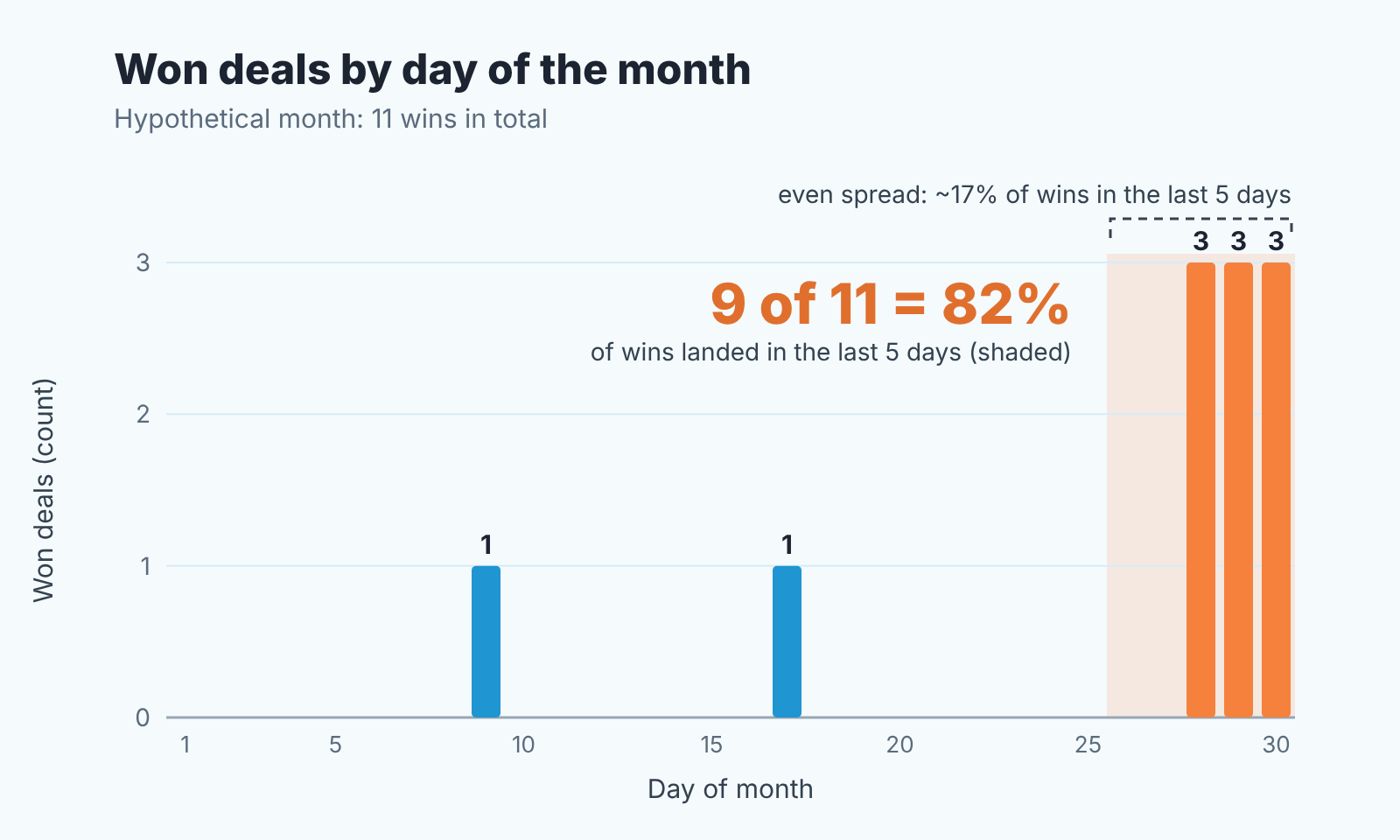
She never sends it. Between the 28th and the 30th, nine deals close and the month ends above plan. The month before did the same thing. So did the one before that.
Most of what’s written about this shape blames procrastinating reps or prescribes forecasting software. Neither tells Wilhelmina whether her 22nd is normal.
What she needs first is a number: how skewed her own month is, measured on her own deals. Second, the commission plan, open to the page that says when the bonus pays. Hers pays when a rep’s won revenue for the month clears a line, and pays nothing below it. The rest of this post is how to get the number and why the two documents tend to agree.
Count your own skew: won deals by day of the month
Pipedrive’s Deal performance report in Insights counts deals started, won and lost in a period (Pipedrive: Insights reports, deal performance), which is fine for a monthly total. For a count by day we go to the Deals list, because it shows every won deal with its won time, and the rest is arithmetic.
- Open the Deals list view and apply the predefined Won filter. Add the Won time, Value and Owner columns through the gear icon, then sort by Won time and take last month’s deals.
- Get the rows into a spreadsheet with “… > Export filter results”, or read them off the screen if the list is short.
- For each deal, note the day of the month from its won time. Then add up two shares for the last five calendar days: the share of the month’s won deals by count, and the share by value. Those are your skew numbers.
- Repeat for the two months before, because one month is an anecdote and three are a pattern. Then split by owner. A team-level skew of 50% that comes from one rep is a different conversation from one that comes from everyone.
What counts as a lot? If wins were spread evenly across the calendar, the last five days would hold about 17% of them (5 of 30; 16% in a 31-day month). If you’d rather count working days, the last five working days of a month with about 22 of them hold about 23%. Either works. Just don’t compare a working-day share against a calendar-day benchmark.
Our rule of thumb, and it is a rule of thumb rather than a finding, uses calendar days. Under 30% in the last five days is ordinary lumpiness, and we would leave it alone. Between 30% and 60%, open the commission plan. Above 60%, the month is really one week with a three-week preamble, and the plan is the first suspect.
Two more checks before you trust the number.
Run the same list with the predefined All lost deals filter for the same month and note the day each one was lost. If losses also pile into the last days, reps are clearing out deals that won’t make the threshold while they close the ones that will. Same mechanism, seen from the other side.
Won time can also be edited after the fact. Who should hold that permission, and what to write down when it’s used, is in changing a deal’s won date in Pipedrive. For the skew count the point is simpler: take it on the first working day of the next month, from the same list you use to close the month, so the number you measure is the number that was reported.
Why thresholds create the spike
The clearest study we know of is a working paper by Sohoni and colleagues, 2007 version, on car dealers and the bonuses manufacturers pay them (Sohoni et al., working paper). Two findings carry over to a sales team. Threshold incentives, where a bonus or quota pays only once a line is crossed, produce a rush at the end of the period. A shortage of information produces one too: when the people chasing the threshold can’t see where they stand until late, they act late. The authors’ suggestion for the manufacturer is to manage the spike by delaying the point at which the threshold is calculated.
Kellogg Insight’s write-up of the same research calls the end-of-period behavior a “manic rush” and adds the other half: dealers who could not reach the month’s goal waited for the next month’s target (Kellogg Insight). The step to a sales team is our inference, not theirs. A rep who has already missed the line has every reason to let a deal that could close on the 27th slide to the 1st.
The limits are real. Dealers sell cars, the manufacturer sets the bonus, and the paper is a working version from 2007. Nobody in it runs a five-person software team in Pipedrive. What transfers is the mechanism, and its enough to explain Wilhelmina’s month. A rep below the line on the 20th pulls everything that will move; a rep who can’t reach it sits on what’s left. Both put deals on the boundary, from opposite directions.
So our position: a month-end spike is more often a sign of the threshold than a sign of a lazy team. The rep who closes on the 29th did the work in the three weeks before. The plan told them which day to press the button. If you measured a skew above 30% and your bonus pays nothing below a line, start with the line.
What the last-week deals look like
Numbers aside, the deals that close in the last five days have a look to them, and you learn it by opening ten of them.
Wilhelmina does this with her nine. Three carry a discount the rep hadn’t mentioned in the pipeline review. One had an expected close date that moved twice in the previous month, each time to the next month-end, with no note about who proposed the new date. We’ve written about that pattern in the close date you keep pushing; the point here is that the pushed date and the last-week close are often the same deal seen twice. Deals marked won before the signed order arrives are the other usual suspect, and that one is a definition problem, cheaper to fix than the the plan (the won-time post above covers it).
There is no sourced percentage for any of this, so we won’t invent one. What we can give you is the question to ask about each deal. Did the buyer choose the 29th, or did we? A buyer whose budget expires, or whose signer leaves on holiday, chose the date for thier own reasons, and that deal would have closed on the 29th under any commission plan. A discount offered to sign before month-end is the cost of the threshold, and it belongs on the same page as the bonus.
Small moves that flatten it without removing the bonus
Nobody here is arguing for taking the bonus away. A threshold bonus is a legitimate plan, and how to choose between a flat rate, a tier and a bonus is in sales commission structures for a small team. This section is about the window and the date, which you can change without touching the rate.
Count a date the rep can’t choose. Sohoni and colleagues suggest delaying when the threshold is calculated; for a small team the nearest equivalent is counting the signed order or the first invoice rather than the click on Won. We made the same case for spiffs, which are thresholds in miniature with spikes of their own, in sales spiffs for a small team.
Lengthen the window. Kellogg’s write-up lists longer measurement windows (three months or more for car dealers), rolling windows and realistic targets, and reports that DaimlerChrysler lengthened its windows and lowered targets (Kellogg Insight). A quarterly threshold still has an end. It just has one end in three months instead of three.
Make the standing visible early. The information half of the Sohoni finding is the one small teams forget. If reps only learn on the 25th where they stand against the threshold, the 25th is when they start moving deals. A weekly line in the team meeting, won revenue against threshold per rep, takes a minute and removes the surprise.
Change one thing at a time, at a quarter boundary, and remeasure the skew three months later with the same count. If the share in the last five days hasn’t moved, the plan wasn’t the cause, and now you know that too.
What to tell the forecast: the last week can’t be extrapolated
The forecast on the 22nd is the real casualty of the spike. If 60% of a month’s wins arrive in the last five days, a team at a third of plan on the 22nd is on track, and a straight-line projection from day 22 is wrong by design. Don’t extrapolate the handle to find the blade.
Instead use the skew you measured. From three months of counts by day you can read off how much of a typical month is in by the 10th, the 20th and the 25th. Compare this month’s running total to those marks rather than to the calendar. “We are at 35% on the 22nd, and our last three months were at 30% to 40% on the 22nd” is a sentence a manager can plan from. “We are at 35% with eight days left” is not.
Say the shape out loud when you present the number: “most of our wins land after the 25th, so the mid-month figure undercounts.” It keeps the conversation on the plan rather than on who is behind. The wider habits are in sales forecast accuracy for small teams; the December version, where the buyer’s own year-end adds a second threshold on top of yours, is in which deals will really close by December 31.
A disclosure, since this sits in our territory: we build SalesBond, a sales management layer on top of the CRM a team already uses; we started with Pipedrive. Deal Health checks every deal in the connected CRM against more than 20 rules, in categories that include Forecast and Progression, so the deals behind a skew show up before the 29th rather than after. It won’t compute your day-of-month share, that’s the spreadsheet above, but if you want to see the deals behind it, check your CRM with SalesBond.
Back to Wilhelmina. She counts the three months before this one, hypothetical like the rest of her: 71%, 64% and 78% of won deals in the last five days. Her plan pays a bonus on monthly won revenue above a line. She doesn’t send the message about pace. She takes the count and the plan to the owner and asks for a quarterly window and a definition of won that means a signed order. The spike won’t vanish next month. But the 22nd stops being a crisis, and that was the part that was costing her.