
The sunk cost fallacy is the habit of carrying on with something because of the time and money already spent on it, even though the payoff still ahead doesn’t justify spending more. OpenStax’s Principles of Economics 3e (section 2.1) defines sunk costs as “costs that were incurred in the past and cannot be recovered” and says they “should not affect the current decision”; the psychology of why they still do was studied by Arkes and Blumer in “The Psychology of Sunk Cost” (Organizational Behavior and Human Decision Processes, 1985). In a sales team it shows up as the “almost closed” deal that reps keep working because half a year went into it, while the buyer hasn’t done anything for weeks. Those hours are gone whichever way you decide. What matters is what the next hour on that deal is likely to return.
A sunk cost fallacy example from a sales team
Picture a $40,000 annual contract with a logistics company. A five-rep team has been on it since May (every number below is invented for the example). It’s late November now. Here’s the CRM record.
| What the CRM record shows (example) | Value |
|---|---|
| Deal value | $40,000 |
| Age of the deal | 6 months |
| Calls logged | 14 |
| Proposal versions sent | 3 |
| Discount already offered | 10% |
| Rep hours logged | about 45 |
| Last reply from the buyer | 47 days ago |
| Days in the “Proposal sent” stage | 96 (the team’s median for this stage is 18) |
At Monday’s review the rep says, “We’ve put six months into this one, we can’t drop it now.” Heads nod. The only argument anyone offers for the next hour is the 45 hours behind it. Nobody at the table mentions a single thing the buyer did since early October.
Now run the same deal forward. Keeping it alive through December will take about six more hours: a couple of follow-up calls and a fourth proposal, plus a pricing chat inside the team. For the chance of a win, skip the stage probability from your pipeline settings and use your own history. Filter closed deals for the ones that sat in this stage longer than 60 days, then count the wins. Say the team finds 3 wins out of 52, which is about 6%.
Next to it sits an $18,000 deal where the buyer booked a demo last week. Deals like that one closed 35% of the time in the same history.
| Next month (example) | Stale $40,000 deal | $18,000 deal with a demo booked |
|---|---|---|
| Rep hours needed | 6 | 6 |
| Chance of a win, from the team’s closed deals | 6% | 35% |
| Expected revenue | $2,400 | $6,300 |
| Expected revenue per hour | $400 | $1,050 |
Look for the 45 hours in that table. They’re missing on purpose. They would be the same number in both columns of any choice the team can still make.
Sunk cost vs opportunity cost vs marginal cost
The same OpenStax textbook gives the other two terms in one line each. Opportunity cost “is the value of the next best alternative” (section 2.1), and here that’s the $18,000 deal that would get those six hours. Marginal cost “is the cost of producing one more unit of output” (section 7.3); in a deal, read it as the six extra rep hours plus any further discount. Both of those are still ahead of you, so both go into the decision, and the 45 hours stay out.
Want the arithmetic on real CRM numbers? Each term has its own guide on this blog: opportunity cost and the next best deal and marginal cost and when a discount still pays. This one stays with the psychology and the exit rule.
How it looks in a pipeline: “almost there” for six months
A stale deal keeps its seat through vocabulary. “They’re still interested.” “Budget opens in Q1.” Each update reports what the rep believes the buyer intends. Neither describes something the buyer did. If your reviews run on sentences like these, the difference between hopeful and cautious reporting is covered in sandbagging vs happy ears.
The forecast makes it worse. In the example, “Proposal sent” carries a 60% stage probability, so the weighted pipeline shows $24,000 for a deal the team’s own history prices at $2,400. As the owner you see a healthy number. Would you question it?
The rep has reasons too. OpenStax puts the first one plainly in its section on sunk costs: dealing with them “often means admitting an earlier error in judgment.” On top of that, in plenty of teams a closed-lost deal counts against the person who closes it. Research has a name for the result. Barry Staw called it escalating commitment in his 1976 study “Knee-deep in the big muddy: a study of escalating commitment to a chosen course of action” (Organizational Behavior and Human Performance). So the deal stays open, gets one more “checking in” email every two weeks, and that email refreshes the record.
The usual advice at this point is to ignore the past completely and cut your losers after a fixed number of days. We disagree with both halves. As a cost, the past hours are gone. As evidence they’re the best you have: fourteen calls followed by 47 days of silence say more about the odds than the stage name does. So we take the hours off the cost side and keep the history for estimating the probability. And a blanket age limit closes long deals that are moving. A nine-month deal where procurement answers every week is healthy, which is why we’d tie the exit rule to buyer action and treat age as a prompt to look. For telling the two kinds apart, see stalled deals vs dead deals.
Signals your CRM already holds
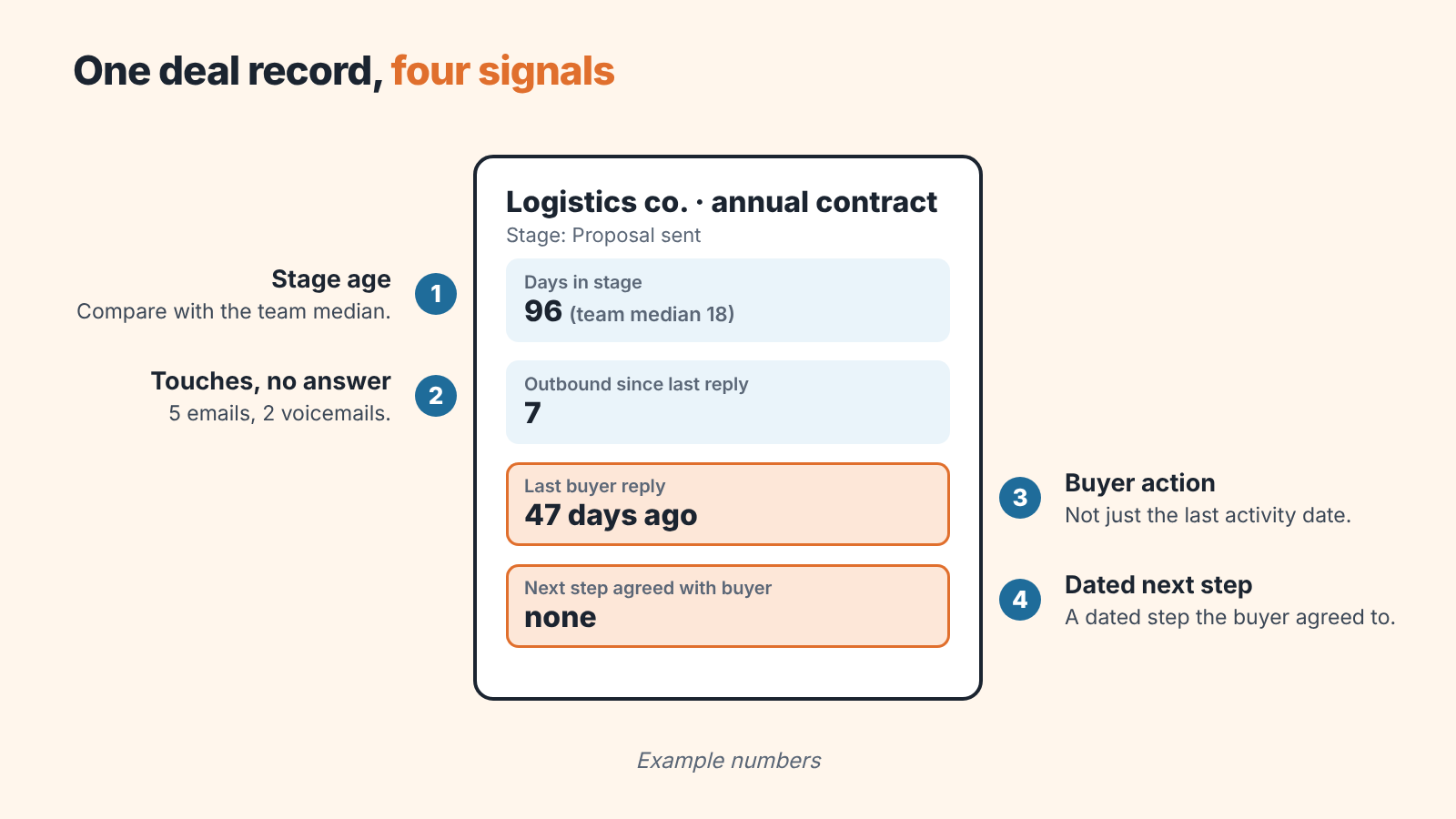
Start with days in the current stage. The raw count means little until you put it beside your team’s median for that stage. A deal sitting at several times the median (96 days against 18 in the example) deserves a question at the next review.
Then count outbound activities since the buyer’s last reply. In the example deal it’s five emails and two voicemails, seven touches with nothing coming back. Any CRM can show you that, as long as emails are synced and reps log an outcome on each call.
The date of the last buyer reply is the hardest of the four to get right. Check which events move your CRM’s “last activity” date. If an email sent by the rep moves it, a deal that’s being chased looks fresh, and youll need a filter on inbound messages or a custom date field the rep fills in after each real reply. Settings differ by CRM and change over time, so look at yours as it stands today.
Last, the next step. Is there a dated activity the buyer has agreed to, such as a call in their calendar or a document they promised by Friday? A task that says “follow up” belongs to the rep alone. Our deal review questions about buyer action give the wording for asking this without starting an argument.
Building these views by hand takes an afternoon, and somebody has to reopen them every week. A disclosure, since this is where our product sits: we build SalesBond, a sales management layer on top of the CRM a team already uses. Its Deal Health checks every deal against more than 20 rules and shows which ones a deal breaks. The free CRM audit looks at the last 30 days of your CRM and sends a PDF report that includes money at risk, deal health and the pipeline bottleneck. Seven days later a second PDF shows what changed. Deciding whether to close the deal stays with the owner and the rep. Check your CRM with SalesBond.
How to avoid the sunk cost fallacy: three questions before another hour goes in
What has the buyer done in the last 30 days?
Look for something the buyer did: a reply, a meeting they showed up to, a document they sent, a colleague they brought in. Opening an email doesn’t count. Thirty days is our example threshold; a fair starting point for your team is about twice the normal gap between buyer replies in deals you won.
What would the next hour buy, and at what odds?
Ask the rep to name the action and the buyer-side event it should cause (“I send the revised terms, their CFO signs by the 12th”). For the odds, use the win rate of your closed deals with a similar silence, as in the 3-out-of-52 example above.
Which deal gets that hour if this one doesn’t?
If the rep can name a deal with recent buyer action, the hours move there. If the queue is truly empty, another hour on the stale deal costs very little, and it’s fine to keep going.
When the first two answers come back as “nothing” and “low” and the third has a name in it, close the deal as lost with the reason “no buyer action”. Send the buyer a short note saying you’re closing the file and how to reach you if the project returns. Then set a task to look again in 90 days.
A shorter check works in the meeting itself. Would we open this deal today, knowing what we know? For the example deal, at 6% odds and 47 days of silence, the honest answer is no.
The rule has limits. It doesn’t fit a deal where the buyer gave a dated commitment in writing (a board vote on February 3, say), since silence until that date is expected. An owner may also decide to keep investing in a strategic account on purpose. In that case give it an hour budget per month and say so out loud, so everyone knows it’s a bet.
What do you tell the rep? Something like, “Those 45 hours were a reasonable bet on what you knew in May. I’m asking about December.”
Where sunk cost hides outside deals
Start with tools. Say the team paid $6,000 in January for an annual plan on a prospecting tool, and by June three of the five reps have stopped opening it. The pressure to “get our money’s worth” pushes work through a tool that slows people down. The $6,000 is spent whether anyone logs in again or no one does. What’s still open is whether the tool saves time over the remaining months and what happens at renewal, so put the renewal date in the calendar now with a note of who actually uses it.
Discounts work the same way. The 10% offered in month two quietly becomes the floor, and when the deal stalls the rep asks for five more “so the first ten weren’t for nothing.” Each further cut is a fresh decision about margin on this one deal. On a $40,000 contract, those extra five points are $2,000 off the price.
Then there’s the customer a rep “has invested in”. The account got custom reports and weekend calls during onboarding, it buys little and the rep defends every hour because of the history. Pull the last twelve months of revenue from that account, set it beside the hours logged, and ask the same three questions you’d ask about a deal.
What to do with the hours you get back
Closing the example deal frees about six hours a month. If each of five reps carries two deals like it, that’s 60 hours a month across the team (5 reps × 2 deals × 6 hours, example numbers).
Freed hours disappear into the week unless they’re assigned on the spot. In the same review where the deal is closed, have the rep name the the deal that receives the time and book its first activity before the meeting ends. Pick by buyer action in the last 14 days; deal size comes second. No better deal in the queue? Then the hours become a prospecting block with a fixed slot in the calendar.
A month later, check two numbers in the CRM: how many deals were closed with the reason “no buyer action”, and whether the median days in your slowest stage went down.
FAQ
Is a sunk cost always a waste?
No. Money and time spent on a reasonable bet were well spent even when the bet lost. The fallacy begins only when that past spending is used as the reason for the next spend.
How is the sunk cost fallacy different from persistence?
Persistence has fresh evidence in front of it, like a buyer who replied last week or a meeting on the calendar. With the fallacy, all the evidence is behind you. In a deal review, ask for the most recent buyer action and its date, and you’ll hear which one you’re dealing with.
How many days without a buyer reply should close a deal?
There’s no number that fits every team. Take your own won deals and find the longest gap between buyer replies in each. If, for example, nine out of ten won deals never went more than 21 days without a reply, a deal at 45 days of silence is far outside what winning looks like for you.
Should a closed stale deal be deleted from the CRM?
Keep it, marked as lost with its reason. Those records are what gives you the win rate for long-silent deals, the figure the second question of the exit rule depends on.
What is it called when you throw good money after bad?
Usually escalation of commitment. Barry Staw studied it in 1976 as “escalating commitment to a chosen course of action”, the subtitle of his paper. In sales it looks like the fourth proposal or the extra discount on a deal the buyer stopped answering.