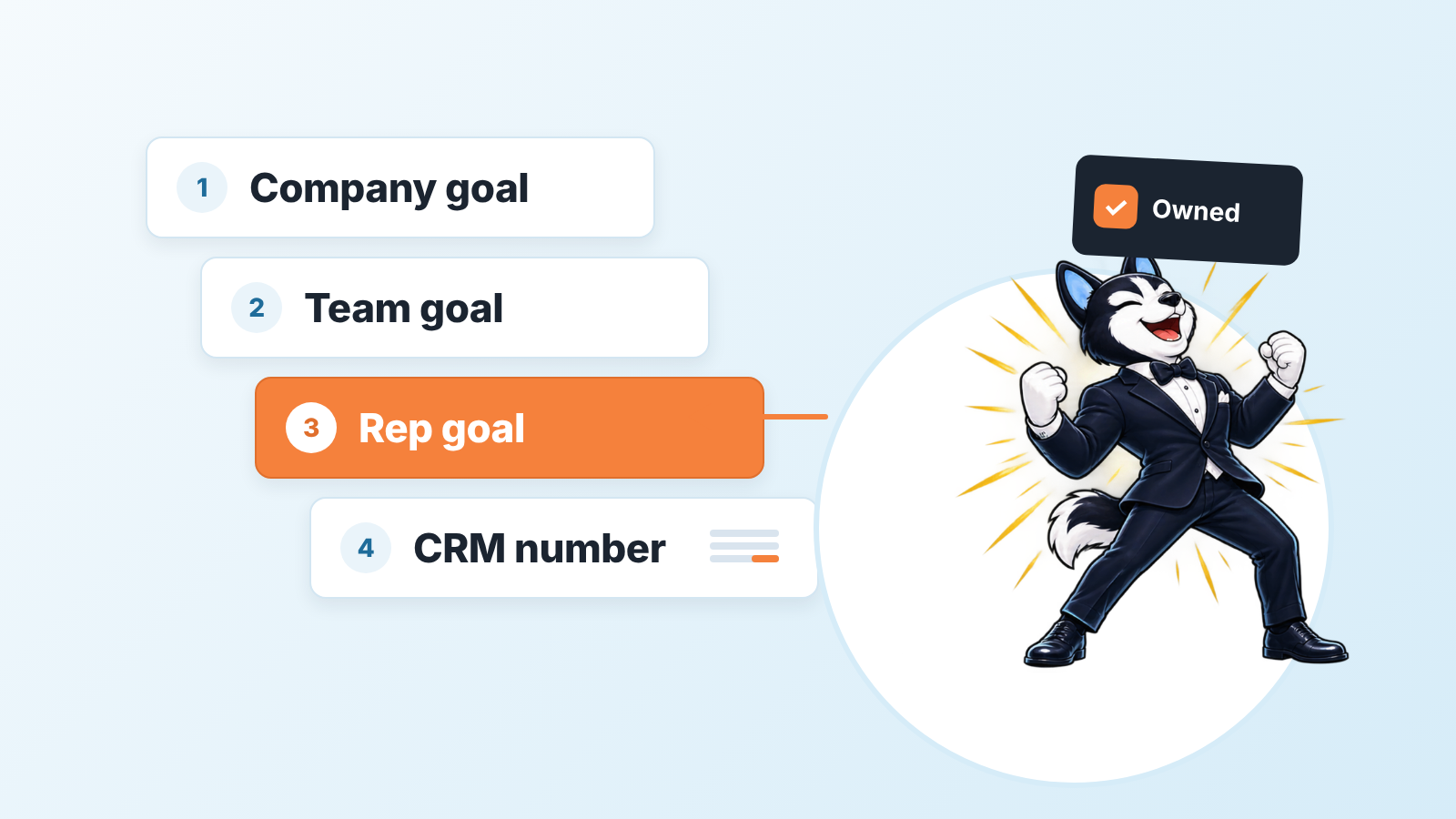
Goal setting is the work of deciding on a result, a deadline and a measurable indicator, and then naming the person who owns it. In a sales team the goal works when its number comes out of the CRM, it has exactly one owner, and the rep has said back to you how the number is counted. For a team of three to fifteen people that takes a four-step ladder from company goal to rep goal, a fifteen-minute conversation with each rep, one CRM report behind each goal and a check in week six or seven of the quarter.
Setting a goal in any role
Strip the sales vocabulary away and every work goal I have seen hold up had the same six parts. A result someone outside the team would recognise. A date. One number that says whether the result happened. One owner. A short plan for the first two weeks. And an agreed day to look at the number again.
Here is an example from outside sales, with made-up numbers. Your office manager handles supplier invoices, and late payments keep costing you discounts. The goal becomes: every supplier invoice paid within ten days of arrival, from April 1 to June 30, counted from the accounting tool’s payables report, owned by the office manager. The plan for week one is to move invoice approval to a single person; the check is the first Monday of each month. Nobody will ever call that inspirational. It works because on any Monday both of you can open the same report and get the same answer.
Personal-productivity guides compress the routine into four steps: choose the goals, write them down, track your progress, celebrate the wins (MindJournals: goal setting). That holds for a team too. The part a team adds is acceptance, because the person who sets the goal and the person who owns it are usually two different people.
What goal setting means when you own the business
For an owner, goal setting means turning one company number into numbers other people hold. An HR glossary describes the process as identifying measurable goals and building a timeline and plan of action to reach them, with strategic planning, time management, motivation and focus among the benefits (Akrivia HCM: goal setting). Ramsey Solutions sorts goals into seven areas of life, with career as one of the seven, and advises writing goals down for accountability (Ramsey Solutions: types of goals).
Both are written for the person who sets a goal for themselves. An owner sets goals for other people, and that adds the acceptance step. A goal counts as set when the rep can explain it back to you: the number, how it is counted, and what has to happen in their pipeline for it to land. Until then you have a number on a slide. We agree with Ramsey on writing it down, and we write it in the CRM, where the fact lives and where the team looks every day.
If you have searched for the three types of goals, the standard answer comes from sport psychology: outcome goals, performance goals and process goals. Outcome goals name the result you want. Performance goals measure improvement against your own earlier level, so they sit more within your control. Process goals name the techniques and actions behind a good performance (Human Kinetics: creating an action plan).
A sales team uses the same three under plainer names, and we set exactly one of each per rep. The result goal is money or won deals in a period. The pipeline goal says what has to enter or move through the pipeline for the result to be possible, and it plays the part of the performance goal. Then one behaviour goal, a habit you can read from the CRM, like a next activity on every open deal. That one is the process goal. You will also meet goal-setting theory, the academic line of work on how goals affect performance; we leave it aside, because none of it changes what you type into the CRM on Monday.
From the company number to a rep number: a six-person team
The ladder has four steps, and every step is one number with one owner. We will walk it with a made-up team so the arithmetic is visible. Every figure in this section is an illustrative example; yours come out of the last two quarters of your own CRM.
The owner’s number comes first. Say the budget needs $1.2M of new-business revenue this year. That is the company goal, and the owner holds it. The quarter’s share is $300k, and that becomes the team goal, held by the head of sales, or by you if that is still your job. Both numbers are closed-won revenue in the new-business pipeline, counted by won date. Write that counting rule next to the number the first time you say it, because it will come up again in every conversation below. If the words quota, target and forecast are already blurring, we pulled them apart in sales quota vs target vs goal vs forecast.
Now the split. Six reps, two of them in their first six months. The equal split gives everyone $50k and gets it wrong twice: it asks the new reps for a number their pipeline cannot carry, and it lets the established reps coast. In the example we give the four established reps $60k each and the two newer reps $30k each. That adds to $300k, and each rep holds exactly one of those numbers.
Then one rep’s ladder goes a step further, down to the pipeline. Take Dana, one of the four at $60k. Her average won deal over the last two quarters is $6k, so she needs ten won deals. Her win rate from the Qualified stage (the share of deals that reached Qualified and were later won) has been 25%, so about forty deals have to reach Qualified. Her average sales cycle, the days from a deal’s creation to its close, is fifty days, which means a deal that is to close by March 31 has to exist by early February, and qualifying it by late January leaves room for a slip. Her pipeline goal writes itself: forty deals in Qualified by January 20. Her behaviour goal is a next activity scheduled on every open deal, checked Monday mornings. She can read all three from the CRM without asking anyone.
If you want the one-page version of this ladder for the whole team, with the planning numbers taken from CRM reports, we described it in a one-page sales plan for a small team, and the yearly frame it hangs on in a one-page strategic plan with CRM evidence.
SMART helps with the wording and fails at the ladder
SMART stands for Specific, Measurable, Achievable, Relevant and Time-bound (WSU HR: goal setting), and some authors stretch it to SMARTER (MindJournals: goal setting). We use it exactly once, as a spell-check on the bottom rung. “Dana closes $60k of new business, counted by won date, in Q1” passes all five letters. “Dana improves her pipeline” fails three of them and should never leave the meeting room.
Above that rung SMART stops helping. It tests a goal in isolation. It cannot tell you whether six rep goals add up to the team goal, whether the team goal adds up to the company goal, or who counts the number and from which report. It also hands you the A for Achievable as if you could judge it from your chair. You can’t. The rep is the only person who can argue whether forty qualified deals by January 20 is realistic, so that letter gets settled in the conversation in the next section, with the rep in the room.
The fifteen-minute goal conversation
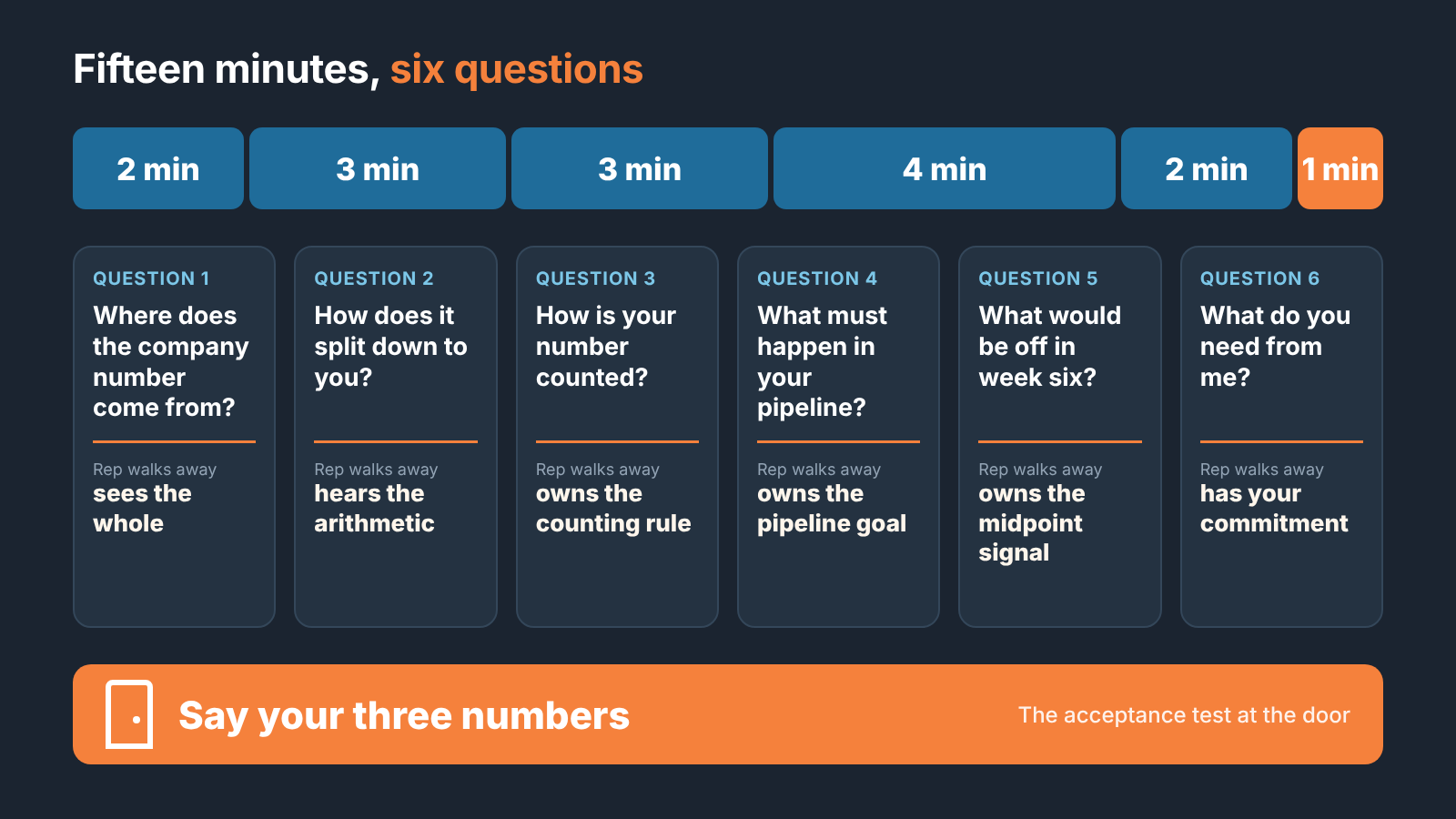
Fifteen minutes, one rep, the CRM open on the screen between you. By the end the rep should be able to repeat the number, the counting rule and the pipeline goal without looking at anything. If the meeting runs forty minutes, either the number is wrong or the data behind it is, and both are worth knowing now.
- “This is the team number and where it came from.” Two minutes. Show the top two steps of the ladder. Reps accept a share more readily when they see the the whole.
- “This is your share and how I got to it.” Say the arithmetic out loud: average deal, win rate, cycle. If you used last year’s win rate and the rep knows the territory changed, this is where it surfaces.
- “Tell me how this number is counted.” The rep answers; you stay quiet. The answer you want sounds like “closed-won, won date inside the quarter, new-business pipeline only”. If the rep cannot say it, the goal is not set yet, whatever the spreadsheet says.
- “What has to be true in your pipeline for this to happen?” Build the pipeline goal together. Most reps land close to the number you computed, and when they land far from it, one of you is using a wrong assumption. If you also want a stretch number on top, say so out loud and keep it apart from the committed one; the difference is in quota vs target vs forecast.
- “What would make you say in week six that this is off?” Agree the midpoint signal in advance. Usually its the pipeline goal, because the result goal lags it by one sales cycle.
- “What is the one thing you need from me?” One thing, written down with your name on it. Pricing approval under two days, a list from marketing, a demo environment. The goal is a two-sided agreement, and this is your side.
Then type the goal into the CRM while the rep watches. In the tools that have a goals feature, this is the goal record itself. In the ones that don’t, it is a saved report with the rep’s name and the period in the title. The acceptance test is at the door: “Say your three numbers.” If they come back without a pause, you are done.
One goal, one owner, one CRM number
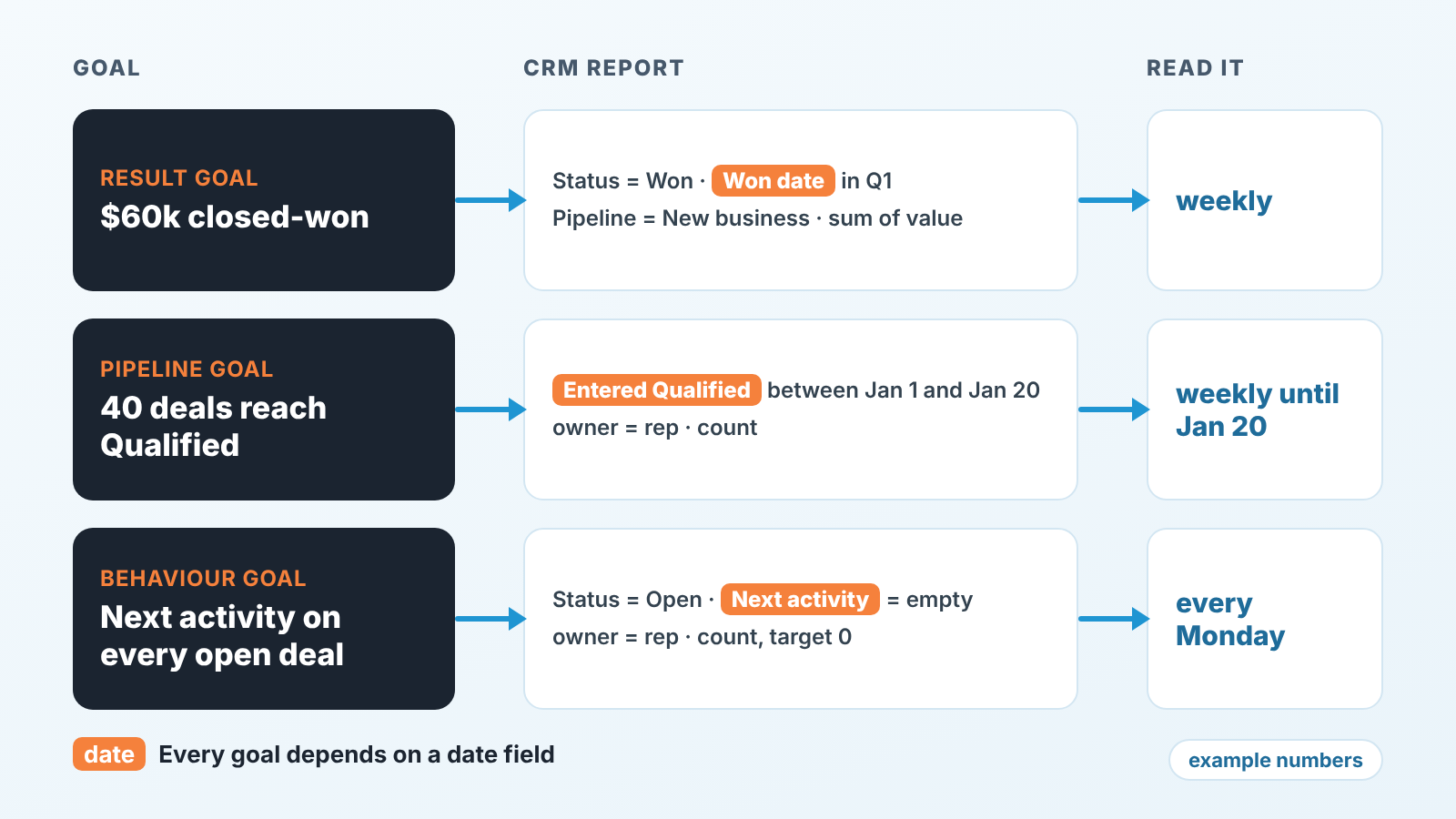
Put the goal in a spreadsheet and it gets counted once a quarter, by whoever remembers, with whatever filter they had that day. Put it in the CRM and the same report counts it every Monday. So each of the three goal types gets one report, and we name the fields before we name the number. Drawn as a table, the three rows below make a workable goal-setting template for a sales rep.
The result goal is a won-deals report: status won, won date inside the period, filtered to the pipeline the goal is about, summed by deal value. The pipeline goal needs stage history, because “forty deals reach Qualified” is a count of deals whose entered-stage date for Qualified falls in the window, and a CRM that only stores the current stage cannot answer it. The behaviour goal is the simplest filter in the system: open deals with no next activity scheduled, owner equals the rep. On Monday morning that list should be empty. We went through the fields behind these and the other usual metrics in sales performance metrics and the CRM fields behind them.
HubSpot is the one CRM where we will be specific, because its goals feature is well documented. Managers build sales goals from HubSpot’s templates and assign them at the user, team or pipeline level, measured weekly, monthly, quarterly, yearly or over custom dates. Sales Hub Starter gets the Revenue goal only; Professional and Enterprise add Deals created, Calls made and Meetings booked, and a meeting counts toward a goal only when its “Activity assigned to” property has a value (HubSpot Knowledge Base: create sales goals). The same page says goal progress updates every eight to 12 minutes, which is often enough for a Monday check. The step-by-step is in HubSpot Goals for rep targets.
Before you set a quarter’s goals on those fields, find out whether the fields can carry them. I build SalesBond, a sales management layer on top of the CRM a team already uses; we started with Pipedrive. The free CRM audit is where I would start here: SalesBond reads the last 30 days of your CRM and sends a PDF report with money at risk, a CRM score, managers, deal health, the pipeline bottleneck and what to fix, then a second PDF seven days later showing what changed. If that report shows won deals without a won date, or deals that skipped Qualified entirely, you have learned it before you set a goal on that field, which is the cheap moment to learn it. Check your CRM with SalesBond. Once the goals are in, Sales Plan keeps target, current attainment, forecast and the gap between them on one screen, with fact and forecast kept apart, so the Monday question “where are we” takes one look.
The midpoint check, and what to do when a goal is off
Week six or seven of a thirteen-week quarter. Sit down with each rep for ten minutes and look at four things: attainment against time elapsed, the pipeline goal, the midpoint signal you agreed in the conversation, and the Monday behaviour list. At this point the pipeline goal matters most. The result goal still has a sales cycle to run and will look bad even when the quarter is fine.
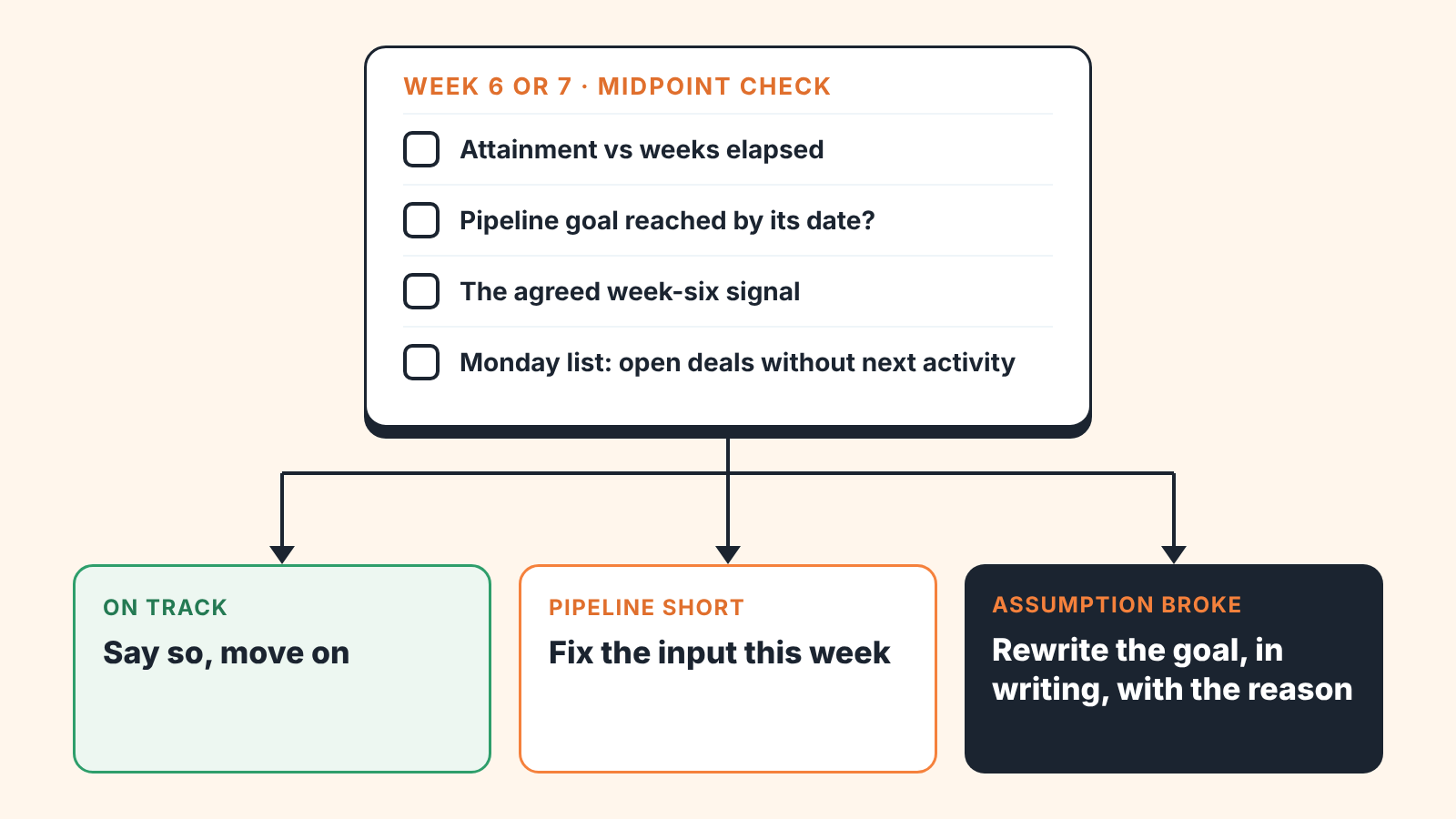
Three outcomes come out of that check. The goal is on track: say so in one sentence and spend the rest of the ten minutes on deals. Or the pipeline is short while the result is still reachable. Fix the input this week, which usually means prospecting time or a marketing hand-off, and move the pipeline date. Or an assumption broke: the average deal shrank, a key account left, the win rate was last year’s. Then the goal is wrong, and keeping it does more damage than changing it.
Change it openly. Rewrite the number in the CRM with the reason in the notes, tell the team what changed and why, and do it at most once per quarter. A goal lowered in writing with a reason keeps the next goal credible. Leave a goal at an impossible number and everyone learns that goals are decoration, so the next conversation starts from zero. When the thing that broke is a conversion step make fixing that one step the goal for the next quarter; the OKR shape works well for that, and we showed how to read it from the CRM in OKRs for a small sales team.
Mistakes we keep seeing
The equal split. Six reps, team number divided by six, everyone gets the same figure. It feels fair and it is lazy. The new rep gets an impossible number and the senior rep coasts on one they hit in week nine.
Goals that live in the owner’s spreadsheet. The rep saw it once in January. By March nobody can find the file, the filter that produced the number is gone, and the argument about whether a deal counts happens after the quarter ends.
Activity as the main goal. Fifty calls a week is a behaviour goal and has its place as one of the three. As the only goal it produces fifty logged calls and no revenue, because the CRM counts what gets logged.
Changing the counting rule mid-quarter. A deal from the renewal pipeline gets pulled into the new-business number because the quarter looks thin. Everyone notices. You pay back whatever you gained that quarter in every goal afterwards.
Setting goals on a CRM nobody trusts. If won dates are missing and stages get skipped, the report that counts the goal is fiction, and the rep knows it before you do. Clean the field first, or pick a goal on a field thats already clean.
More than three goals per rep. One result, one pipeline, one behaviour. Add a fourth and one of them gets ignored, and the rep decides which.
Pick one rep this week, run the fifteen-minute conversation, and see whether they can say their three numbers at the door. If the CRM fields behind those numbers worry you, sign up for SalesBond and start with the free CRM audit.