
What strategic planning is, and the five parts of the plan
Strategic planning is the yearly cycle in which a company’s leaders look at where the business stands, choose a direction and a few priorities, and write them into a strategic plan they check every quarter.
A strategic plan is a short document that states where the company is now, where it wants to be in a set period, the few priorities that will get it there, and the numbers that will show whether it is working. For a small company, take the baseline numbers from your CRM (closed-won revenue, win rate, sales cycle, average deal), set the targets against that baseline, and review them every quarter.
That is five parts: where we are, where we are going, three priorities, the measures, and a review date. Everything else people put into strategic plans (mission statements, SWOT grids, a page of values) is optional on the page itself. A SWOT does its work during the planning session and rarely needs to be printed in the plan.
Two documents sit below this plan and get confused with it. A sales plan is the quarter’s arithmetic: how many deals at what average value get the team to the target. A sales strategy is how the team works the pipeline to get there. The strategic plan sits above both. It is the owner’s document about the whole company, and sales is one of its sources, usually the only one already measured every day. Before you set targets, it helps to write down your business model in a few lines and see where each part shows up in your pipeline stages.
How far ahead should it look? For a small company we keep the horizon to one to three years. The textbook horizon is longer: NC.gov’s guidance for state agencies has the plan cover the next three to five years. That suits an agency with a fixed mandate. A ten-person company whose biggest customer can leave next spring is better served by a plan it can actually see the end of.
Plan, strategy, business plan: which document you are actually writing
People use the three words for the same file, so a quick sort.
A strategy is the set of choices: which customers, what offer, why they pick you. It can be three sentences. A strategic plan is the strategy plus a baseline, targets, owners and review dates, so you can tell a year later whether the choices worked. Strategic planning is the work; the strategic plan is the page it produces. A business plan is the longer document written for outsiders, a bank or an investor, with market analysis and financial projections. You write it when someone asks for it.
If you have a strategy in your head but nothing on paper you need the plan. If you have a plan with no numbers in it, you have a strategy that cannot be checked. That second case is the common one.
Strategic planning for the whole company: the cycle, step by step
Most small companies we talk to plan sales once a year and plan the company never. Hiring happens when someone quits and the price list changes when a supplier raises theirs. Each decision makes sense on the day. Added up, they point nowhere in particular. Strategic planning is the yearly habit that fixes this: money and hiring follow the same three priorities, and twelve months later you can see which of your decisions did anything at all. HBS Online makes a related point. Going through the process forces you to explain why you are making each decision and to back it up with data, projections or case studies, which keeps your own biases in check (HBS Online: Why Is Strategic Planning Important?). For a small company most of that data lives in the CRM, which is why the cycle starts there.
The cycle has five steps.
- Look at where the company stands. Pull the four numbers from the CRM (closed-won revenue, win rate, sales cycle, average deal) with a source line under each, add cost base and cash from the books, and run a short SWOT on top of them. How to pull the numbers, and what goes wrong the first time, is in the baseline section.
- Choose a direction and a horizon. One sentence about where the company is in one to three years: what revenue, which customers, what is different about the business at the end. A mission or vision statement can sit above that sentence if the owner wants one. The plan works without it.
- Pick three priorities that move the baseline toward that sentence. The test for each is in the priorities section: one owner, one report that shows it moved.
- Turn each priority into targets, an owner, a budget and a first set of actions. A priority with no money and no hours set aside for it will sit in the plan untouched until the next review, even when the budget is only “four hours a week of Anna’s time”. Targets and owners covers the format.
- Review quarterly, rewrite yearly. Four dates in the calendar, the CRM open during the review, and a full rewrite that starts with the same four numbers twelve months on.
The Balanced Scorecard Institute lays out a five-step version that opens with mission and vision, then a situational analysis with SWOT as one of its exercises, then goals, action plans and monitoring (Balanced Scorecard Institute: Strategic Planning Basics). We put the numbers first and the direction second, so that a vision statement for a small business owner has the win rate and the rest of the baseline to stand on.
Where SWOT fits
A SWOT grid is a tool for step 1 and nothing more. It has a place in the cycle because it forces the room to say out loud what the numbers only imply, and because opportunities and threats are the half of the picture the CRM never sees.
Fill it from the baseline first. Strengths and weaknesses are internal, and for a small company most of them are already sitting in the won deals report. A win rate above your own history on one customer type is a strength; write it down with the number next to it. A sales cycle that doubled in the second half of the year is a weakness. So is a loss-reason field that says “other” on half the lost deals, because it means you do not know why you lose. Opportunities and threats come from outside: calls with ten customers, what competitors charge, a supplier changing terms, a regulation due next year. We covered how to collect the competitor half of that in competitive analysis for a sales team. The customer half is phone calls, and nobody has found a shortcut.
Then apply one rule. Every line in the grid either produces one of the three priorities, or an action under one of them, or it gets crossed out. Twenty lines cut down to three survivors is a normal result for a grid that did its job.
The same rule answers the question we get most often: do we need a SWOT or a mission statement at all? Only if they change a decision. A mission statement nobody in the company can recite has changed nothing yet. The first year start with the five parts of the plan, leave the rest out, and see what you miss.
Who is in the room
Five people, for a company of ten to forty. The owner runs the session and makes the final calls. The head of sales brings the CRM baseline, printed, with the source lines, and is the one who gets asked why the win rate moved. Whoever keeps the books brings cost base, cash and margin because a priority that grows revenue at a loss needs catching here, in the room. The person who runs delivery or operations says what the company can actually produce if sales hits the number. And one person who talks to customers every day, a support lead or a senior account manager, brings the conversations that the CRM reduces to a stage name.
In a company of six, two or three of those roles belong to the same person. That is fine. Each role still needs a voice.
The rest of the team feeds the session before it happens. Ask them two questions in teh week before: what stopped you winning deals this year, and what would you fix first. Their answers go into the SWOT. The session itself stays with the five people above; a room of fifteen produces a list, and a list is what you have before planning starts. If there is an outside advisor or a board, they read the draft plan and attend the annual review. They can skip the working session.
A yearly rhythm a small company can keep
Say the financial year starts in January. In the first week of November the head of sales pulls the four baseline numbers with the dates set to the last twelve months, the books produce cost base and cash as of the end of October, and the owner sends the two questions to the team. That six-to-eight-week lead time exists because the first pull always surfaces unmarked lost deals and empty value fields, and cleaning them takes a couple of weeks of ordinary work. The free CRM audit from SalesBond checks the last 30 days of your CRM and sends a PDF report with its findings and what to fix, then a second PDF a week later showing what changed (Check your CRM with SalesBond). The twelve-month baseline still comes from your own pull; the audit shows what in the CRM needs fixing before you rely on it.
The working session goes in the last week of November: half a day, or a full day the first time, with the baseline on the wall and the SWOT built in the room. It ends with a direction sentence, three priorities and a first draft of the measures.
One week later the owner sends the one-page plan to the whole company. Send the page itself with the source lines on it. Anyone who doubts a number can open the report and check.
Then four quarterly reviews, in the first week after each quarter closes, run the way the quarterly review section describes. They sit next to the sales team’s own week 4, 8 and 12 checkpoints on the quarterly sales plan and should stay a separate meeting.
The quarterly review changes actions and occasionally a target, it should leave the three priorities alone, or the plan stops being a plan. The annual rewrite begins the following November with the same pull, the dates moved forward a year, and the gap between last year’s targets and this year’s baseline is the most useful page you will read all year. HBS Online describes strategic planning as an ongoing process; this calendar is what ongoing looks like at a company of twelve.
The baseline comes out of the CRM, not out of memory
Every strategic plan we have seen fail started with a baseline the owner estimated. “We close about a third.” “A deal takes a couple of months.” The CRM has the real figures, and they are usually less flattering.
You need four numbers, all from the same twelve months, pulled on the same day. Closed-won revenue is the won deals report, filtered by won date for the last twelve months and summed on the deal value field. Win rate is won deals divided by won plus lost deals, by count, over the same period; count by deals, since by value one big deal will decide the number. Sales cycle is the average days from deal created to deal won, on those same won deals. And the average deal is simply closed-won revenue divided by the number of won deals.
Write each one into the plan with its source line, for example: “Won deals report, won date 2025-11-01 to 2026-10-31, pulled 2026-11-02.” That line is what makes the plan checkable. Next November someone pulls the same report with the dates moved forward and compares.
Two things will go wrong the first time. Lost deals that were never marked lost will still be sitting open, which inflates the win rate and hides the cycle; mark them before you pull. And deals with no value will drag the average down. Fix the values or exclude them, and say so in the source line. If the data is too thin or too messy to trust, write that in the plan as well. “We do not know our win rate because lost deals were not recorded” is an honest baseline and a very good first priority.
For a team with few closed deals the win rate will jump around from quarter to quarter. The sales plan article has a section on what to do with fewer than 30 closed deals; the short version is to use the whole year and expect noise.
The baseline also needs numbers the CRM does not have: cost base, cash, headcount, revenue from existing customers if your CRM only tracks new business. Those come from the books. More on that below.
Three priorities, not ten
Here is the test for a priority: can you name the one person who owns it and the one report that will show it moved? If not, it is a wish.
Three sits close to the ceiling of what a small company can carry alongside the day job. ASAE’s guide to personal strategic plans puts a realistic year at three or four goals, with one or two action steps under each (ASAE: Create Your Personal Strategic Plan). It is written for one person’s career, but a company of ten people is not much different in this respect. Every priority needs a meeting slot, an owner’s attention and some money. Ten priorities get none of those.
The baseline tells you where to look. A win rate that is low against your own history points to qualification or offer. A long cycle points to the middle of the pipeline, where deals wait for proposals or sign-off. A small average deal points to who you sell to. And if all four look healthy and the pipeline is still too small? Then the problem is at the top: not enough new deals created per month, which is a fifth number the CRM gives you for free.
Write each priority as an outcome. “Win a higher share of the deals we already get” is a priority; “launch a newsletter” is a task that might serve one. The difference shows up at the quarterly review, because an activity is always “done” and an outcome is either moving or not.
Targets and owners, the part everyone skips
A target is a number, a date and a name. Leave out any one of the three and it stops being a target.
The number has to be something the CRM, or the books, can produce on demand. Say you want to track deals by customer segment and there is no segment field. Then the first task under that priority is to create the field and fill it; the target comes after. A target on a measure nobody records cannot be checked at the review.
The name is one person. Shared ownership reads well and fails quietly. For a company of eight, the owner will hold one priority, the head of sales another, and the third goes to whoever runs the the thing it is about.
If you want a tighter shape for the measures, the OKR format works well here: one objective per priority, two or three key results, each a CRM field or report. The full method is in how to pull key results straight from CRM data. In the strategic plan the key results are the measures column, and they are the same reports you pulled for the baseline.
The quarterly review, with the pipeline open
Pick a date now, one per quarter and put all four in the calendar before the plan is finished. Without them, the first review tends to slip until the plan is out of date.
The review itself is short when every measure has a source line. For each priority, open the report named in the measures column. Compare to the target. Then decide one of three things: keep going, change the action, or change the target. Write the decision in the plan, with the date. That is the whole meeting.
Keep the CRM open on the screen rather than pasting numbers into slides the week before. The reason is practical. A slide shows a number; the pipeline view shows the deals behind the number, and the conversation that matters (“why are these six proposals still open from June?”) only happens when people can see them.
This quarterly review differs from the in-quarter checks on the sales plan. Those test whether this quarter’s revenue is on track, and the week 4, 8 and 12 checkpoints are the right tool. The strategic review asks a slower question: is the direction right, and are the three priorities moving the baseline? A team can miss one quarter and still be on the plan, or hit four quarters and still be off it if the deals it wins are the wrong ones.
What the CRM cannot tell you
The CRM knows what happened to the deals you logged. It does not know about the deals you never saw, and that gap is most of the market.
So it cannot tell you how big the market is or how much of it you hold; that needs outside figures, and we have a separate piece on estimating market share for a small company. It cannot tell you your margin, because cost of delivery lives in accounting, not in the deal record, and a priority that grows revenue at a loss is one you want to catch early. It cannot tell you why customers buy, only that they did; the why comes from calling ten of them. It usually cannot tell you about churn or renewals unless someone built that into the pipeline deliberately. And it has no idea what competitors are charging.
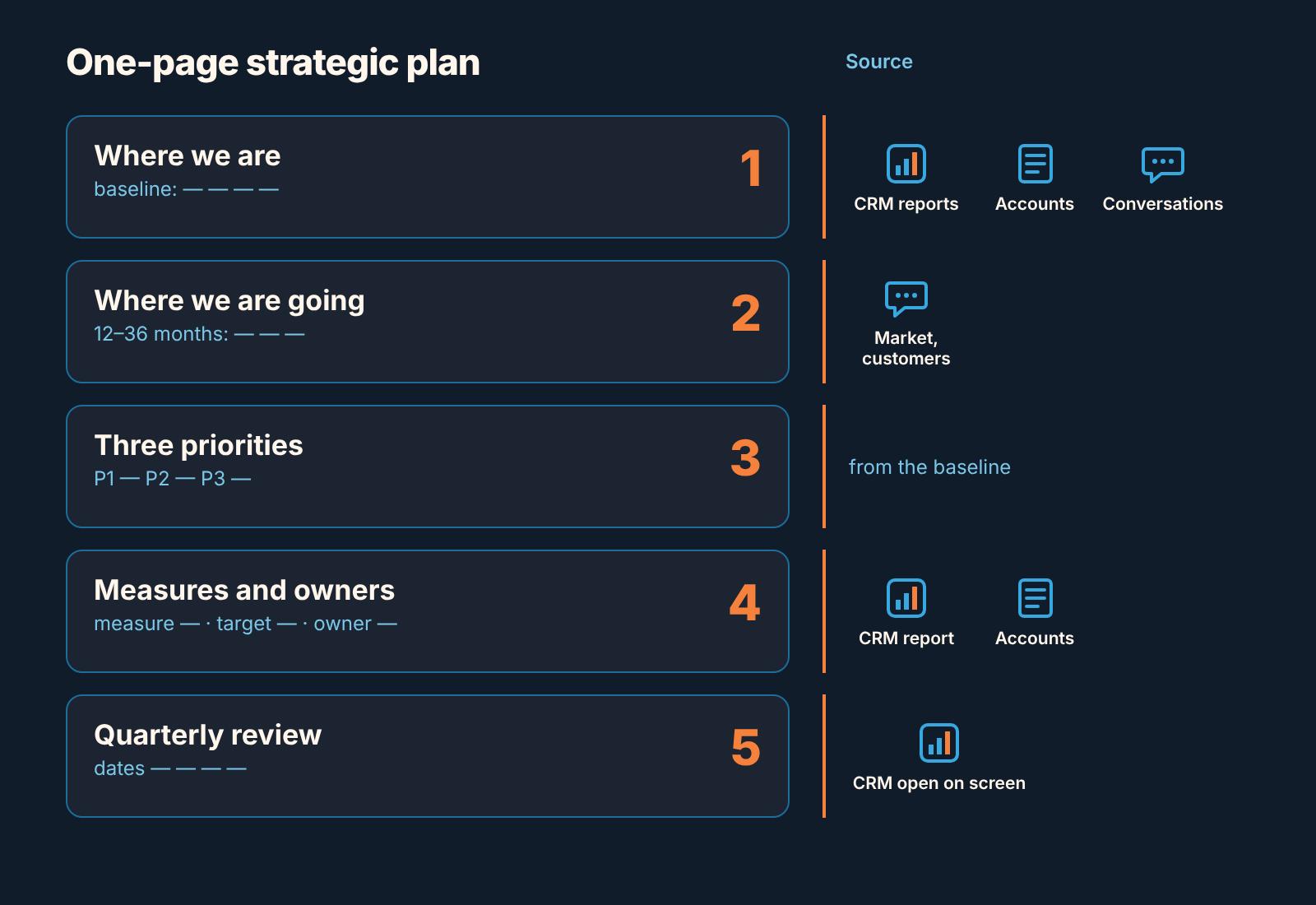
This is why the one-page plan should mark each line by it’s source. CRM-sourced lines are fast and checkable every quarter. Book-sourced lines come once a year with the accounts. Conversation-sourced lines (market, customers, competitors) are the ones you have to go and get, and they are the easiest to leave as last year’s guess. Once the source is written next to each line, you can see which half of the plan is a guess.
A one-page strategic plan template
Plain text, so you can paste it into whatever you write in. Replace the brackets; leave the “Source” entries, they are the point. The plan itself is one page; the appendix is a folder of saved CRM report links and can be as long as it needs to be.
STRATEGIC PLAN  [company]  [date written]  horizon: [12 / 24 / 36 months]

1. WHERE WE ARE (baseline, last 12 months)
   Closed-won revenue   [    ]   Source: won deals report, won date [from]–[to], pulled [date]
   Win rate             [    ]   Source: won / (won + lost), by count, same period
   Sales cycle          [    ]   Source: avg days created→won, same deals
   Average deal         [    ]   Source: closed-won revenue / won deals
   New deals per month  [    ]   Source: deals created, same period / 12
   Cost base, cash      [    ]   Source: accounts, [period]
   What we do not know  [    ]   (e.g. market share, churn, why customers buy)

2. WHERE WE ARE GOING ([horizon])
   One sentence. Revenue, customer type, and what is different about the company at the end.

3. THREE PRIORITIES (outcomes, not activities)
   P1 [                 ]   Owner: [name]
   P2 [                 ]   Owner: [name]
   P3 [                 ]   Owner: [name]

4. MEASURES AND TARGETS
   P1 → [measure]  baseline [ ]  target [ ] by [date]   Source: [CRM report / accounts / survey]
   P2 → [measure]  baseline [ ]  target [ ] by [date]   Source: [ ]
   P3 → [measure]  baseline [ ]  target [ ] by [date]   Source: [ ]

5. QUARTERLY REVIEW
   Dates: [Q1] [Q2] [Q3] [Q4]      Who attends: [ ]
   Decisions log: [date] – [priority] – keep / change action / change target – [note]
What does section 4 look like once it is filled in? Here is a hypothetical one for an invented company. The numbers stay in brackets on purpose, because yours come from your own reports.
HYPOTHETICAL EXAMPLE
P1 Win a higher share of the deals we already get        Owner: head of sales
   → win rate, by count   baseline [from won deals report]   target [baseline + a few points] by [end of Q4]
P2 Cut the time deals wait for a proposal                Owner: [whoever writes proposals]
   → sales cycle, days created→won   baseline [ ]   target [ ] by [date]   Source: won deals report
P3 Know which customer type we make money on             Owner: [owner]
   → margin by segment   baseline: not known   target: first figure by [date]
     Source: accounts + a new segment field in the CRM
One page. If it runs over, the plan is carrying something that belongs in the sales plan, the task list, or the SWOT you were supposed to cross out.