Sales conversion rate is conversions divided by the group you started with, times 100. A B2B team has four such groups, so four rates: lead to deal, deal to won, stage to stage, and activity to meeting. “Our conversion rate is 20%” means nothing until you name the denominator. Most small teams need two: lead to deal and deal to won.
Why two teams report 20% and 6% as “conversion rate”
Much of what ranks for this query is written for online shops, where the rate is orders divided by visitors and everyone shares one denominator. A sales team has no visitors. It has leads, deals, stages and calls, and a conversion can be counted between any two of them.
So when a manager says 20% and a rep on the same team says 6% nobody is lying. The manager divided won deals by closed deals. The rep divided the same won deals by every lead that came in. Both are conversion rates. They answer different questions, and the argument that follows is about the denominator. Performance never comes into it.
Our rule: never say “conversion rate” out loud without the two nouns around it. “Lead-to-deal conversion” or “deal-to-won conversion”, every time, in the report header and on the planning call. The habit takes a week or two to stick, and after that the planning call stops arguing about which rate is which.
Sales conversion rate formulas: four rates, four denominators
| Rate | Formula | Question it answers | Where it lives in the CRM |
|---|---|---|---|
| Lead to deal | deals created from leads ÷ leads received in the period | Is the intake worth working? | Leads Inbox or lifecycle stage reports |
| Deal to won (win rate) | won deals ÷ closed deals (won + lost) | How well do we sell what we qualify? | Won/lost or deal conversion reports |
| Stage to stage | deals that reached stage N+1 ÷ deals that entered stage N | Where does the pipeline leak? | Funnel or stage reports |
| Activity to meeting | meetings booked ÷ outreach activities done | Is the outbound motion working? | Activity list, usually exported to a sheet |
Two things are easy to miss. The win rate’s denominator is closed deals only, because an open deal has no result yet, and counting it makes the rate drop every time a rep creates a deal. And the stage rate is per stage. A pipeline with six stages gives five of them, which is why nobody should call it “the” conversion rate.
The CRM-specific versions of the two rates we recommend are already written: lead conversion rate in Pipedrive and HubSpot, and win rate in Pipedrive, HubSpot, Salesforce and Zoho CRM.
One month, one team: the same deals, four numbers
Take a team of three reps and one month, October. Example numbers only.
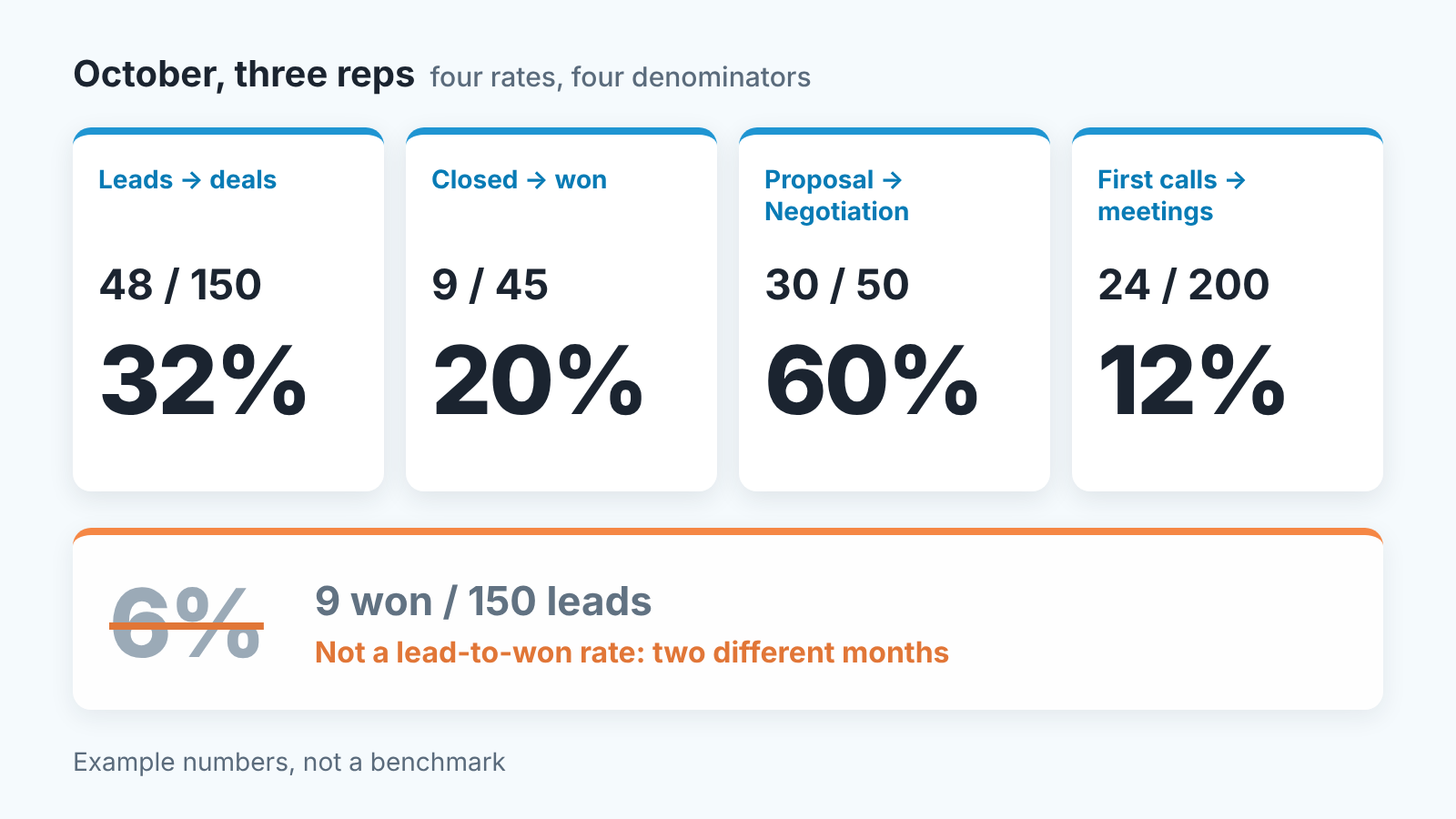
In October, 150 leads came in and 48 of them were converted to deals. Lead-to-deal conversion: 48 ÷ 150 = 32%.
In the same month the team closed 45 deals, most of them created in earlier months: 9 won, 36 lost. Deal-to-won conversion: 9 ÷ 45 = 20%.
Fifty deals entered the Proposal stage in October and 30 of them moved on to Negotiation. Proposal-to-Negotiation conversion: 30 ÷ 50 = 60%.
The reps logged 200 first calls, and 24 of them ended with a meeting booked. Activity-to-meeting conversion: 24 ÷ 200 = 12%.
And the number that started the argument: 9 won deals divided by 150 leads is 6%. It looks like a lead-to-won rate, but six of those nine wins came from deals opened in July and August, while the 150 leads are October’s. It is a ratio of two mostly unrelated groups, and it swings for reasons that have nothing to do with the team.
Which one to track for what decision
For a team of three to eight people, our position is simple: two rates on the weekly report, lead to deal and deal to won. Stage rates when something breaks. Activity to meeting only if you run outbound. Pick by the decision you need to make, whatever the CRM shows by default.
If the question is “should we keep this lead source”, the rate is lead to deal. It is the earliest number and the cheapest to improve, and it says nothing about revenue. A rep can lift it in a week by converting everything, so read it next to win rate.
If the question is “are we good at selling what we qualify”, the rate is deal to won. It is the the number for coaching, for the quarterly review and for the forecast. It moves slowly because deals take weeks to close, so judging it on a two-week window is judging noise.
If the question is “where exactly do deals die”, the rate is stage to stage: a diagnostic for when something breaks. We pull it when win rate drops, to see whether the leak is at Qualified, at Proposal or at the end. Five stage rates on every Monday report are more than a manager will read each week. The free CRM audit from SalesBond includes the pipeline bottleneck in its PDF report on the last 30 days of your CRM, so the stage to check first when win rate drops is already named. The Pipedrive version of that argument is in pipeline stage conversion rates in Pipedrive, the HubSpot one in how to read a HubSpot funnel report weekly.
Activity to meeting is for outbound teams. With inbound leads it is undefined or meaningless. With cold outreach it is the one rate that tells you whether thier list and script work before any deal exists, and it belongs to the SDR.
Where each rate comes from in the CRM
Each CRM we write for has a built-in report for at least one of these rates, and each report has a default that quietly picks your denominator.
Start with lead to deal. Pipedrive’s lead conversion report calculates converted leads × 100% ÷ total leads, and by default it looks at leads created this year, grouped by lead source (Pipedrive: Insights reports, lead conversion). That is a cohort by creation date. Do not read it as “leads that converted this month”. In HubSpot a lead is a contact at a lifecycle stage, and each stage has Date entered and Date exited properties (HubSpot: use lifecycle stages), so the rate is contacts that entered Opportunity over contacts created.
Deal to won is where the default filter matters most. Pipedrive’s win/loss conversion report, with default filters, looks at deals created this year that were either won or lost, and the help page recommends filtering by won and lost status “to display the win/loss rate as expected” (Pipedrive: Insights reports, deal conversion). Keep that filter. Remove it and open deals creep into the denominator.
For stage to stage, every funnel report has a quirk to know before you quote it. Pipedrive’s funnel counts won deals as having completed every stage, no matter where they were closed (same deal conversion page). HubSpot’s funnel filters by the date of the activity, and the deal’s create date plays no part. Its own example is a deal created six months ago that still appears in a 90-day funnel because it passed through both stages in those 90 days (HubSpot: create custom funnel reports).
Activity to meeting has no standard report we would trust across CRMs. We export the month’s done outreach activities and count meetings booked in a sheet: ten minutes in any CRM.
Two mistakes that change the number without changing the selling
The first one is open deals in the denominator. In our October example the team had 70 open deals at month end. Divide the 9 wins by closed plus open, 9 ÷ 115, and the win rate reads about 8% instead of 20%. Nothing changed in the selling. A rep created deals, and the rate fell. Keep the denominator to won plus lost; the Pipedrive default above does that for you.
The second is mixing a period rate with a cohort rate. The 20% above is a period rate: deals closed in October, whenever they were created. A cohort rate asks something else. Of the 48 deals created from October’s leads, how many will be won? By 31 October only 10 of them had closed, 3 won and 7 lost, so the cohort win rate reads 30% on ten deals, with 38 still open. Both numbers are honest. Calling the period rate “October’s deals converted at 20%” is not, and HubSpot’s activity-date logic is where the two get mixed up.
And one more thing moves the number: duplicate leads. If 20 of the 150 October leads were repeat form fills, 48 ÷ 130 is about 37%, against 32% with the duplicates in. Decide whether a lead is a person or a submission; imports and duplicates in Pipedrive has the details.
FAQ
What is the sales conversion rate formula?
Conversions divided by the group you started with, times 100. In B2B, name the group: leads, closed deals, deals in a stage or outreach activities. Each gives a different number for the same month.
What is a good sales conversion rate? Is 2% good?
A 2% figure usually comes from e-commerce, where the base is site visitors, and it does not compare with a B2B lead-to-deal rate or a win rate. The useful comparison is your own rate against your previous quarters, on the same denominator.
Is win rate the same as sales conversion rate?
Win rate is one of the four: won deals divided by closed (won plus lost) deals. “Conversion rate” without the two nouns around it usually means lead to deal or lead to customer.