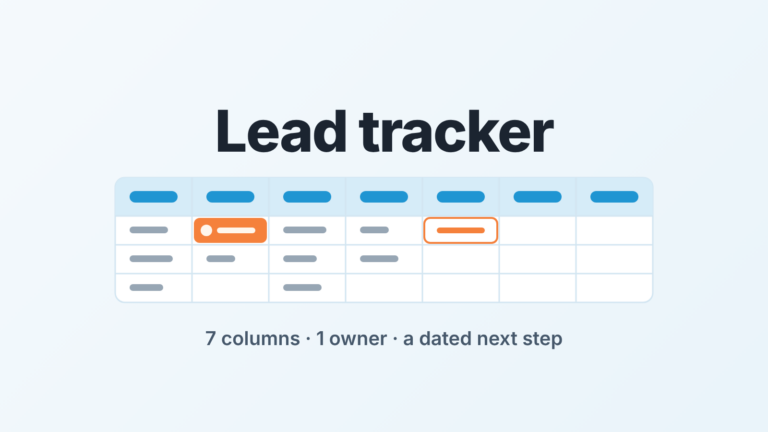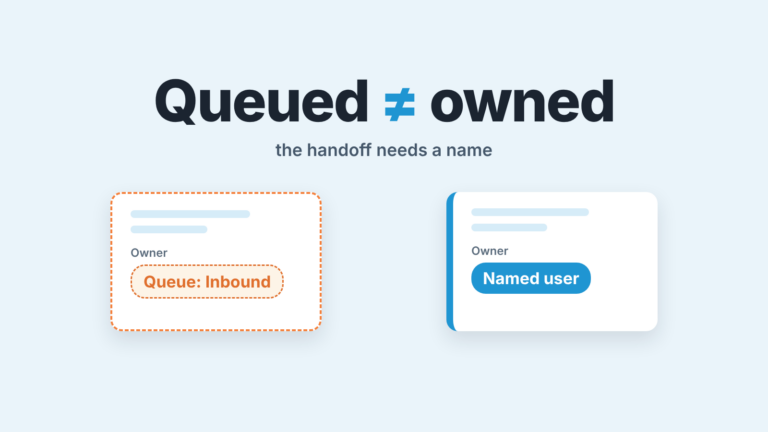
For a small team, an enterprise deal is defined by how it behaves, not by the buyer’s headcount: several people, paper you do not control, a long dated timeline and a size that can swing your quarter. Run it inside your normal pipeline and add a few things to that one deal.
Every stakeholder goes on the deal as a contact. The paper steps become dated next steps. The forecast gets reported twice, with the deal and without it. You do not need an enterprise sales motion. You need five changes to one deal record and one weekly habit.
What enterprise sales means when you are five reps
Salesforce frames enterprise sales as selling to large companies, where the deal can mean a large business impact, a multiyear contract, a complicated implementation and a lot of risk (Salesforce: what is enterprise sales). That describes a job. It is not much use when you have three reps, one pipeline, and a logo in it many times bigger than anyone else you sell to.
So we use a deal test instead of a company-size test. A deal is enterprise-shaped if at least three of these are true:
- You have talked to more than two people at the buyer, and none of them can sign alone.
- Someone on their side has mentioned security, legal, procurement or a vendor form, and you cannot name the person who owns that step.
- There is a date on their side that is not your close date: a budget cycle, a pilot end, a board meeting, a contract renewal with the vendor they want to replace.
- The value is larger than your usual deal by enough that winning or losing it changes what you tell the owner about the quarter.
Two out of four is a big deal. Three or four is enterprise-shaped, and it will not behave like the rest of the pipeline no matter what you call it. A mid-sized buyer with a procurement team and a pilot can score four. A famous logo buying a single seat on a card can score zero, and you should treat it like any other deal.
The test is about behaviour, not status. Reps get attached to logos. The logo does not slow a deal down; the people, the paper and the clock do. Some enterprise-shaped deals start as a formal request; tracking an RFQ response in the CRM keeps its deadline visible.
Four things that change: people, paper, clock, size
An enterprise-shaped deal differs from your usual one in four ways: more people, paper you do not control, a longer dated clock, and a size that bends the forecast. Vendors often wrap this into four stages; Gong, for one, uses Discovery, Diagnosis, Design and Delivery as its headings (Gong: what is enterprise sales). Fine for a team that can run a second process. A small team cannot, so give each of the four a place in the CRM instead.
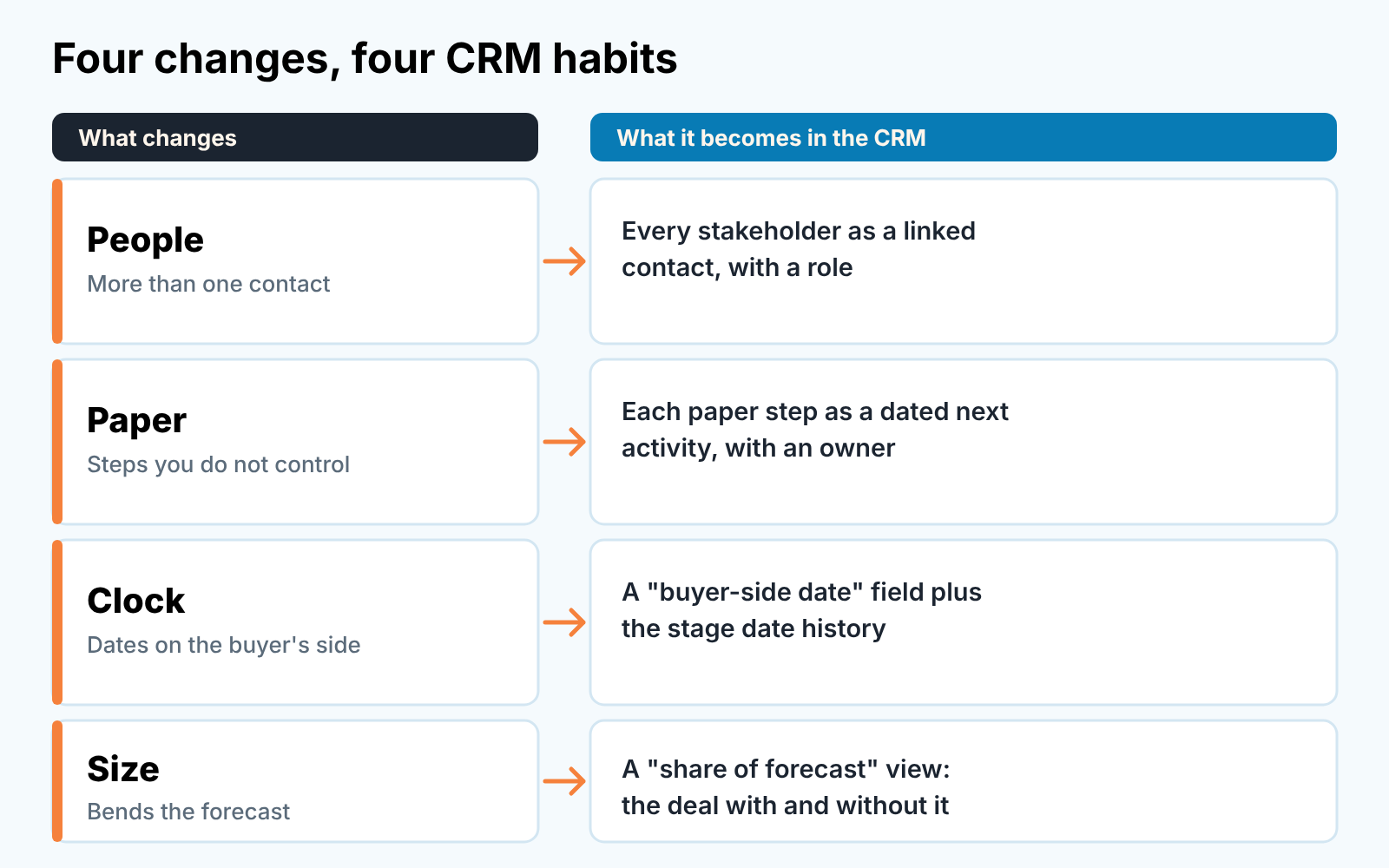
People. Your normal deal has one contact who is also the buyer. An enterprise-shaped deal has a champion, an economic buyer who may never join a call, a technical reviewer, and whoever runs the paper. One contact on the record is the biggest risk here: if that person leaves or goes quiet, you have no deal and no way to find out why.
Paper. Security questionnaire, legal redlines, a vendor onboarding form, procurement sign-off. You do not control the order, the owner, or the duration of any of these. They run in parallel with your stages and, on a small team’s default pipeline, out of sight.
Clock. A normal deal has an expected close date and a rep’s instinct about it. This one has several dated events on the buyer’s side, and your close date is downstream of all of them. If the only date in the CRM is the close date every slip looks like a rep problem and nobody can see what actually moved.
Size. The deal may be worth more than the rest of the quarter’s open pipeline combined. A weighted forecast, where each deal’s value is multiplied by its stage probability and the results are added up, was built for a pipeline of many similar deals. One deal of this size makes the weighted number say whatever that deal’s probability says. At that point the forecast is a bet with a label on it.
Set up the enterprise deal in your CRM
Should one big deal get its own pipeline? No. A second pipeline holding one deal is a pipeline nobody opens, and the forecast distortion it is meant to fix is handled by two numbers: the quarter with the deal and without it. Keep the deal in your normal stages, don’t add a stage called “Enterprise”, and let the one record carry more information.
Here is what we add to it:
- Every stakeholder as a contact linked to the deal, with a role a manager can see: champion, signer, technical review, procurement, legal. Names typed into a note do not count.
- A buyer-side date field: the one date on their side that your close date depends on (pilot end, budget approval, the renewal date of the incumbent). Pipedrive lets you add it as a custom field on deals (Pipedrive: custom fields); any CRM that supports custom deal fields will do.
- A paper status field with fixed options: not started, security in review, legal in review, procurement, done.
- Each paper step as a dated next activity with an owner on your side. Not “follow up on legal” but “Send redlines back to their counsel by Thursday, owner: Anna.”
- A close date set from the buyer-side date rather than from hope. If the pilot ends on the 20th and procurement takes its own time after that, the close date is not the 21st.
If your CRM makes any of these hard, write the missing piece in the deal description with a date next to it. The point is that the next person who opens the deal, including you in six weeks, can see who is involved, what paper is open and which date actually matters.
If the buyer is going to run a pilot before they sign, treat the pilot as its own dated event with its own exit criteria; see our piece on proof-of-concept and pilot deals. If the buyer agrees to a shared timeline, a mutual action plan for small teams is the lightweight version of this list that lives on their side too.
The paper stage: security, legal, procurement, and who owns each
Small teams lose enterprise-shaped deals in the paper, not on the demo. The paper itself is rarely hard. The trouble is that nobody on your side owns it and nobody on their side is in a hurry.
The security questionnaire usually arrives as a long spreadsheet. Decide now who answers it: the founder, your most technical person, or an outside advisor. Put a date on it. Keep the completed one; the next enterprise-shaped deal will send almost the the same sheet.
Legal is redlines on your terms, or their paper instead of yours. Decide in advance what you will concede without a call (payment terms, notice period) and what you will not (liability caps, IP). Every round of redlines is a dated activity on the deal, with the date they promised their answer by.
Procurement is the step with the least to do and the most waiting. Find the person who actually raises the purchase order, add them as a contact, and ask your champion one question: “What does procurement need from us before they can start?” Then do that before they ask.
We wrote a longer piece on deals stuck in legal and procurement. The short version: a deal in the paper stage with no activity scheduled on it is not “waiting on them”. It is a deal nobody is working. If several of these start piling up and you find yourself inventing approval rules on the fly, that is the moment a deal desk for a small team starts paying for itself, even if it is one person and a shared document.
Keep it from eating the quarter
Here is what happens without a rule. The big deal is exciting, the rep spends a growing share of the week on it, the owner asks about it in every one-to-one, and the normal deals that would have closed this quarter quietly stall because nobody scheduled thier next steps. Then the big deal slips a quarter, which enterprise-shaped deals do for reasons that are nobody’s fault, and you miss on both.
So we run the big deal with a rule about its share of the forecast and a rule about the rep’s time.
The forecast rule: the quarter’s number is reported twice, with the big deal and without it. The number without it is the commitment; the number with it is the upside. Put the share on the deal itself as a one-line note, “This deal is X% of the quarter’s open pipeline”, using whatever your CRM shows that week. Illustrative arithmetic, not a benchmark: with 400,000 in open pipeline and 150,000 of it in this deal, one deal carries more than a third of the quarter. We explain how to show the range in one big deal in the forecast. The owner should be able to say both numbers from memory.
The time rule: the rep who owns the big deal keeps a fixed number of normal deals active and visible, and the manager checks that list weekly, not the big deal. Ten minutes on Monday. Open the big deal, read the buyer-side date, the paper status and the next activity, ask whether anything changed on the buyer’s side since last week, and stop. Spend the rest of the time on the rep’s other pipeline, because that is where the quarter actually comes from. The big deal gets it’s own longer review once a month or when a stakeholder changes, whichever comes first.
Then a capacity rule, worth saying out loud at the planning meeting: an enterprise-shaped deal costs the time of one rep plus a slice of whoever answers security and legal. On a team of three that is a third of your selling capacity plus the founder’s evenings. Write it next to the deal and decide as a team whether the expected value is worth it.
Sometimes it is not, and the time to hear that is before the security questionnaire arrives. If the deal fails your own fit test, or the buyer has made it clear you are the price check against the incumbent, step away: a benchmark quote is a dated activity on someone’s calendar, not pipeline, and our note on no-decision deals covers how to spot one early. If the fit is good but the effort is real, price the effort in and say so plainly: “The pilot and the security review are a week of our team’s time; the price reflects that.”
We build SalesBond, a sales management layer on top of the CRM a team already uses. Its Deal Health product checks every deal against more than 20 rules (activity, progression, data, forecast) and shows what is wrong with each one, so the normal deals do not go quiet while everyone is looking at the big one. If you want to see what it finds in your open deals today, check your CRM with SalesBond. The time rule works in a spreadsheet, though; the product just means someone is doing the checking every day.
One more habit, for while the deal runs and after it closes or dies. Keep the stage history honest: if a new stakeholder sends the deal back a stage, move it back, because Pipedrive’s deal detail view shows how many days the deal spent in each stage (Pipedrive: deal detail view) and that record is only useful if it is true. When it is over, read that history and write down how long each step took on the buyer’s side. That is your own data on how long these deals actually take, and the next time a logo many times your usual size shows up in the pipeline, you will know what you are agreeing to before you say yes.